
 1,1,
1,1,- 1INAF - Istituto di Astrofisica e Planetologia Spaziali, Roma, Italy (helen.grant@inaf.it)
- 2Hangzhou Institute for Advanced Study, UCAS, Hangzhou, China
Introduction
China’s first lunar sample return mission, Chang’e 5, collected 1731g of Lunar material in December 2020 from the Northern Oceanus Procellarum, a large mare on the western edge of the near side of the Moon. It has been identified to contain some of the youngest mare basalts on the Moon (up to 2 billion years old; Li et al., 2021; Quian et al., 2021). Despite its young age relative to other regions of the Moon, it is still likely material on the surface of this region has experienced extensive space weathering effects over time as a result of physical (e.g., micro-/meteorite) and radiogenic (Solar wind and cosmic rays) bombardment. These produce physical chemical, and mineralogic changes such as amorphization, nanophase metallic iron (npFe0) production, melting, and vaporisation (e.g., Denevi et al., 2023). The effects of these processes can cause significant changes to the infrared spectra of bodies, which affects our ability to reliably interpret remote sensing data. It is therefore highly important to have a thorough understanding of the effects and extent of space weathering on a range of airless bodies in the Solar System, to mitigate the impact it can have on existing and future studies.
Methods
Near- to mid- FT-IR spectra were collected using a Bruker VERTEX 80V FT-IR Spectrometer with a Hyperion 2000 Microscope on a 10mg aliquot of CE5 lunar soil at the Hangzhou Institute for Advanced Study, UCAS. Spectra ranged from 600 – 4000 cm-1 (2.5 – 16.6 µm) with a resolution of 2cm-1. A total of ~250 spectra, corresponding to over 100 individual grains, were analysed for bulk characterisation. Following this, 28 large grains ranging from ~ 270 µm up to ~850 µm in diameter were handpicked under a binocular microscope and mounted on conductive carbon tape for field emission scanning electron microscopy (FE-SEM) and energy dispersive X-ray spectroscopy (EDS) analysis using a HITACHI-SU8020 FE-SEM, also at HIAS.
Results & Discussion
Reflectance IR spectra of almost all mineral grains across the 10mg aliquot contain clear Christiansen features (CF, ~8 µm) and Restrahlen bands (RB, ~ 9-12 µm), a summary of which can be seen in figure 1. The soil is largely composed of high and low Ca-pyroxenes, olivines, plagioclase feldspars, and smaller amounts of phosphates, and glasses, in agreement with existing mineralogical analyses of CE5 soils (e.g., Yang et al., 2022; Zhang et al., 2022). Previous correlations between the intensity contrast of the strongest RB - CF and approximate sample maturity, as determined by the content of npFe0 have been performed on Apollo 14, 15, and 16 samples (Morlok et al., 2022). When considering the determined intensity contrasts of these CE5 grains in the framework of previous Apollo samples, we find that the grains, particularly those with higher levels of crystallinity, appear to be very immature. This suggests that regolith sampled by CE5 has experienced low levels of space weathering relative to previously sampled lunar regions. This is in line with previous measurements, and the fact that CE5 samples being some of the youngest material sampled on the Moon (Li et al., 2021; Yang et al., 2022). Nevertheless, some grains do show signs of weathering relative to standards. For example, crystalline features tend to be broadened and muted, possibly due to surface amorphization (e.g., Morlock et al., 2022). Similarly, many of the spectra exhibiting signs of spectral amorphization also contain CF which are slightly redshifted, further indicating at least minor levels of space weathering on surface materials around the CE5 sampling region (Kumari et al., 2024). Geochemical and optical investigations are still ongoing at the time of submission, which will provide the opportunity to further characterise and potentially quantify the variations in effects between different mineral types within these young mare samples.
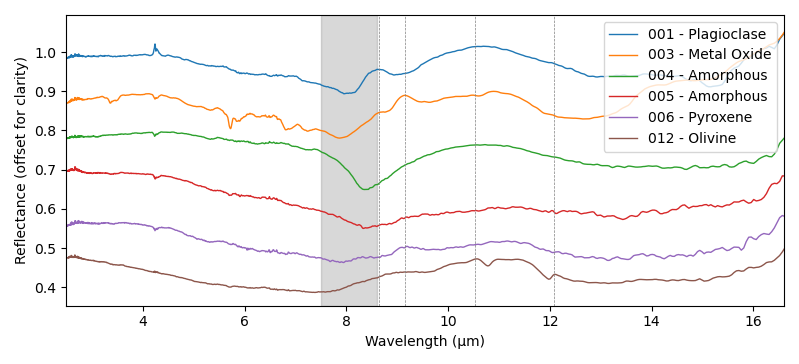
Figure 1: Summary comparison of 6 different grain types which have been separated from the CE5 regolith. The grey region encompasses the Christiansen Feature range, where more pristine crystalline phases exhibit CFs at shorter wavelengths, and vertical dashed lines represent crystalline features.
References
Denevi, B.W., Noble, S.K., Christoffersen, R., Thompson, M.S., Glotch, T.D., Blewett, D.T., Garrick-Bethell, I., Gillis-Davis, J.J., Greenhagen, B.T., Hendrix, A.R., Hurley, D.M., Keller, L.P., Kramer, G.Y., Trang, D., 2023. Space Weathering At The Moon. Reviews in Mineralogy and Geochemistry 89, 611–650. https://doi.org/10.2138/rmg.2023.89.14
Kumari, N., Glotch, T.D., Shirley, K.A., Greenhagen, B.T., Byron, B.D., 2024. Effects of space weathering on the Christiansen feature position of lunar surface materials. Icarus 412, 115976. https://doi.org/10.1016/j.icarus.2024.115976
Li, Q.-L., Zhou, Q., Liu, Y., Xiao, Z., Lin, Y., Li, J.-H., Ma, H.-X., Tang, G.-Q., Guo, S., Tang, X., Yuan, J.-Y., Li, J., Wu, F.-Y., Ouyang, Z., Li, C., Li, X.-H., 2021. Two-billion-year-old volcanism on the Moon from Chang’e-5 basalts. Nature 600, 54–58. https://doi.org/10.1038/s41586-021-04100-2
Morlok, A., Joy, K.H., Martin, D., Wogelius, R., Hiesinger, H., 2022. Laboratory IR spectroscopy of soils from Apollo 14, 15, and 16: Spectral parameters and maturity. Planetary and Space Science 223, 105576. https://doi.org/10.1016/j.pss.2022.105576
Qian, Y., Xiao, L., Head, J.W., van der Bogert, C.H., Hiesinger, H., Wilson, L., 2021. Young lunar mare basalts in the Chang’e-5 sample return region, northern Oceanus Procellarum. Earth and Planetary Science Letters 555, 116702. https://doi.org/10.1016/j.epsl.2020.116702
Yang, Y., Jiang, T., Liu, Y., Xu, Y., Zhang, H., Tian, H.-C., Yang, W., Zou, Y., 2022. A Micro Mid-Infrared Spectroscopic Study of Chang’e-5 Sample. Journal of Geophysical Research: Planets 127, e2022JE007453. https://doi.org/10.1029/2022JE007453
Zhang, H., Zhang, Xian, Zhang, G., Dong, K., Deng, X., Gao, X., Yang, Y., Xiao, Y., Bai, X., Liang, K., Liu, Y., Ma, W., Zhao, S., Zhang, C., Zhang, Xiaojing, Song, J., Yao, W., Chen, H., Wang, W., Zou, Z., Yang, M., 2022. Size, morphology, and composition of lunar samples returned by Chang’E-5 mission. Sci. China Phys. Mech. Astron. 65, 229511. https://doi.org/10.1007/s11433-021-1818-1
How to cite: Grant, H., Xu, X., Tong, T., Huang, S., Luo, S., Wang, X., Longobardo, A., Palomba, E., and Shu, R.: Spectral identification of low levels of space weathering on Chang’e 5 regolith grains, EPSC-DPS Joint Meeting 2025, Helsinki, Finland, 7–12 Sep 2025, EPSC-DPS2025-1781, https://doi.org/10.5194/epsc-dps2025-1781, 2025.


