
 1,2,3,2,5,1,1,8
- 1Vrije Universiteit Brussels, Faculty of Sciences and Bioengineering Sciences, Archaeology, Environmental changes and Geo-Chemistry (AMGC) Research Unit, Brussel, Belgium (cem.berk@observatory.be)
- 2Reference Systems & Planetology Department, Royal Observatory of Belgium, Brussels, Belgium
- 3Museum für Naturkunde - Leibniz Institute for Evolution and Biodiversity Science, Berlin, Germany
- 4State Kay Laboratory of Lunar and Planetary Sciences, Macau University of Science and Technology, Taipa, Macau
- 5Department of Earth Science and Engineering, Imperial College London, London, UK
- 6Johns Hopkins University–Applied Physics Lab, Laurel, MD, USA
- 7Space Research and Planetary Sciences, Physics Institute, University of Bern, Bern, Switzerland.
- 8Department of Earth, Ocean and Atmospheric Sciences, University of British Columbia, Vancouver, Canada
Introduction: Understanding the NASA DART impact [1,2], shock physics modeling emerges as a promising approach. Model simulations [3-8] have thus far examined the impact cratering, ejecta plume, and momentum exchange resulting from DART-scale impactors. Those analyses involved factors varying from the surface strength and porosity to impact obliquity, projectile shape, target layering, and boulder distribution. Here, we focus on the role of proximal boulders near the DART impact site, systematically comparing 2D and 3D hypervelocity impact simulations to quantify the effects on the impact outcome for asteroid Dimorphos.
Methods: Representing boulders with a lateral offset results in a torus-shaped geometry in a 2D impact model with axial symmetry (2DC). In this configuration, lateral boulders inherently form a torus swept around the symmetry axis, generating a higher boulder mass per ring compared to the actual 3D case. To compensate for this effect, the porosity of torus-shaped lateral boulders was increased, while spherical central boulders were assigned a fixed porosity of 10% in the 2DC model. The required porosity increase was identified by comparing the masses of torus-shaped boulders in 2DC to those of actual spherical boulders in 3D, adjusting the packing density accordingly. This adjustment increased the effective boulder porosity, determined by a relationship based on the boulder mass and radius [9]. A comparative study is conducted between 2DC and 3D simulations to validate this approach through the iSALE shock physics modeling [10-12]. Regarding the model setup, asteroid, material, and modeling settings follow recent studies using the iSALE model [9, 13]. DART-scale impact simulations are performed on a flat target, assuming a cohesion of 1 Pa, consisting of multiple lateral boulders with a cohesion of 1 MPa. The Lundborg [14] and ROCK [11] strength models are chosen for the regolith target and boulders, respectively. The internal friction of the target material and boulders is assigned to 0.4 and 0.59, respectively. The Johnson-Cook scheme [15] is used for a non-porous aluminum projectile with a diameter set to the size of the spacecraft bus (approximately 1.3 m). The porosity compaction is modeled using the ε-α model [12] with an assigned porosity of 30% for the target material and corresponding settings [6].
Results: Simulations are analyzed up to 2 seconds post-impact, focusing on the ejecta, and resulting momentum enhancement factor, β (Figure 1). Two assemblies of proximal boulders are modeled with volume packing ratios of 𝛾=42% (Figure 1a,c) and 𝛾=51% (Figure 1b,d). The 3D simulations serve as the reference for two sets of 2DC simulations where the lateral boulders are represented as toroidal rings because of axial symmetry. The first set applies a fixed ring boulder porosity of 10%, while the second set adjust the ring boulder porosity to 74.5% for 𝛾=42% (Figure 1e) and 69.4% for 𝛾=51% (Figure 1f), to match the mass per radial ring. In Figure 1e, the second set of 2DC simulations leads to closer agreement with the 3D reference simulations for 𝛾=42%. In the first set, relative β differences were found to be 9-10% for Nb=6, 22, 38 boulders. The mass-conserving second set, in contrast, improved the relative β difference to 4% for Nb=6, 3.6% for Nb=22, and 1.6% for Nb=38. To further verify this trend, an additional boulder scenario with a higher packing ratio (𝛾=51%) was simulated (Figure 1f). In this case, the first set (without boulder mass conservation) led to relative differences of 14.9%, 14.5%, and 4% for Nb=6, 22, 38, respectively. Whereas the mass-conserving second set consistently produced lower relative differences in β compared to reference 3D simulations: 3.4%, 2.0%, and 1.4%, respectively. These findings reveal that applying boulder mass conservation in 2DC simulations significantly improves the impact momentum transfer, especially in cases with abundant proximal boulders, as observed on Dimorphos’ boulder-strewn surface.
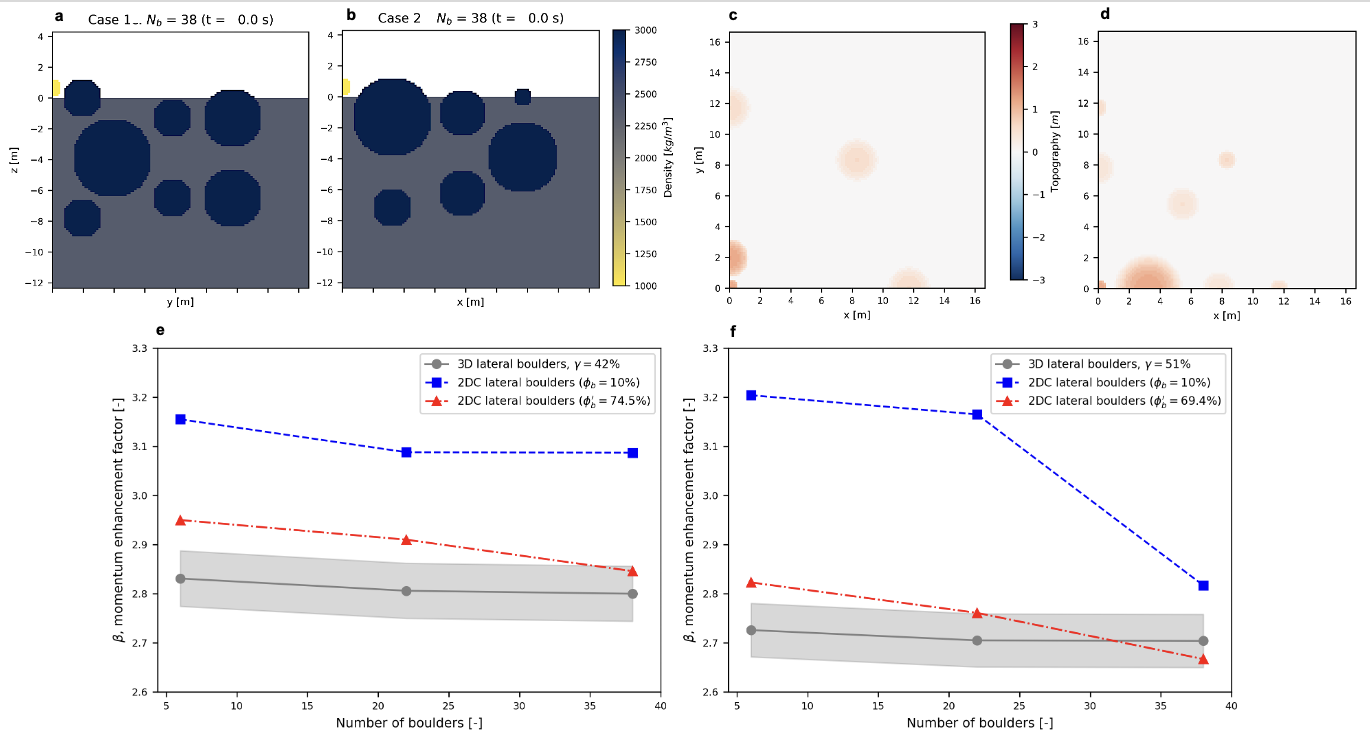
Figure 1: Assembly of lateral boulders near the impact site shown pre-impact from a side view for two volume packing ratios of (a) 𝛾=42%, and (b) 𝛾=51%.
Perspectives and future work: While the distribution of subsurface boulders and the interior of Dimorphos remains currently unknown, a detailed surface characterization of the impact crater by the ESA Hera spacecraft and CubeSats images [16], radar probing of the interior by the JURA instrument [17], and gravity experiment by the Gravimeter for the Investigation of Small Solar System Bodies (GRASS) instrument [18] will provide significant constraints for the numerical models, especially the local subsurface heterogeneities and the global mass of Dimorphos. The next steps will explore further scenarios, including varied boulder distributions with a wider range of volume packing ratios and the effect of surface curvature.
Acknowledgments: This research is financially supported by Research Foundation Flanders (FWO) with grant: 12AM624N to C.B.S. P.C. and S.G. acknowledge the support of the Vrije Universiteit Brussel (VUB) strategic program. O.K. acknowledges the support of EU Horizon 2020 research and innovation program, NEO-MAPP project (grant: 870377), and PRODEX program managed by ESA with the help of BELSPO. R.L. acknowledges the funding from ESA, project S1-PD-08.2. The computational resources and services were provided by the VSC (Vlaams Supercomputer Centrum), funded by the FWO and the Flemish Government. Here, we gladly acknowledge the developers of iSALE shock physics model.
References: [1] Daly et al. (2023). Nature, 616 (7957), 443-447. [2] Thomas et al. (2023). Nature, 616 (7957), 448-451. [3] Bruck-Syal et al. (2016). Icarus, 269:50-61. [4] Stickle et al. (2022). PSJ, 3(11), 248. [5] Owen et al. (2022). PSJ, 3(9),218. [6] Luther et al. (2022). PSJ,3(10),227. [7] Raducan et al. (2024). Nat. Astronomy., 8, 445–455. [8] DeCoster et al. (2024). PSJ, 5(1), 21. [9] Senel et al. (2025). PSJ (in review). [10] Amsden et al. (1980)., LA-8095:101p. [11] Collins et al. (2004). MPS, 39(2), 217-231. [12] Wünnemann et al. (2006). Icarus, 180(2), 514-527. [13] Dai et al. (2024). PSJ, 5, 214. [14] Lundborg (1968). IJRMA, 5, 427. [15] Johnson & Cook (1983), 7th Int. Symp. on Ballistics, 541. [16] Michel et al. (2022). PSJ, 3(7), 160. [17] Herique et al. (2020). EPSC2020-595. [18] Karatekin et al. (2025) Space Science Reviews (submitted).
How to cite: Senel, C. B., Luther, R., Dai, K., Luo, X.-Z., Karatekin, Ö., Collins, G., Goderis, S., DeCoster, M., Davison, T., Raducan, S. D., Zhu, M.-H., Wünnemann, K., and Claeys, P.: Effects of proximal boulders on ejecta and momentum transfer: Comparison of 2D and 3D hypervelocity impact simulations on Asteroid Dimorphos, EPSC-DPS Joint Meeting 2025, Helsinki, Finland, 7–12 Sep 2025, EPSC-DPS2025-1783, https://doi.org/10.5194/epsc-dps2025-1783, 2025.


