
- 1Earth Science and Engineering, Imperial College London, London, United Kingdom (ism17@ic.ac.uk)
- 2School of Physical Sciences, The Open University, Milton Keynes, United Kingdom
Fossil micrometeorites (MMs) are mostly I-type cosmic spherules (CSs): iron rich cosmic dust particles that have survived atmospheric entry and later preserved in sedimentary rock [1] [2]. The quantity and composition of fossil MMs can advance our understanding of dust producing bodies in the solar system throughout Earth’s history, providing ground-truth empirical evidence of previous asteroid break-up events and cometary showers that would have otherwise remain undiscovered [3] [4] [5]. Their abundances and estimates of local sedimentation rates have been used to reconstruct the past flux of extraterrestrial dust [6] [7], but the influence of terrestrial or sampling processes ultimately affecting these calculations were ignored (e.g. diagenesis [8] or separation techniques). The cause for difference in CS concentration found throughout a Cenomanian succession in Dorset, England is discussed here, focusing on possible explanatory terrestrial and solar system processes utilising spherule quantification, petrography and geochemistry. Additionally, numerical models simulating changes in micrometeoroid size during entry heating are also used to study the possible entry parameters, sources, and solar system events acting as causes for changes in flux .
To determine changes in CS concentration, 2-10kg of chalk/marl from 5 horizons in the South England Chalk Group in Lulworth Cove, Dorset were analysed. Each sample was processed by a rock crusher and then placed into an electric vibrating sieve to separate the dust fractions (<250µm) which were then magnetically separated three times and optically examined to find CSs following protocols described in [1]. The CSs external petrographic textures and qualitative geochemistry were acquired using a desktop Hitachi TM4000Plus SEM and JEOL JXA-8530F EPMA.
The numerical models used closely resemble those discussed in [9]. Atmospheric deceleration was obtained using a simulation based on the model of [10] where deceleration is calculated from the momentum loss of spherical particles due to collisions with atmospheric gas molecules in its flight path. The final radius of particles is calculated using a balance of mass gained by oxidation (assuming every encountered oxygen molecule reacts and is incorporated with the molten iron) and evaporative mass loss.
All sediment samples returned numerous CSs, totalling 481 – the majority being I-types, but some are characterised as potential altered S-types (silicate rich CSs) or G-types (intermediate composition CSs). A minority presented unusual features such as cracks, mottled exteriors, and skeletal magnetite crystals (Figure 1). Most I-types showed similar chemical spectra with high Fe peaks, minor Ti and Mn implantation and variable amount of Si and Al (mostly on the exterior). Sample “Bed 8” yielded the highest number of spherules (>3x the others) normalised to 142 CS/kg of dust. The diameters ranged from 12µm to 130µm, and the mean values were between 24µm and 36µm which is comparable to other fossil MM studies [7] [8].
Almost all particles in the simulated conditions reach peak temperatures above the solidus for iron oxides (1809oK), causing them to melt and become CSs. To create the smallest sized I-types in this study (<25µm), ~25µm-sized micrometeoroids must enter at >14km/s at ~90o. At 18km/s <25µm I-types can be generated in a wider range of settings, encompassing micrometeoroids with initial sizes of up to ~350µm entering at >~75o. At higher velocities, evaporative loss and peak temperatures are too high for dust to survive in most set conditions.
The retention of characteristic quenched dendritic textures, preservation of intact metal beads, detectable Ni and Cr in some samples, and the sub-mm size and spherical nature of the particles indicate these Fe-oxides are extraterrestrial I-types. Since the sampled beds are geologically equivalent, contiguous, have similar accumulation periods and were processed using identical protocols, the high CS/kg concentration of Bed 8 likely represents a significant change in flux rates during the Cenomanian, rather than terrestrial or sampling influences. The enhancement in I-type accumulation rate (given in m-2.yr-1) was calculated by integrating power lines fitted on flux vs diameter plots for each bed and modern-day values (using [11] as the background; Figure 2). The ratios of the integrals reveal Bed 8 had an enhancement factor of >20x for I-types between 30 and 90µm in size, presenting a clear spike in flux.
The results of the numerical simulations show high entry velocities and angles are required to produce the small sizes of I-types discovered in this study, implying the dominating source of dust had an elliptical orbit such as from a cometary flyby. However, the lower power law exponents of the beds compared to those of modern day could indicate that most dust had lower velocities, which may suggest an asteroidal origin [10]. Further work will refine the possibilities of solar system events leading to this CS enrichment by discussing influences on these calculations and source assumptions.
[1] M. J. Genge, et al. (2008) Meteorit. Planet. Sci., 43(3): 497–515. [2] M. Genge, et al. (2020) Planet. Space Sci., 187: 104900. [3] B. Schmitz, et al. (1997) Science, 287: 88-90. [4] P. R. Heck, et al. (2008) Meteorit. Planet. Sci., 43: 517-528. [5] G.G. Voldman, et al. (2013) Geol. J., 48: 222–235 [6] S. Taylor and D. E. Brownlee (1991) Meteorit. Planet. Sci., 26(3): 203-211. [7] T. Onoue, et al. (2011) Geology, 39(6): 567-570. [8] M. D. Suttle and M. J. Genge (2017) Earth Planet. Sci. Lett., 476: 132-142. [10] S. G. Love & D. E. Brownlee (1991) Icarus, 89: 26-43. [11] J. Rojas, et al. (2021) Earth Planet. Sci. Lett., 560: 116794. [12] M. D. Suttle & L. Folco (2020) J. Geophys. Res. Planets, 125(2).
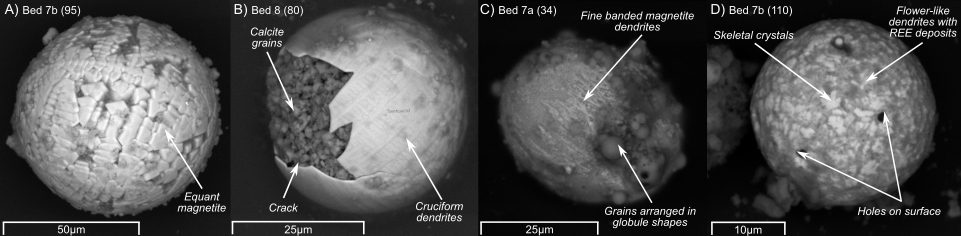
Figure 1. SEM images of fossil I-type cosmic spherules (CSs).
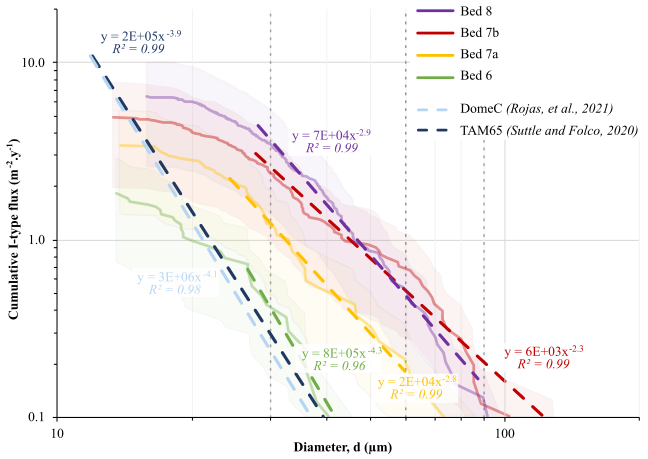
Figure 2 The cumulative I-type flux (m-2.yr-1) plotted against diameter of spherules. Dashed lines represent power lines fitted to the main population of spherules. The blue dashed lines are extrapolated fitted power lines for [11] and [12]. The shaded regions show errors in the sedimentation rate used. The flux assumes <5% of their collection consists of I-types. The grey dotted lines show the regions selected to represent medium-sized, and large spherules in the study (d = 30 to 60µm, 60 to 90µm).
How to cite: Mattia, I., Genge, M., Suttle, M., and Wong, A.: An Estimate of Cenomanian Cosmic Dust Flux: Implications on Their Identification, Sources, and Mass Contribution Calculations, EPSC-DPS Joint Meeting 2025, Helsinki, Finland, 7–12 Sep 2025, EPSC-DPS2025-1793, https://doi.org/10.5194/epsc-dps2025-1793, 2025.


