EPSC Abstracts
Vol. 18, EPSC-DPS2025-1812, 2025, updated on 09 Jul 2025
https://doi.org/10.5194/epsc-dps2025-1812
EPSC-DPS Joint Meeting 2025
© Author(s) 2025. This work is distributed under the Creative Commons Attribution 4.0 License.

Planetesimal initial mass functions formed via the Streaming Instability agree with Cold Classical KBO size distributions

- Iowa State University, Physics and Astronomy, United States of America (wmhall@iastate.edu)
Introduction
Planetesimals are small bodies held together by their own gravity, usually 1-1000 km in diameter. They can grow efficiently into planets by accreting pebbles and solid dust. The formation of planetesimals is an important open question in planetary science. A leading candidate for their creation is the streaming instability (SI), where radially drifting solid particles experience a drag force from embedded gas where angular momentum exchange between gas and solids leads to aerodynamic clumping of the solids. This instability can increase the density necessary to gravitationally bind particles together and grow planetesimals.
Many small bodies in our solar system are evolved usually via collisions that affect their shape and size. However, the Cold Classical Kuiper Belt objects (CCKBOs) are thought to be relatively pristine, having been formed from the primordial protoplanetary disk and remaining relatively unchanged. This means that they are an ideal testbed to compare size distributions between the observed size distribution of planetesimals and the size distribution of planetesimals formed in numerical simulations employing the SI.
In this work we study of the nature of planetesimal initial mass functions (IMFs) from numerical simulations. In particular, we study the effects of various physical parameters on planetesimal formation, and ultimately compare simulation IMFs to observed size distributions to determine if the SI model of planetesimal formation produces distributions that are similar to reality. The underlying assumption that makes this comparison reasonable (since the numerical simulation cannot reach the size and resolution necessary to model the CCB in its entirety), is that planetesimals formed via the physical process of the SI is comparable to randomly selecting planetesimal sizes from some underlying distribution, where that underlying distribution contains characteristics of the physical parameters of the numerical simulation. We carry out several statistical analyses (both parametric and non-parametric) that rely on different sets of assumptions to show that as numerical simulations approach the conditions of the early solar system, planetesimal IMFs become more similar to the observed CCKBO size distribution.
Methods
In short, we used the ATHENA hydrodynamical code to solve the equations of hydrodynamics inside of shearing boxes, which are small sections of a protoplanetary disk containing solid particles and an isothermal fluid that interact through momentum exchange. The SI is then allowed to concentrate the particles until an effective clumping saturation is reached, after which particle self-gravity is turned on. As the simulation continues, particles become clumped together in gravitationally bound objects that resemble clouds of pebbles, and have the necessary gravitational influence to collapse into large planetesimals. We track the particles throughout the simulation and use their characteristics at initial formation to inform the IMF.
We performed 6 simulations with different physical parameters for each one, choosing to vary particle size represented by a dimensionless stopping time parameter τ, a pressure gradient parameter relating the ratio of the particle velocity to the gas sound speed Π, the dust to gas mass ratio Z, and the relative strength of self-gravity to tidal shear ˜G. We were able to compare the relative distribution shape to confirm that each parameter has effects on the IMF that can be measured.
Using the observed Hr magnitude distributions of the Cold Classical Belt (Kavelaars et al 2021, Napier et al 2024)
, the size distribution can be compared to simulation IMFs. The Kolmogorov-Smirnov (K-S) test can be used to determine the likelihood that simulated IMFs were drawn from the observational distribution, and by bootstrap sampling the observed distributions, a 2-sample K-S test can be used to estimate the similarity between observation and simulation.
Lastly, simulation IMFs were parametrically fitted to match the functional form of the CCB distribution, which relies on some assumptions about pebble cloud characteristics and behavior in the simulations, and small body characteristics of the CCKBOs. The existence of a strong exponential taper cutoff has been shown in the CCB, and this method can probe for its existence in the simulation IMFs as well.
Results
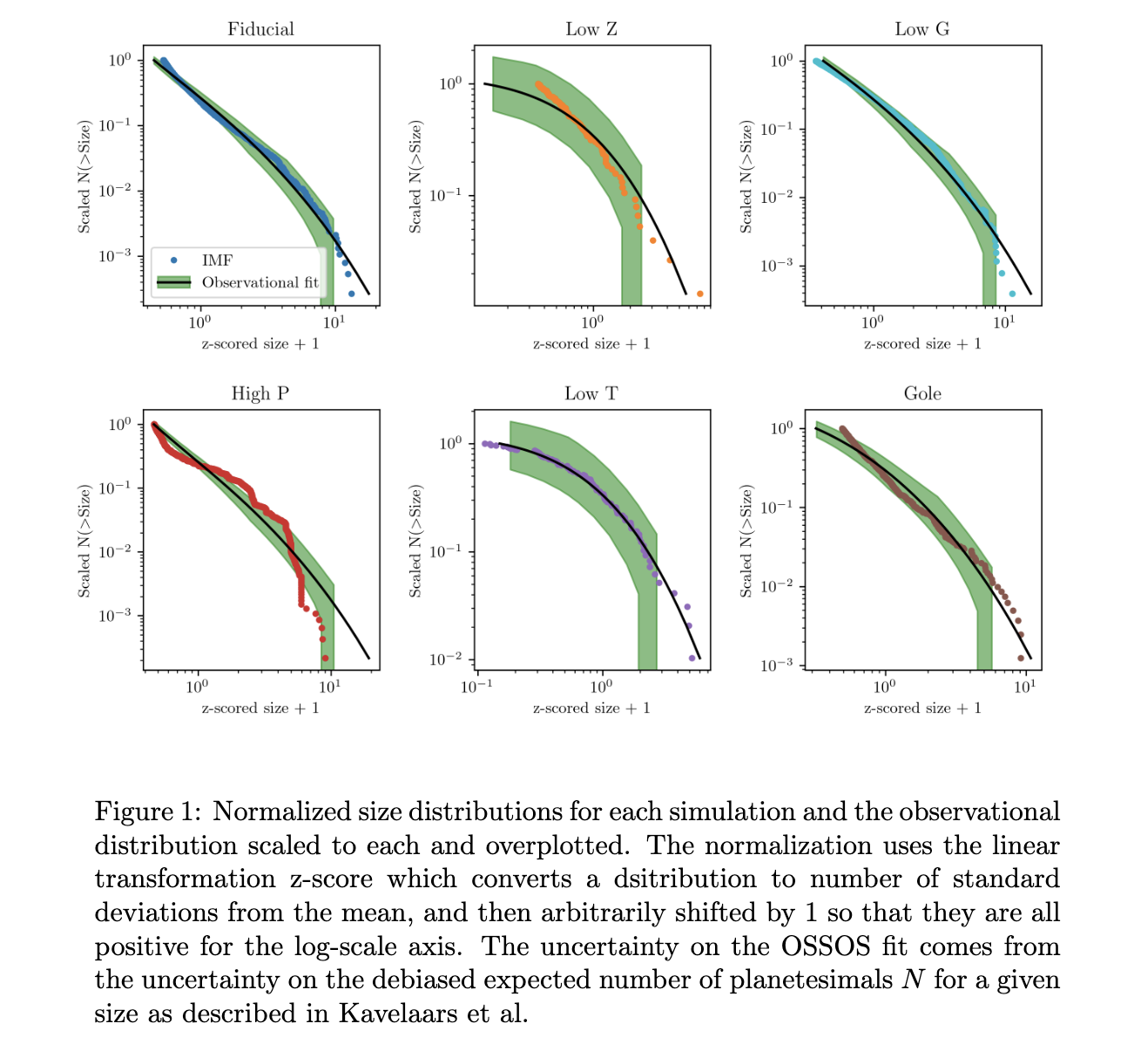
The non-parametric comparisons can be seen in Figure 1. K-S test results between simulation IMFs and observational distributions yielded p-values greater than 0.05 for the ``Low G'' simulation and the α=0.5 distribution in Kavelaars et al. and the ``Low T'' simulation and all three distributions in the literature. Parametric fits can be seen in Figure 2. For the simulations that could probe the small-mass regime of the size scale well, power law slopes favored the gentler slope of Napier et al. When constraining the low-mass regime of the distribution, tapering power laws for the high-mass end mildly preferred the gentler slope of Kavelaars (α=0.4) and really favored the gentler slope in Napier et al., agreeing with the unconstrained fits.
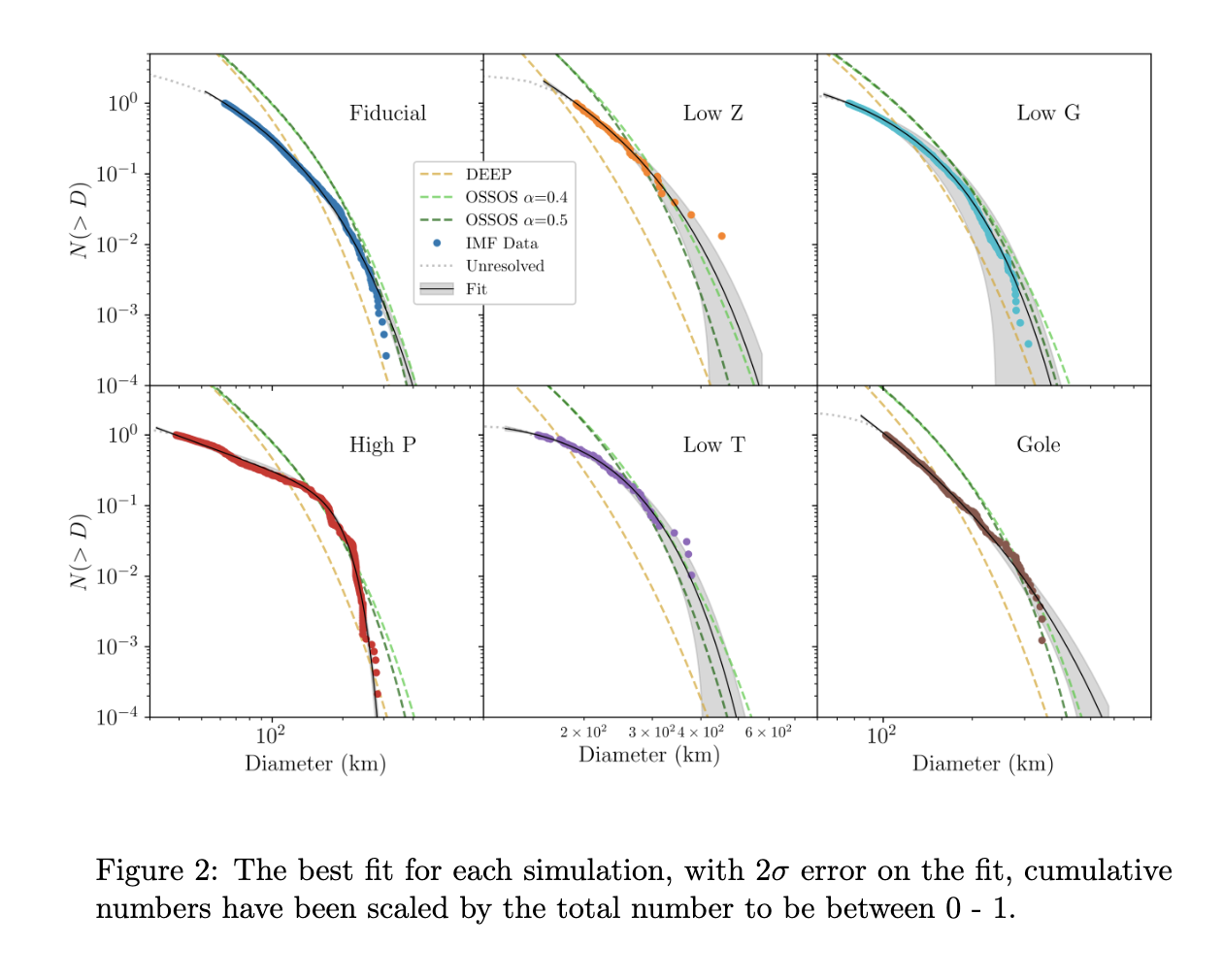
The strong comparison between simulations ``Low Z'', ``Low G'', and especially ``Low T'' with observation suggest that physical parameters (like those chosen for these runs) that are similar to the primordial CCB produce stronger comparisons. The agreement between the SI results and observation are very promising. This is evidence that the SI can produce the necessary size distributions that match our solar system planetesimal populations.
How to cite: Hall, W. and Simon, J.: Planetesimal initial mass functions formed via the Streaming Instability agree with Cold Classical KBO size distributions, EPSC-DPS Joint Meeting 2025, Helsinki, Finland, 7–12 Sep 2025, EPSC-DPS2025-1812, https://doi.org/10.5194/epsc-dps2025-1812, 2025.


