
 1,2,1,2,
- 1Purdue University, Earth, Atmospheric, and Planetary Sciences, West Lafayette, United States of America (daminton@purdue.edu)
- 2Purdue University, Department of Physics and Astronomy, West Lafayette, United States of America (daminton@purdue.edu)
- 3SETI Institute, Mountain View, United States of America (mcuk@seti.org)
The formation history of Deimos and Phobos is debated and varies between direct capture, formation after a giant impact, or in a ring-moon cycle resulting from a giant impact impact disk. In either of the giant impact origin scenarios, Deimos is formed directly from the circumplanetary impact disk with the former scenario suggesting that Deimos (or its precursors) passed through resonances with the inner moon during its evolution}. However, this implies an excited modern-day orbit with Deimos having a chaotic eccentricity history. Present-day Deimos has low eccentricity (e = 0.00033) and moderate inclination (i = 1.8o to the Laplace plane), and tidal dissipation within Deimos is too inefficient for eccentricity damping. With a more excited orbit, sesquinary impactors would have a higher impact energy and could break up a rubble-pile-like body via a runaway sesquinary bombardment. Sesquinary impactors are ejecta from the target satellite that have escaped its gravitational pull and reimpact it after orbiting the parent planet on an independent orbit.
Here, we test and show that the sesquinary catastrophe can break up an excited proto-Deimos into a debris disk. This disk is easier to circularize and would eventually re-accrete into modern-day Deimos, just under the sesquinary catastrophe threshold q ~ 10-14 where q = √(e2 + sin2 i ) vorbital / vescap is a measure of the sesquinary excitation of the satellite. We launch impactors from the surface of Deimos with initial velocities of1 - 3 vescape with a total mass of 0.1 % MDeimos. These impactors have the same density as Deimos. As they evolve over time, they precess and re-impact Deimos, potentially causing erosion. The ejected mass can escape Deimos and feed this cascade. We see consistent mass loss at various excitations q > 5-10, and complete break-up in accelerated simulations.
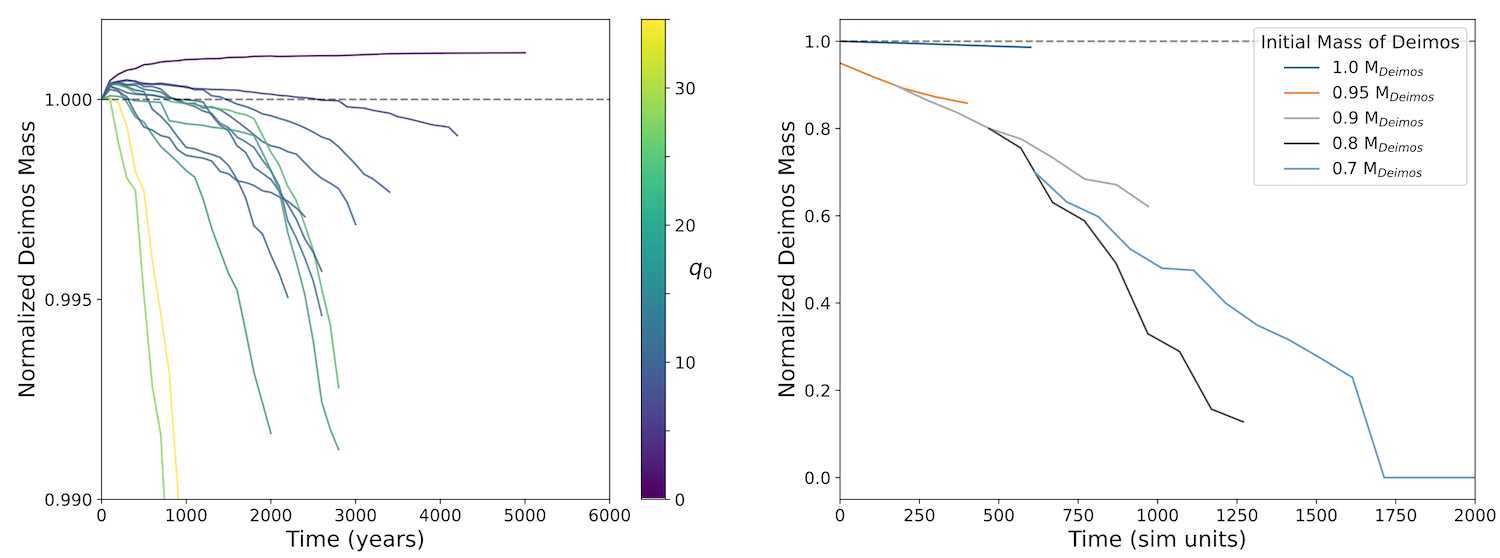 Figure 1: Deimos’ mass loss due to sesquinary impacts. (a) Mass loss across multiple initial orbital excitations q. Impactor Rinitial∼100−200 m. (b) Accelerated mass loss for Deimos at q∼23 with lower starting mass and bigger impactors. We see consistent mass loss in both sests of simulations.
We find a semi-analytical timescale for break-up as a function of q. The impact velocity in the simulations has a Rayleigh distribution with a mode q·σ where σ ≈0.25. We then average the mass loss scaling laws with the impact velocity distribution and obtain an approximate breakup threshold of q ~ 10-14. This breakup time is on the order of 104 years but varies depending on the impact velocity distribution.
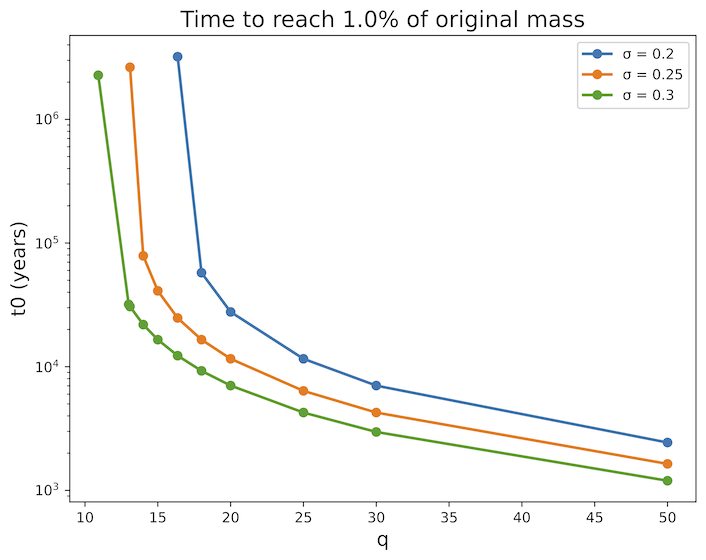
Figure 2: Time taken to breakup a Deimos-like satellite to 1% of it’s original mass via the sesquinary catastrophe.
We use the N-body integrator Swiftest with a cratering collision model to model the sesquinary impacts. Swiftest has a built-in collisional fragmentation model (FRAGGLE) for similar-size impactors and a cratering impactors. This work shows that the sesquinary catastrophe is viable mechanism to reconcile an excited proto-Deimos with the cooler orbit of modern Deimos.
How to cite: Anand, K., Minton, D., and Ćuk, M.: The sesquinary catastrophe can reconcile Deimos' cool present with it's excited past, EPSC-DPS Joint Meeting 2025, Helsinki, Finland, 7–12 Sep 2025, EPSC-DPS2025-1834, https://doi.org/10.5194/epsc-dps2025-1834, 2025.


