
 ,
,- National Institute for Astrophysics, Italy, Osservatorio Astronomico di Trieste, Trieste, Italy (stavro.ivanovski@inaf.it)
Introduction: Developing a suite of models that can address different physical scenarios in the encounter of asteroids is a timely question for planetary defense science. The role of plasma events in dust dynamics in the close vicinity of the asteroid has not been tackled methodologically. After the successful launch of the ESA/HERA mission [1] on October 7, 2024, it is timely to recall what we have learned from the NASA Double Asteroid Redirection Test (DART) impact [2] and the ASI/Light Italian Cubesat for Imaging of Asteroids (LICIACube) [3] mission. Among the scientific objectives of the HERA mission is to determine the physical properties of Dimorphos, including its internal structure, and to constrain binary formation scenarios. Here we present how dust dynamics simulations can help constrain the physical properties of the dust in the asteroid and/or in the binary system, together with a plasma model which can accelerate particles and change their dynamics in the encounter with the asteroid. Such a scenario could be of interest to study the environment of an asteroid that can be subject to strong plasma events, as in the planned ESA/JAXA RAMSES mission to Apophis in 2029.
The models: We couple two models - the 3D+t model – LIMARDE [4] and the MHD model that analyzes shock dynamics and space weather event observations MIM[5]. Dust dynamical simulations are constrained with laboratory observations [6], impact simulations, and near-field observations such as the LICIACube [7] images, and simulate the long-lived ejecta. The model computes single particle trajectories, dust rotational frequencies and velocity, as well as particle orientation at any time and distance. We compute the dust velocity distribution based on the physical properties (size, mass, and shape) derived from the LICIACube observations. The results are useful to check the role of particle fragmentation and to constrain the physical properties based on the dynamical properties of the ejected dust in the near- and mid-environment.
The MIM model studies the MHD instabilities in space weather events and the velocity changes in the plasma flow that can contribute to changes in the dynamics of particles in the vicinity of the asteroid.
Results: The first group of results regards the dust dynamics modeling that will be coupled with the plasma model. We carried out a numerical analysis to determine how many and which non-spherical particles remain gravitationally bound to the Didymos system, how much mass escapes, and the corresponding percentages relative to the total (see Figure 1).
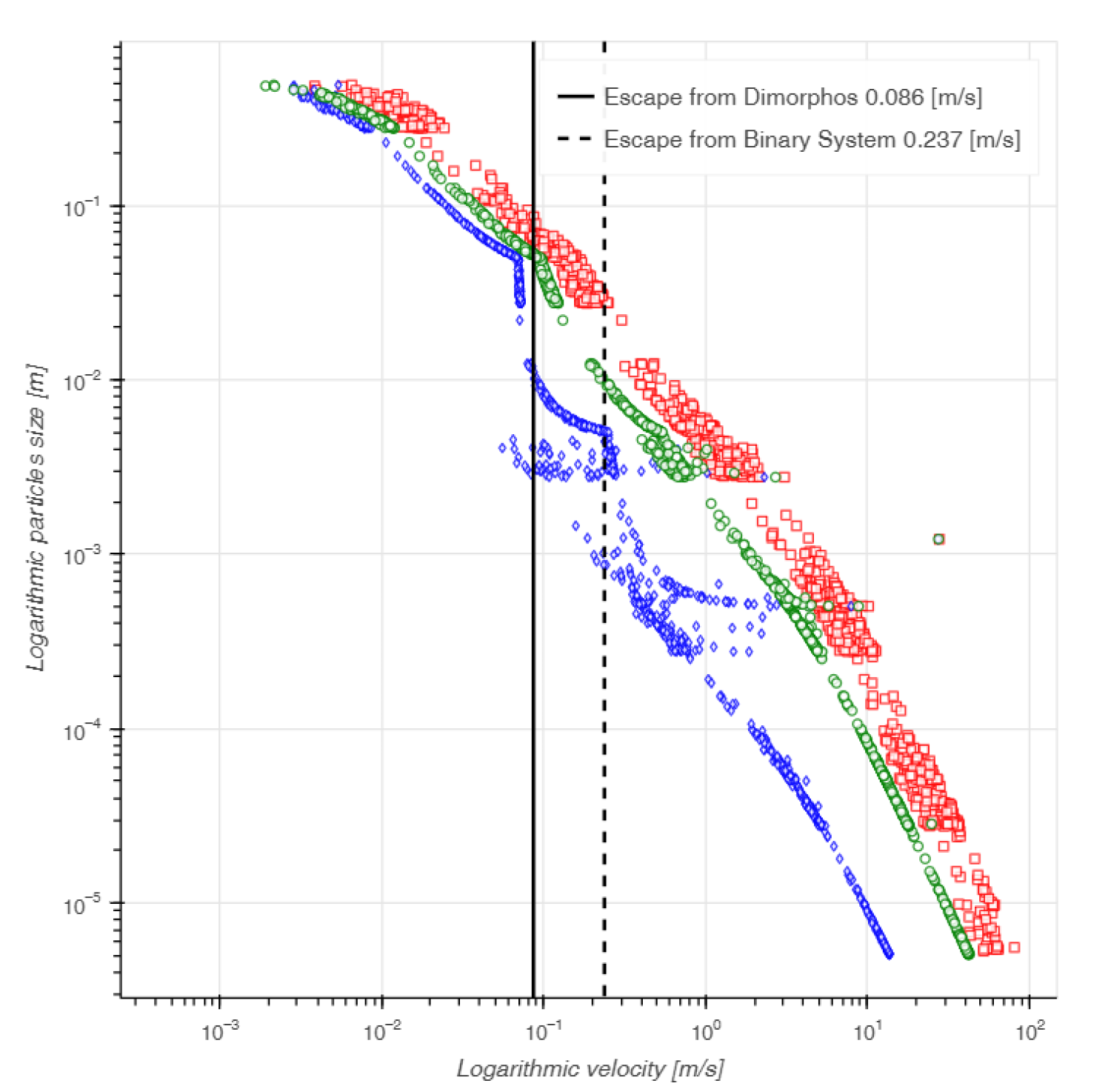
Figure 1. Logarithmic-scale plot showing the relationship between particle velocity and size. This graph refers specifically to the 120th second of the simulation in the presence of a vapor plume, without fragmentation, and includes data for 1000 oblate particles (red squares), 1000 prolate particles (blue diamonds), and 1000 spherical particles (green circles).
References: [1] Michel, P. et al. 2022 PSJ 160 [2] Rivkin, A.S. et al. 2021, PSJ, 2, 24pp; [3] Dotto, E. et al. 2021, PSS 199, [4] Fahnestock et al. 2022, PSJ; [5] Biasiotti et al. 2024 [6] Ormo et al. 2022, E&PSL [7] Dotto et al. 2024, Nature
How to cite: Ivanovski, S. L., Calderone, L., and Biasiotti, L.: Dust dynamics and plasma simulations in support of planetary defense missions such as HERA and RAMSES, EPSC-DPS Joint Meeting 2025, Helsinki, Finland, 7–12 Sep 2025, EPSC-DPS2025-1841, https://doi.org/10.5194/epsc-dps2025-1841, 2025.


