
 1,2,
1,2,- 1INAF − Astronomical Observatory of Padova, Padova, Italy
- 2Museum für Naturkunde – Leibniz Institute for Evolution and Biodiversity Science, Berlin, Germany
Introduction. LUMIO, LUnar Meteoroid Impacts Observer, is an ESA 12U form-factor CubeSat mission for the lunar exploration [1] [2]. Thanks to the LUMIO-Cam, an optical instrument designed for observations in the visible and near-infrared spectrum, this mission aims at monitoring and quantifying the flashes produced during the impact of meteoroids on the far side of the Moon from an L2 orbit.
The collected data will be more accurate than the ground-based telescopes, due to the CubeSat closer to the observing event and unaffected by the influence of the terrestrial atmosphere. Thus, these will allow to outline the first accurate dynamical model of the meteoritical flux in the lunar environment.
The lightcurve of the flash allows to derive the integrated energy Eremitted within the spectral interval Δλ on the lunar surface, and once known the luminous efficiency η, to derive the kinetic energy EK as Er/ η. At the same time, additional information can be learned about the outcome of the collision – the crater – using data from other space missions, as for instance the Lunar Reconnaissance Orbiter (LRO). In particular, the LRO camera (LROC [3]) system can provide images in the panchromatic broad filter with a resolution up to 0.5 m (Narrow Angle Cameras / NACs), which can be furtherly combined to derive accurate digital terrain models (DTMs) of specific lunar features. These DTMs could allow the detailed analysis of the morphology of impact craters, and provide both constraints on the surface stratigraphy and ground-truth of numerical models of the formed impact structure [4].
In the framework of the LUMIO mission, our focus is to investigate how the impact mass and velocity, as well as the near-surface target properties can affect the final crater morphology.
Methods. A systematic numerical investigation has been carried out using iSALE shock physics code (https://isale-code.github.io/, e.g., [5, 6, 7, 8]).
For this initial investigation, we simulated projectiles of increasing diameters (1 µm, 1 mm, e 1 m) impacting at 9 km/s on the lunar surface. The target is assumed as an infinite half space, made of a basaltic regolith-like material, with 12% porosity. We varied cohesion from 5 Pa to 0.5 MPa, to evaluate its influence on crater morphology, keeping the friction coefficient constant to a value of 0.6.
Results. In this work, we present the very preliminary results of these numerical simulations. In Figures 1 and 2, we show the case of a 1-m projectile impacting on a target with a 5 Pa and 0.5 MPa cohesion, respectively. In the first case, we obtain a shallower crater where the plastic deformation occurs along in a region surrounding the crater’s wall and floor. Also, the ejecta blanket was made of completely damaged material. In the second case, the crater is bowl-shaped, and its ejecta boulders deposit more dispersedly on the lunar surface. Passing from one extreme to the other of the tested cohesion range, the crater diameter increases up to a factor of three. The depth-to-diameter ratio varies from 0.22 to 0.47.
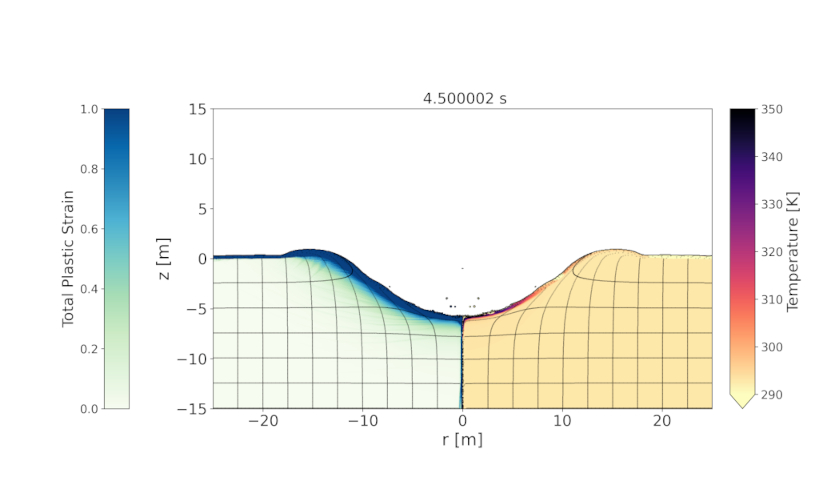
Figure 1. Final time step of a 1 m basaltic projectile impacting at 9 km/s on the surface, with temperature set to 293 K. The left and right panels show the Total Plastic Strain distribution and the temperature variations. Cohesion is set to 5 Pa.
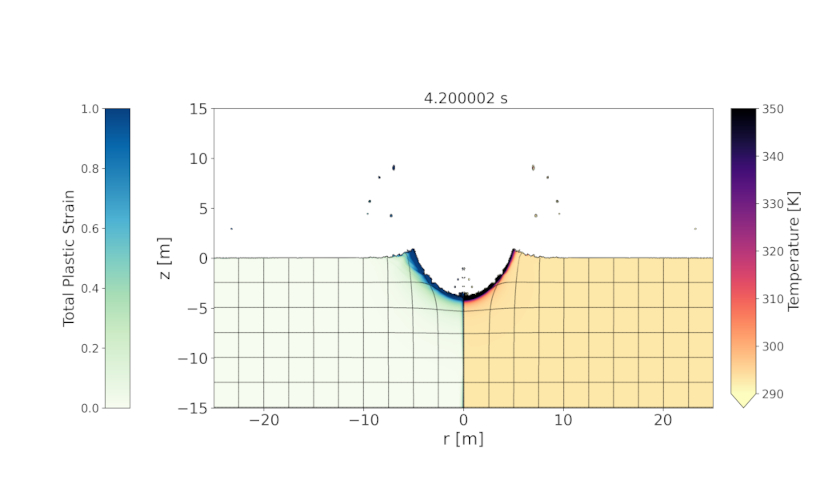
Figure 2. Final step of a simulation run with the same model parameters of Figure 1, except the target cohesion, which was set to 0.5 MPa.
Future work. We are currently running modelling with different values of coefficient of frictions and with multiple layers. Indeed, as shown by [9], the friction coefficient has a considerable influence on the crater efficiency. On the other hand, a layered target is a more realistic representation of planetary terrains (e.g., [10], [11]). We also aim at investigating the ejecta distribution for varying target properties.
Acknowledgements.
We gratefully acknowledge the developers of iSALE‐2D/Dellen version (https://isale-code.github.io/), including Gareth Collins, Kai Wünnemann, Dirk Elbeshausen, Boris Ivanov, and Jay Melosh. Some plots in this work were created with the pySALEPlot tool written by Tom Davison.
This work has been funded by the Italian Space Agency through the agreement n. F43C23000340001 entitled “Supporto scientifico alla missione LUMIO”.
References.
[1] Cipriano et al. (2018) Front Astron Space Sci 5, 29, 23 pp. [2] Topputo et al. (2023) Icarus, 389, 115213. [3] Robinson et al. (2010) Space Sci Rev 150, 81–124. [4] Martellato et al. (2017) Meteorit Planet Sci 52, 1388−1411. [5] Amsden et al. (1980) Los Alamos Nat Lab Rep LA−8095, 101 pp. [6] Collins et al. (2016) iSALE-Dellen manual, figshare. [7] Collins et al. (2004) Meteorit Planet Sci 39, 217−231. [8] Wünnemann et al. (2006) Icarus 180, 514−527. [9] Prieur et al. (2017) J Geophys Res: Planets 122, 1704−1726. [10] Hopkins et al. (2019) J Geophys Res: Planets 124, 349−373. [11] Martellato et al. (2020) J Geophys Res: Planets 125, e2019JE006108.
How to cite: Martellato, E., Luther, R., and Rice, P.: Impacts: exploring the far side of the Lunar surface, EPSC-DPS Joint Meeting 2025, Helsinki, Finland, 7–12 Sep 2025, EPSC-DPS2025-1864, https://doi.org/10.5194/epsc-dps2025-1864, 2025.


