
- Institute of Space and Astronautical Science, JAXA, 3-1-1 Yoshinodai, Sagamihara, Kanagawa 252-5210, Japan
Japan Aerospace Exploration Agency (JAXA) has a strategic small-body sample return program to understand the formation, evolution, and migration of planetary building blocks, water, and organics in the early solar system. The JAXA's sample return program started with Hayabusa for S-type asteroid Itokawa in 2010, followed by Hayabusa-2 for C-type asteroid Ryugu in 2020, and the future mission of Martian Moons eXploration (MMX) for Phobos in 2031 (Fig. 1). My presentation covers the recent achievements of Hayabusa 2 and OSIRIS-REx curation at ISAS/JAXA and the recently launched Ryugu Reference Project. I also present an overview of MMX, particularly how we leverage the Hayabusa 2/OSIRIS-REx experience to develop the MMX curation.
The Hayabusa 2 curation is unique in that it acts as a "bridge" between the remote sensing and sample analysis communities. Along with the conventional curation tools (e.g., optical microscope and balance), JAXA installed remote sensing instruments (e.g., ONC: Optical Navigation Camera) in the curation facility for ground truthing. Moreover, a flight spare of MicrOmega (infrared hyperspectral microscope) detected important minor phases (clays, carbonates, organics) in the apparently black Ryugu samples in the early stage of the curation.
Such a unique Hayabusa 2 curation policy expands the activities of OSIRIS-REx curation for JAXA's Bennu fractions (0.66 g) transferred from JSC/NASA on August 21, 2024. Since we received the Bennu fractions, we have completed the basic characterization of bulk fractions; the basic characterization is continued for selective individual grains. The basic characterization includes optical microscopy and further hyperspectral infrared measurements using MicrOmega and an FT-IR attached to the OSRIS-REx clean chamber.
Extending JAXA's curation activity incubates a new project (RRP: Ryugu Reference Project) to maximize the potential merit of the returned sample. The RRP aims to set an international standard for the elemental and isotopic abundances in the solar system using samples from the asteroid Ryugu. This project involves forming a Measurement Definition Team (RRP-MDT) to outline scientific goals and analysis methods. The RRP-MDT will document them in a white paper to ensure that the findings are accessible and beneficial for future research. Based on the MDT's white paper, JAXA will evaluate the significance and scientific merit of proceeding with RRP.
JAXA plans a Phobos sample return mission, MMX, in 2026-2031. The MMX spacecraft is scheduled to be launched in 2026, orbit Phobos and Deimos (multiple flybys), and retrieve and return >10 g of Phobos regolith to Earth in 2031. The Phobos regolith represents a mixture of endogenous Phobos building blocks and exogenous materials that contain solar system projectiles (e.g., interplanetary dust particles and coarser materials) and ejecta from Mars and Deimos. The MMX Sample Analysis Working (SAWT) team outlined the curation and sample analysis protocol to identify Phobos' fragments with different origins. Following the MMX-SAWT report, JAXA curation is designing the MMX curation facility and instrumentation for the system requirement review in 2026.
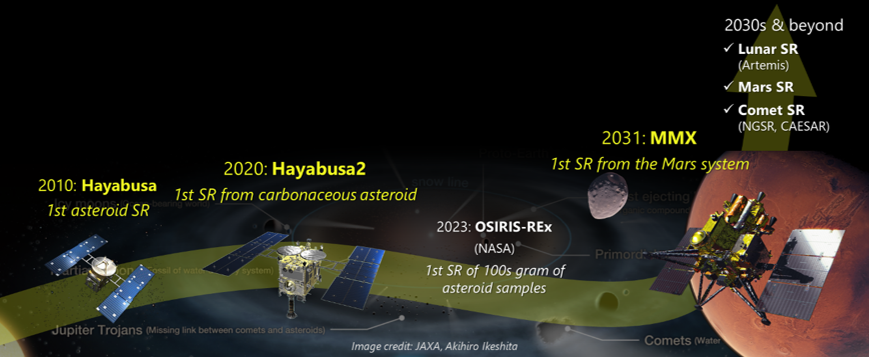
Figure 1: Sample return missions by JAXA (Hayabusa, Hayabusa 2, and MMX) and by international partners (OSIRIS-REx).
How to cite: Usui, T.: From Asteroids to Martian Moons: Recent Achievements and Future Challenges of JAXA's Small-Body Sample Return Missions, EPSC-DPS Joint Meeting 2025, Helsinki, Finland, 7–12 Sep 2025, EPSC-DPS2025-1880, https://doi.org/10.5194/epsc-dps2025-1880, 2025.


