
 2,3,1,
- 1School of Earth and Space Science and Technology, Wuhan University, Wuhan, China
- 2Swedish Institute of Space Physics, Kiruna, Sweden
- 3Division of Space and Plasma Physics, School of Electric Engineering and Computer Science, KTH Royal Institute of Technology, Stockholm, Sweden
Abstract
Rosetta measurements at comet 67P revealed ion speeds of 5–10 km/s, far exceeding the observed speed of the neutral gas of 0.5–1 km/s. Models assuming an ion speed similar to the neutral gas also give good agreement with measurements of ion densities. This discrepancy points to a missing mechanism in our understanding of ion-neutral coupling. One possible explanation would be a presence of counter-streaming ions. Two ion populations, moving anti-cometward and cometward, respectively, would result in a low bulk speed but high individual velocities. Such counter-streaming populations may also drive wave generation, particularly ion acoustic waves, which have been detected within the diamagnetic cavity and could arise from ion-ion instabilities.
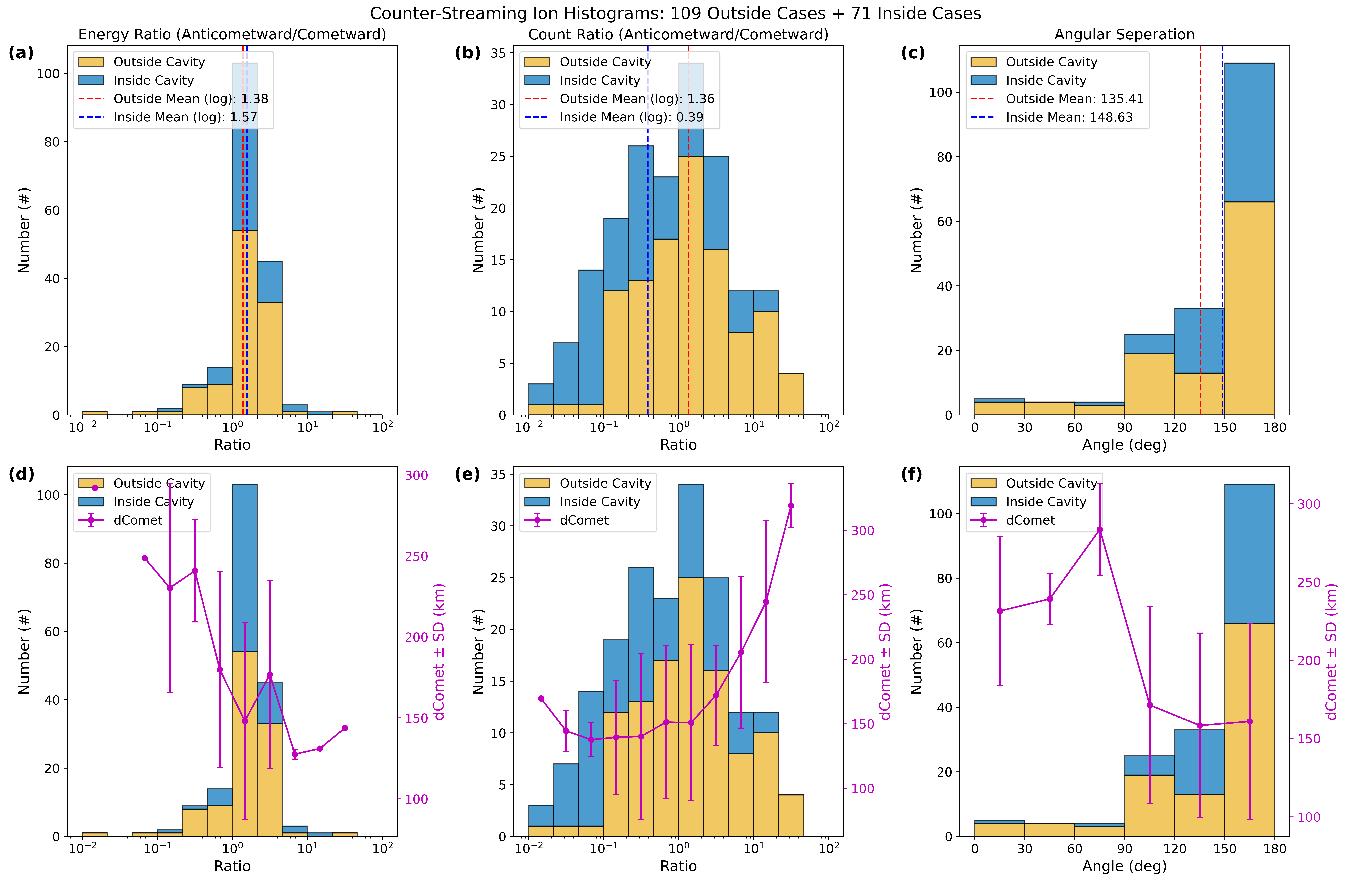
Using high- and normal-resolution data from Rosetta’s RPC-ICA instrument recorded near the diamagnetic cavity, we identify and statistically characterize counter-streaming ion populations. We find the counter-streaming ions are often observed in this region. Our results further reveal a dependence on cometocentric distance which can be seen in Figure 1. At smaller distances, (1) the ratio between the mean energy of the anti-cometward and cometward ions is higher, (2) the ratio of the observed number of counts of anti-cometward and cometward ion is lower, and (3) the angle between the streaming directions of the two populations is larger. In addition, we find that some parameters, for example the angle between the streaming populations, is different inside and outside of the diamagnetic cavity. These findings provide statistical insights into counter-streaming ions, demonstrating how local plasma conditions shape ion dynamics in the cometary environment
Figure 1. Statistical analysis of counter-streaming ion populations. (a–c) Stacked histograms showing the distributions of (a) the ratio of the mean energy, (b) the ratio between the observed counts, and (c) angular separation between ion flow directions. Yellow and blue bars represent populations outside and inside the diamagnetic cavity, respectively. Red and blue dashed lines denote the mean values for each parameter outside and inside the cavity, respectively. (d–f) Same as (a–c), but omitting the mean value lines (red/blue dashed lines), and adding a right y-axis showing cometocentric distance (±SD) as a magenta solid line with dots marking bin means and vertical error bars representing standard deviations.
How to cite: Yun, X., Stenberg Wieser, G., Nilsson, H., Bergman, S., Fu, S., and Ni, B.: Characteristics of Counter-Streaming Ions at Comet 67P, EPSC-DPS Joint Meeting 2025, Helsinki, Finland, 7–12 Sep 2025, EPSC-DPS2025-1944, https://doi.org/10.5194/epsc-dps2025-1944, 2025.


