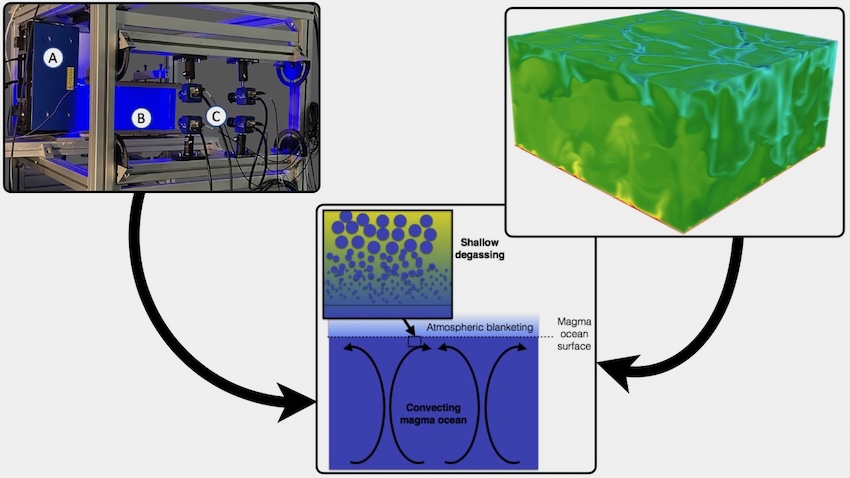
Terrestrial planets likely experienced at least one early global silicate magma ocean stage. Upon cooling, vigorous convective motions are commonly thought to efficiently outgas dissolved volatiles, progressively forming a secondary atmosphere. Atmospheric blanketing, fed by exsolved volatiles can significantly affect the solidification of magma oceans, thereby altering the final thermo-chemical state of planetary mantles, their long-term evolution, and eventually their habitability. In this context, efficient volatile outgassing has been a common hypothesis made in coupled magma ocean-atmosphere studies. However, despite extremely vigorous convective motions, volatile outgassing may be limited by the fact that fluid parcels containing dissolved volatiles need to reach shallow exsolution depths to form bubbles that are subsequently outgassed into the atmosphere (Fig. 1).
To test these hypotheses, we conducted computational [1,3] and analog [2,3] fluid dynamics experiments at various convective vigour and turbulent states, designed to reproduce planetary magma ocean dynamics (Fig. 1).
Figure 1: Analog (left: Particle Tracking Velocimetry) and numerical (right: Finite Volume modelling) approaches for characterizing the effciciency of volatiles outgassing in vigorously convecting planetary magma oceans.
These works have shown that the common assumption of efficient (equilibrium) outgassing is far from being systematically true.
In particular, these experiments allowed to derive for the first time the flux of exsolved volatiles out of a magma ocean of evolving thickness [2].
We showed that the temporal evolution of the exsolved volatile fraction is directly proportional to the exsolution depth and to the magnitude of convective velocities.
This parameterized volatile flux was incorporated into a coupled magma ocean–atmosphere evolution framework to more rigorously quantify the influence of convective transport on secondary atmosphere formation and the associated mantle evolution [3].
Our simulations demonstrate that, over a broad parameter space—including high planetary rotation rates, increased planetary masses, and low initial volatile inventories—inefficient volatile outgassing can result in mantle solidification timescales reduced by over an order of magnitude compared to cases assuming volatile-atmosphere equilibrium. These dynamics have substantial implications for the thermal evolution and compositional differentiation of the solid mantle, particularly with respect to major and trace element distributions, and may exert long-term control over the geochemical and geophysical evolution of terrestrial planets.
References:
[1] A. Salvador, H. Samuel, Convective outgassing efficiency in planetary magma oceans: insights from computational fluid dynamics, Icarus, doi:10.1016/j.icarus.2022.115265, 2023
[2] A. Walbecq, H. Samuel, A. Limare, Fully determined three-dimensional velocity field in a divergence-free convection experiment with rigid boundary conditions, Experiments in Fluids, 65, 70, doi 10.1007/s00348-024-03807-y, 2024
[3] A. Walbecq, H. Samuel, A. Limare, The effect of out-of-equilibrium outgassing on the cooling of planetary magma oceans, Icarus, 434, 10.1016/j.icarus.2025.116513, 2025

 1,
1,