
 3,
3,- 1Institute of Geodesy and Geoinformation Science, Technische Universität, Berlin, Germany
- 2Institute of Geological Sciences, Freie Universität, Berlin, Germany
- 3Institute of Space Research, German Aerospace Center (DLR), Berlin, Germany
Introduction: The planetary defense mission HERA [Michel et al., 2022] performed a Mars swing-by on March 12th 2025. During the flyby, the Asteroid Framing Camera (AFC) captured seven images of Deimos in front of the Martian surface. These images are useful for calibration purposes but likewise suited for astrometric observations of Deimos, thus supporting the improvement of ephemerides.
The evaluation of images containing only a single planetary object requires accurate information on the spacecraft pointing or some means to deal with pointing offsets or random errors. However, with a second object in view, the spacecraft pointing can be corrected applying the knowledge of the secondary object’s 3D-position, thus improving the accuracy of the overall measurement. Here we measure the position of Deimos by using craters on the Martian surface in the background to correct the spacecraft pointing.
Methods: First the image coordinates of Deimos’ center of figure (COF) are determined. This is achieved by computing a simulated image, based on ephemerides for Deimos and HERA, a shape and a rotational model for Deimos (Thomas et al., 2000, Stark et al., 2017) and information on the AFC’s nominal pointing and camera parameters [Vincent et al., 2024]. Moreover, the photometric behavior of Deimos’ surface is modeled using the parameterless version of the Akimov disk function (Shkuratov et al., 1999; Longobardo et al., 2014).
The simulation is then used to detect Deimos in the measured image with pixel accuracy. A cut-out of this image is matched to Deimos in the measured images with sub-pixel accuracy. As the shape model was put into the simulated image at the location of the center of mass (COM), the location of Deimos’ center in the measured image is easily determined if a good match between observation and simulation can be achieved [Ziese and Willner 2018]. However, Deimos’ ephemerides provide the position of its center of mass (COM), while Deimos’ shape model is given with respect to the center of figure. Our procedure assumes that the COF and the COM coincide. For Deimos no offsets between the COF and COM are known. If they exist, they are believed to be very small.
To correct the spacecraft’s pointing, several of the depicted Mars craters are identified using the MUTED web service [Heyer et al., 2018]. The 3D-coordinates of the craters’ centers are then derived from a crater data base and are used to compute the expected line/sample coordinates of the craters. To determine the image coordinates of the crater centers in the measured image, an ellipse fit using OpenCV [Bradski, 2000] and the lmfit library [Wuttke] is used as craters are observed under oblique viewing geometry and appear elliptic. The difference between the expected and measured line/sample coordinates of the craters is computed and applied to the measured line/sample position of Deimos, thus providing corrected line/sample coordinates for the moon. The line/sample coordinates thus corrected are then converted to RA/DEC of Deimos as seen from HERA with respect to the ICRF.
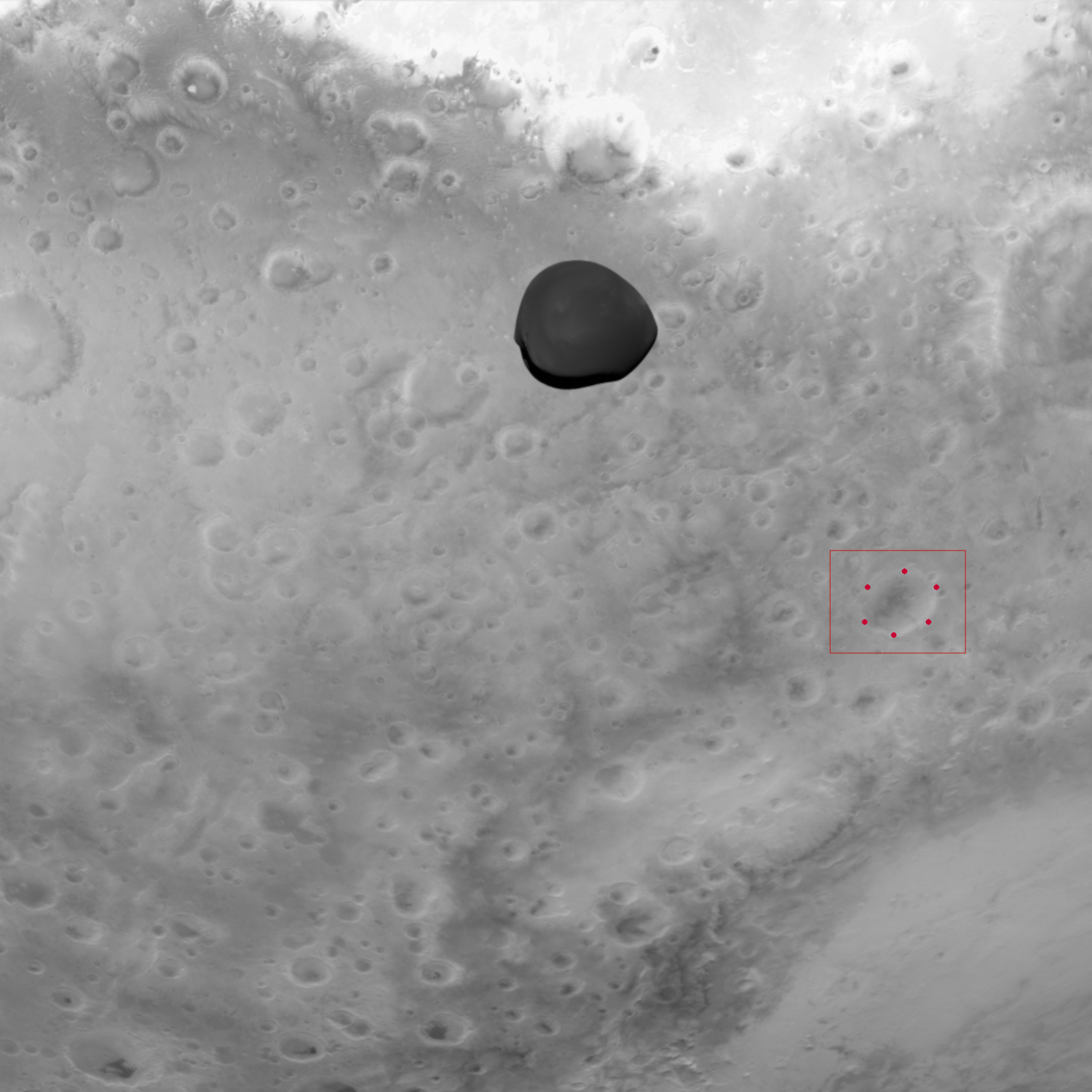
Figure 1: Deimos in front of the Martian surface. [ESA] For several craters the centers are determined by choosing points on their rims and applying an ellipse fit.
Summary and Outlook: We evaluate HERA/AFC images taken during HERA’s Mars Flyby on March 12th 2025, showing Deimos in front of the Martian surface. The measured position of Deimos will be compared against existing orbit models, e.g. MAR097 and NOE-4-2020. The new observations are expected to complement the existing data set and to support the improvement of ephemerides for Deimos.
Acknowledgements: This project is supported by the Deutsche Forschungsgemeinschaft (DFG), research grant number 528586639. The authors thank the HERA/AFC team as well as ESA/ESTEC for their successful planning and acquisition of data.
References:
Bradski, G., 2000. The OpenCV Library. Dr. Dobb's Journal of Software Tools. http://www.drdobbs.com/open-source/the-opencv-library/184404319.
Heyer, T., Hiesinger, H., Reiss, D., Erkeling, G., Bernhardt, H., Luesebrink, D., and Jaumann, R., 2018. The Multi-Temporal Database of Planetary Image Data (MUTED): A web-based tool for studying dynamic Mars. Planetary and Space Science 159, 56–65. doi:10.1016/j.pss.2018.04.015
Longobardo, A., Palomba, E., Capaccioni, F., De Sanctis, M. C., Tosi, F., Ammannito, E., Schröder, S. E., Zambon, F., Raymond, C. A. And Russell, C. T., 2014. Photometric behavior of spectral parameters in Vesta dark and bright regions as indferred by the Dawn VIR spectrometer. Icarus, 240, 20. doi:10.1016/j.icarus.2014.02.014
Michel, P., Küppers, M. et al., 2022. The ESA Hera Mission: Detailed Characterization of the DART Impact Outcome and of the Binary Asteroid (65803) Didymos. The Planetary Science Journal, 3. doi:10.3847/PSJ/ac6f52
Shkuratov, Y. G., Kreslavsky, M. A., Ovcharenko, A. A., Stankevich, D. G., Zubko, E.S., Pieters, C. And Arnold, G., 1999. Opposition Effect from Clementine Data and Mechanisms of Backscatter. Icarus, 141, 132. doi:10.1006/icar.1999.6154.
Stark, A., Willner, K., Burmeister, S., and Oberst, J., 2017. Geodetic Framework for Martian Satellite Exploration I: Reference Rotation Models, European Planetary Science Congress, 2017.
Thomas, P. C., Yoder, C. F., Synnott, S. P., Salo, H., Veverka, J., Simonelli, D., Helfenstein, P., Carcich, B., Black, G. J., Nicholson, P. D., Binzel, R. P., Gaffey, M. J., Zellner, B. H., Bell, J. F., III, and Clark, B. E., 2000. Small Body Shape Models V2.1, NASA Planetary Data System, 173, 2000.
Vincent, J.-B., Kovacs, Gábor, Nagy, B., Preusker, F., Pajola, M., Kueppers, M. and Michel, P., 2024. The Asteroid Framing Cameras on ESA's Hera mission. European Planetary Science Congress. doi:10.5194/epsc2024-445.
Wuttke, J. lmfit – a C library for Levenberg-Marquardt least-squares minimization and curve fitting. Retrieved from https://jugit.fz-juelich.de/mlz/lmfit.
Ziese, R. and Willner, K., 2018. Mutual event observations of solar system objects by SRC on Mars Express, A&A, 614. doi:10.1051/0004-6361/201731644.
How to cite: Ziese, R., Willner, K., Vincent, J.-B., and Oberst, J.: Deimos’ astrometric position from HERA/AFC images, EPSC-DPS Joint Meeting 2025, Helsinki, Finland, 7–12 Sep 2025, EPSC-DPS2025-1965, https://doi.org/10.5194/epsc-dps2025-1965, 2025.


