
 1,1,1,2,3,4,5,1,6,1,1,1,8,
- 1Institute of Space Research, German Aerospace Center (DLR), Berlin, Germany
- 2Freie Universität Berlin, Germany
- 3Planetary Science Institute, Tucson, USA
- 4Mount Holyoke College, MA, USA
- 5Jet Propulsion Laboratory, California Institute of Technology, Pasadena CA, USA
- 6Institute of Earth and Environmental Science, Albert-Ludwigs-Universität Freiburg, Germany
- 7Lunar and Planetary Laboratory, University of Arizona, Tucson, USA
- 8European Space Agency ESA, ESTEC, Noordwijk, The Netherlands
- *A full list of authors appears at the end of the abstract
Introduction
Several major missions to Venus are planned for launch in the early 2030’s, amongst them are NASA’s VERITAS [1] and ESA’s EnVision [2] missions. The VERITAS mission will launch with the Venus Emissivity Mapper (VEM) instrument [3] designed to measure the emissivity of Venus’s surface and atmosphere. Despite being our closest neighbor, we know surprisingly little about Venus, partly due to its optically dense atmosphere of CO2 with clouds of H2SO4, making direct surface observations challenging. The VEM instrument will overcome this challenge by exploiting 6 narrow bands of higher atmospheric transmission in the near infrared (NIR) between 0.86 and 1.18 µm, with the goal of distinguishing felsic from mafic rock types and contributing to the detection of recent or active volcanism [1]. Additional bands observing the cloud and atmosphere composition can be used to correct for atmospheric effects and distortion. In preparation for the mission, extensive work is being carried out on the spectroscopy of Venus analogs in the laboratory, as well as at Venus analog field sites. In this framework the VERITAS Science Team undertook a 2-week field campaign at analog sites in Iceland in August 2023 [4]. As part of this field campaign, of which the major goal was to ground truth radar measurements with detailed lidar scans [4], a team was dedicated to investigating the NIR spectral properties of the sites. To this end an emulator of VEM was constructed for field work [5,6] with the goal of obtaining VEM-like data to train scientists and to investigate the response of various surfaces in the NIR from reflectance and emission spectra collected both in the field, including from hot lavas, and in the lab.
The camera setup
A top view of the camera system is shown in Figure 1. The system is based around a cooled NIR InGaAs OWL 1280 Camera from the company Raptor Photonics, sensitive in the range 0.6 to 1.7µm. A frame grabber (Pleora Technologies, iPort CL-U3) was used to read out images from the camera via a Camera Link interface. In front of this, we positioned a filter wheel containing 6 commercially available 1” bandpass filters from Thorlabs with central wavelengths closely matching those chosen for VEM: 860nm, 910nm, 990nnm, 1030nm, 1100nm, 1200nm. Between the detector and the filter wheel a C-mount 25mm SWIR lens was fitted. The detector, frame grabber and motor controller unit were accommodated inside a dustproof casing with two fans for cooling of the camera housing, which requires heat dissipation due to the inbuilt TEC for detector cooling. The camera system can be mounted on a tripod and packed into a transport box. The camera was calibrated using an integration sphere with halogen light sources, allowing radiance values to be calculated for measurements through each filter [5].
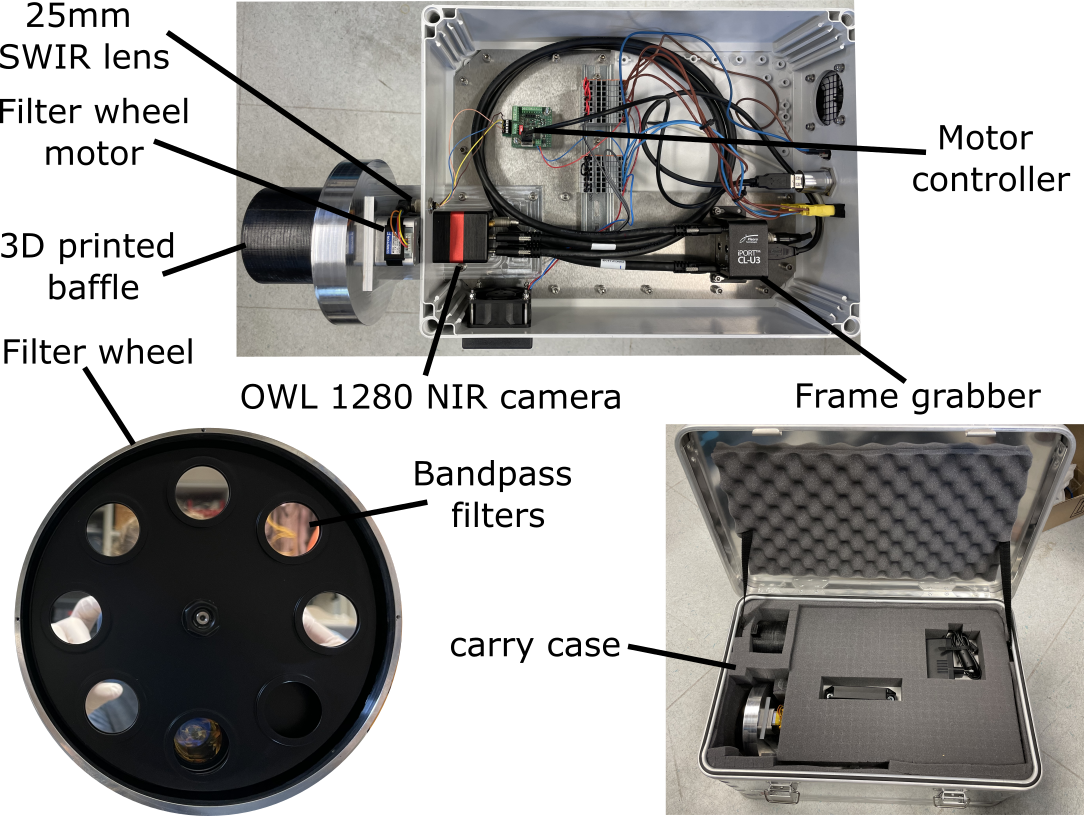
Figure 1. The VEMulator 2.0 camera system.
Field and laboratory measurements
The VEMulator2.0 camera system was originally intended for measuring reflectance spectra in the NIR as part of the VERITAS Science Team 2023 field campaign to Venus analog sites in Iceland. By chance, during the field campaign, a volcanic eruption occurred on the Reykjanes peninsula. By the time the team arrived at the site, the eruption was no longer active, however the crater region still exhibited hot spots up to around 400 °C. VEMulator2.0 measurements were made at nighttime with low ambient light levels with a simultaneous measurement using a FLIR thermal infrared camera to estimate the temperature (Figure 2). Initial calculations of emissivity from a brighter hot spot (210 °C from the FLIR measurement) were not consistent with an independent laboratory-measured spectrum of basalt from the eruption site. The radiance values are more consistent with a basalt in the temperature range of 240°C to 280°C. In fact, the discrepancy is more likely due to the presence of light-toned deposits observed in context photos in this region, which likely have lower emissivity values. This contribution analyzes this problem in more depth, with the support of reference measurements performed at the Planetary Spectroscopy Laboratory [7], by examining different contributions to the observed spectra, such as emission from material at multiple temperatures, and compositional inhomogeneities.
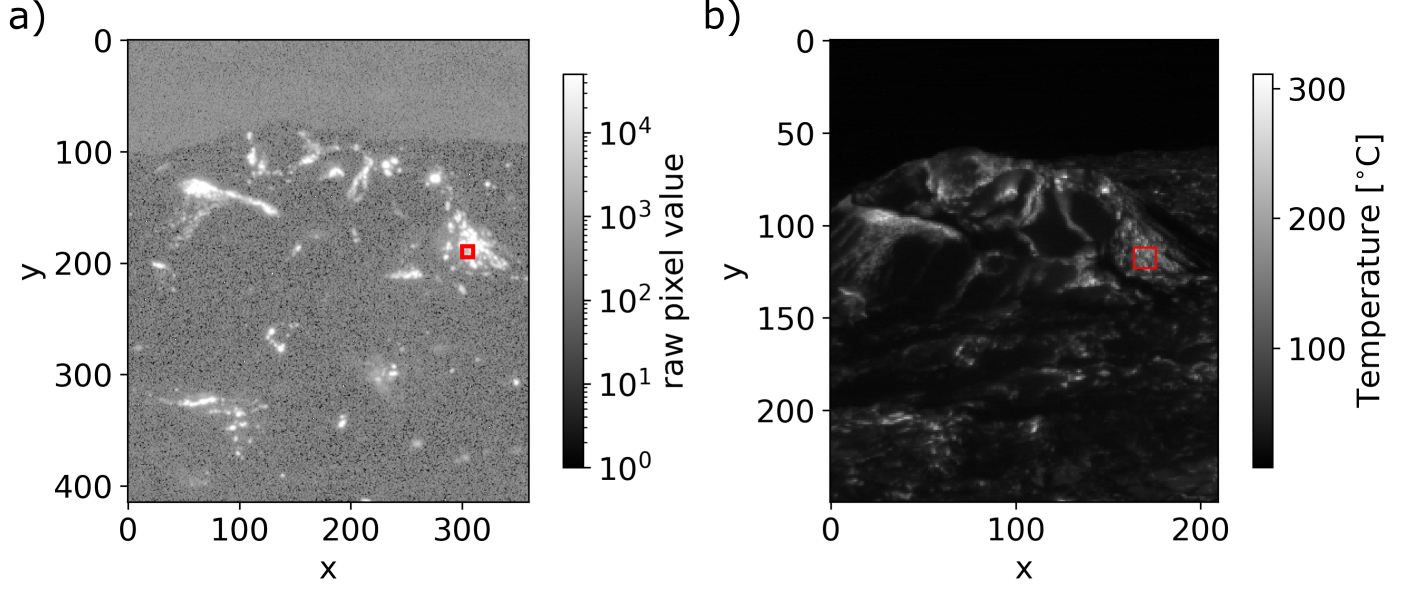
Figure 2. a). Raw pixel values from a region of an image taken with VEMu2.0 using the 860 nm filter. The red square shows a region of interest. b). The same field of view with a FLIR thermal infrared camera showing calibrated temperatures. The red square shows the same regions of interest. From [5].
Acknowledgments: S. P. Garland, S. Adeli, N. Müller, A. Domac received funding from the European Union's Horizon 2020 research and innovation programme under grant agreement No 871149.
References
[1] Smrekar, S. (2022) IEEE Aerospace Conf. [2] Ghail, R. C. et al. (2012) Exp. Astron., vol. 33, no. 2, pp. 337–363 [3] Helbert, J., et al. (2022) SPIE. [4] Nunes, D. et al. (2024) LPSC 55. [5] Garland, S. et al. (2024) SPIE. [6] Adeli, S. et al. (2024) LPI Contributions, vol. 3040, p. 1286. [7] Helbert, J. et al. (2023) SPIE.
The VERITAS Science Team
How to cite: Garland, S. P., Adeli, S., Müller, N., Althaus, C., Dyar, M. D., Smrekar, S. E., Nunes, D. C., Domac, A., Alemanno, G., Barraud, O., Maturilli, A., Breitenfeld, L., Hamilton, C. W., Trauthan, F., Wendler, D., Hagelschuer, T., Chauhan, S., Peter, G., and Helbert, J. and the The VERITAS Science Team: The Venus Emissivity Mapper Emulator 2.0: a NIR camera system for Venus analogue measurements in the field and in the laboratory, EPSC-DPS Joint Meeting 2025, Helsinki, Finland, 7–12 Sep 2025, EPSC-DPS2025-1969, https://doi.org/10.5194/epsc-dps2025-1969, 2025.


