
 1,
1,- 1Space Park Leicester, School of Physics and Astronomy, University of Leicester, Leicester, Leicestershire, UK
- 2Department of Earth, Atmospherics, and Planetary Sciences, Purdue University, West Lafayette, Indiana, U.S.A.
- 3Added Value Systems, Westcott Innovation Centre, Westcott, Buckinghamshire, UK
- 4Diamond Light Source, Harwell Science and Innovation Campus, Didcot, Oxfordshire, UK
Introduction
A challenge in sample return missions to restricted bodies such as Mars, Europa, and Enceladus is enabling mineralogical and geochemical analyses whilst maintaining cleanliness and containment. Notably, due to the potential for back-contamination of Earth from possible extant life on these bodies, strict contamination control measures must be taken for the purposes of planetary protection [1]. These measures restrict how analyses can be performed on the samples until they have been sterilised or judged safe. As the first step of scientific analysis for Mars Sample Return (MSR), for example, sealed samples would undergo a set of measurements called Pre-Basic Characterisation, or Pre-BC [2]. These data would be used to inform tube opening and decide experimental plans for subsequent multi-instrument analyses. Pre-BC includes X-ray CT and magnetic measurements but X-ray Diffraction (XRD) for identification and quantification of crystalline mineral phases is currently only planned for a later phase, due to the need for sample powdering to achieve sufficient diffraction signal using a conventional laboratory diffractometer.
XRD using a synchrotron source enables sampling of sealed MSR sample tubes, but tubes must be kept in containment throughout transport and measurements. We have developed a prototype container at Space Park Leicester that can be used to take unopened drill tubes in a Sample Receiving Facility to a synchrotron beamline such as Diamond Light Source’s I12 and perform XRD analysis whilst maintaining containment.
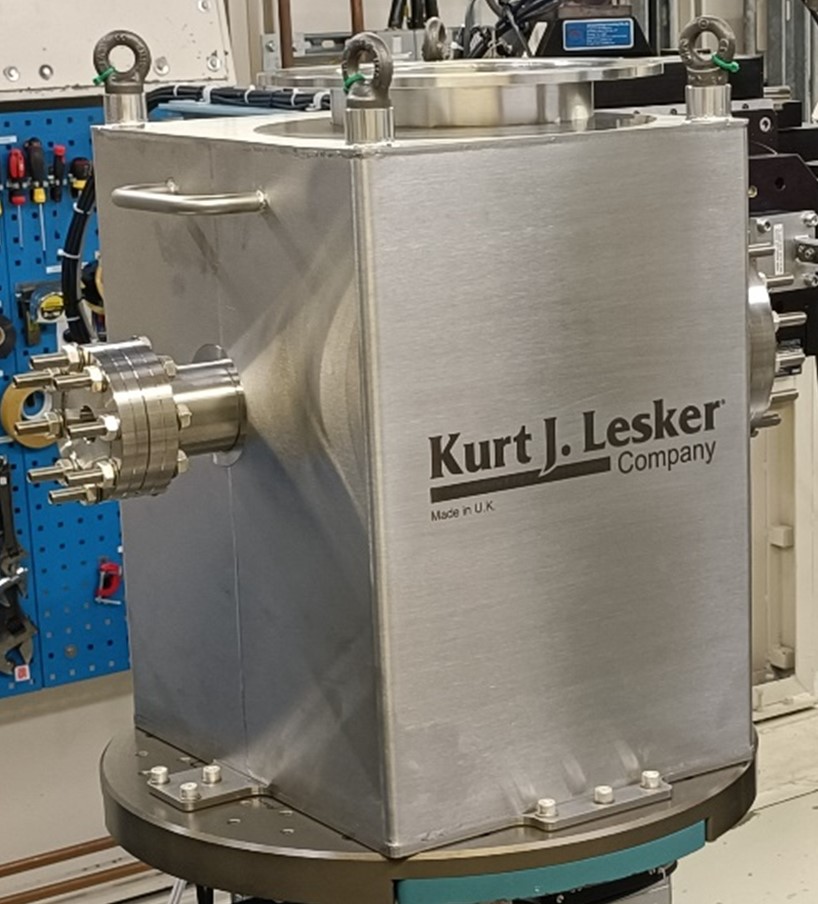
Figure 1: MSR sample tube container for synchrotron XRD.
Method
The sample container used stainless steel construction in accordance with the permissible materials list for MSR samples. Remotely operated, low-offgassing motorised stages were used to position the sample tube and rotate it for spatial averaging. The windows were made out of fused silica, with a 30 mm diameter, 1 mm thick inlet window, and 100 mm diameter, 2 mm thick outlet.
Synchrotron powder XRD measurements were taken at the I12-JEEP beamline at Diamond Light Source. The diffraction methodology was similar to our previous study [3] at I12 in which a basaltic sediment from Þórisjökull, Iceland collected as an MSR analogue through the SAND-E program [4] in just a Ti sample tube analogue was analysed as a feasibility test. The only differences were a 56.59 keV X-ray energy and a 1224.7 mm sample-to-detector distance. Four samples were measured: a solid basalt core from Skye, UK; an Old Red Sandstone core from Pembrokeshire, UK; the Icelandic regolith analogue mentioned previously; and mudstone fragments from Watchet, UK. The last two are official Jezero Crater Mars analogues. Sample analogues inside sample tubes were placed inside the container and diffraction measurements were performed through the windows. An empty tube was also measured as reference.
Semi-quantitative analysis was used to identify the mineral phases present and roughly estimate their quantity, shown for the Icelandic sediment in Fig. 2. Diffraction patterns had the window and tube background subtracted after intensity scaling to enable this analysis as in Adam et al. [3], though this method is imperfect. Rietveld refinement is in progress for more accurate phase quantification.
Results
The expected three constituent minerals, plagioclase, pyroxene, olivine, could still be identified, though with differences in atomic site occupancy for two of the phases (andesine, diopside, and larnite compared to the expected anorthite, diopside, and forsterite). The Figure of Merit of the phase matches was reduced: from 0.792, 0.783, and 0.764 for plagioclase, pyroxene, and olivine respectively, to 0.710, 0.670, and 0.705. Estimated quantity also changed from 42.3%, 34.5% and 23.2%, to 34.5%, 25.9% and 39.6%, respectively, though precise quantification is not expected from this semi-quantitative approach and will come from Rietveld refinement.
Peaks were observed to be broader with the container, increasing overlap and thus reducing identification and quantification accuracy. This also increased the size of the 2-theta regions affected by the sample tube’s Ti diffraction peaks, reducing available angles for sample analysis. A broad amorphous diffraction peak was observed between 2.5 and 3° caused by the fused silica exit window. The entrance window’s diffraction was blocked by the container geometry.
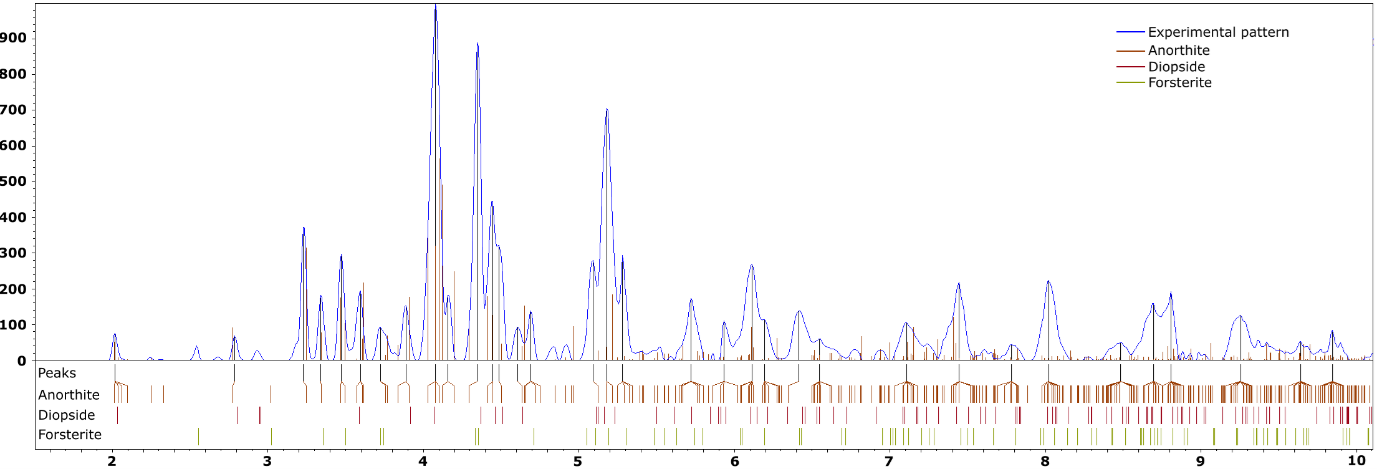
Figure 2: Semi-quantitative phase analysis of the Icelandic basaltic sediment analogue in the sample tube without the container, with the empty titanium tube pattern subtracted.
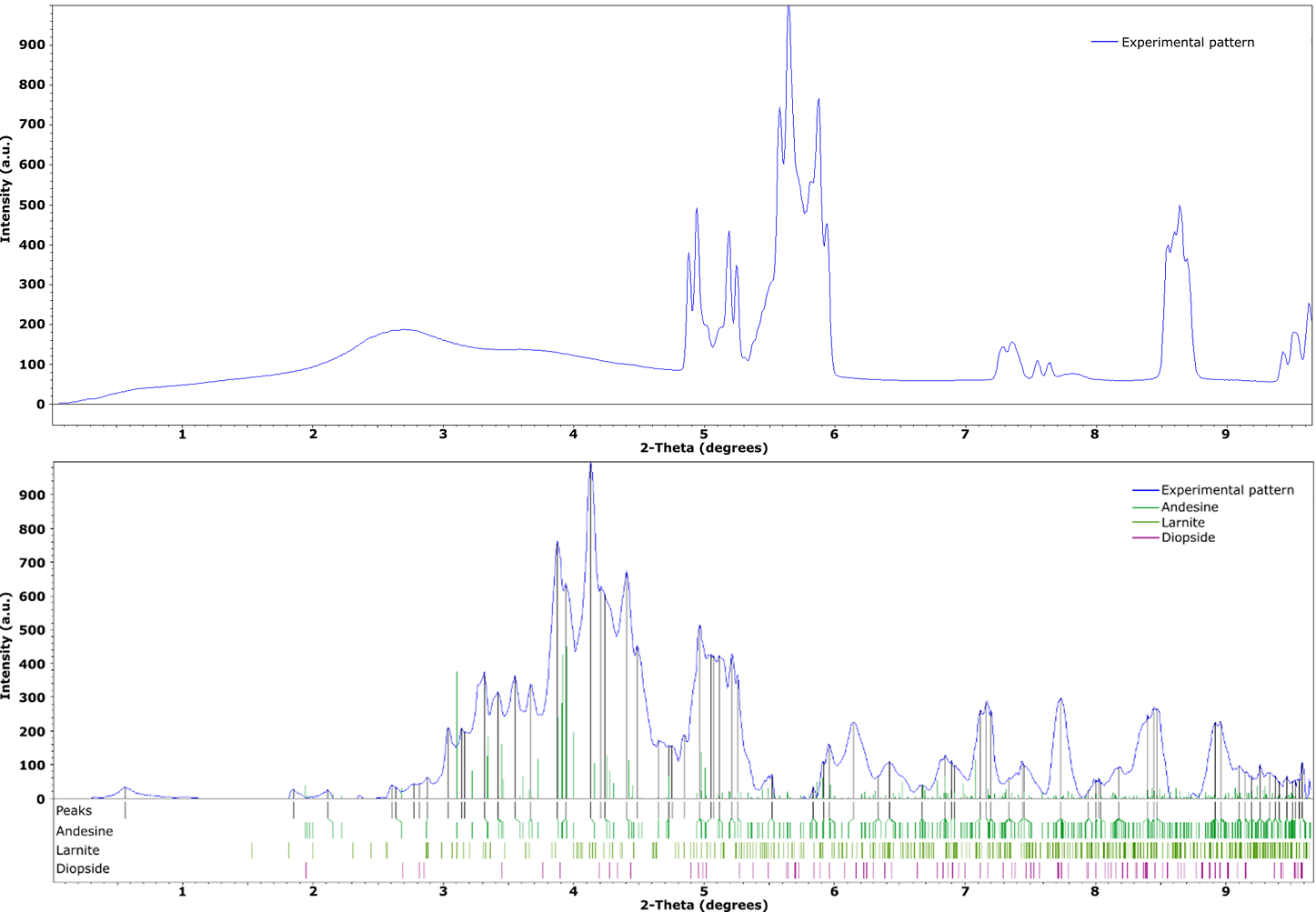
Figure 3: Top: diffraction pattern of the container windows and empty titanium sample tube analogue. Bottom: Semi-quantitative phase analysis of the Icelandic basaltic sediment analogue in the sample tube in the container, with the above pattern subtracted. Note that patterns are not to relative scale.
Conclusions
This work has shown that powder XRD analysis of sealed sample tubes is possible inside of a suitably designed container. However, accuracy is not high, though this needs to be confirmed and quantified through further data analysis. Windows should be kept as thin as is safe to reduce background signal, particularly the exit window which is the primary contributor. Design optimisations to the container can be made that can reduce this through, e.g., positioning the sample closer to the exit window, enabling a reduction in diameter and thus required thickness for the atmosphere pressure differential required for safe containment. Diffraction measurements of the container windows and sample tube were very helpful for data analysis and should be taken for the Sample Receiving Project’s final hardware. While the sample and tube analogues were designed for MSR, much of it can be adapted with relatively little change to samples from other restricted Earth return bodies, or indeed any contamination-sensitive but potentially hazardous or pathogenic sample.
Acknowledgements: This work was funded by UKSA Emerging Technologies grant UKSAG22_0031_ETP2-030. Beamtime on beamline I12 was provided by Diamond Light Source under proposal MG30591. The SAND-E program was supported by NASA PSTAR program #80NSSC18K1519.
Bibliography
[1] UN (2002) UN Treaties & Principles on Outer Space. [2] Tait K.T., et al., Preliminary Planning for Mars Sample Return Curation Activities in a Sample Receiving Facility. Astrobiology, 2022. 22(S1), S-57-S-80. [3] Adam L., Bridges J.C., et al. 2024 Synchrotron X-ray Diffraction for Sealed Mars Sample Return Sample Tubes. Meteorit Planet Sci, 59: 40-54.; [4] Ewing R. et al. (2020) LSPC LI, Abstract #JSC-E-DAA-TN78511.
How to cite: Adam, L., Bridges, J. C., Martindale, A., Holt, J. M. C., Bedford, C. C., Busquets, J. M., White, A. E. L., Zillhardt, T., and McNaughton, T. J.: Synchrotron X-Ray Diffraction of Restricted Earth Return Samples in Containment, EPSC-DPS Joint Meeting 2025, Helsinki, Finland, 7–12 Sep 2025, EPSC-DPS2025-1999, https://doi.org/10.5194/epsc-dps2025-1999, 2025.


