
 1,2
1,2- 1Institute for Space, University of Leicester, Leicester, United Kingdom
- 2School of Physics and Astronomy, University of Leicester, Leicester, United Kingdom
- 3School of Engineering, University of Leicester, Leicester, United Kingdom
Many meteorites in our inventories are crystalline and formed through magmatic activity, showing features similar to terrestrial gabbros, cumulates, pyroxenites and basalts. However, unlike terrestrial basalts, which often contain ubiquitous vesicles resulting from volatile loss and near-surface exsolution of water-rich fluids in ascending magmas, vesicles in asteroidally-derived meteorites are exceptionally rare, with only a few eucrites and angrites (~5) showing vesicular textures [1-3]. The ability for vesicles to form on small airless bodies is ultimately limited by the asteroid size and lack of atmosphere [1], where magma fragmentation and gas escape would occur instead [4]. While the simplest explanation for the occurrence of vesicles in a meteorite is as a lava flow [5], this would require substantially thick flows >>100 m [4], which are unlikely based on our knowledge of most asteroids, including the largest differentiated asteroid Vesta (diameter ~525 km). Instead, previous research has suggested that vesicles could be formed and preserved in a dyke(s) trapped at ~5 km depth that was subsequently excavated from Vesta by substantial impact [1]. Additionally, the carrier gas of the vesicles is thought to be CO or a mix of CO:CO2 [1,6]. Ultimately, the study of vesicles in asteroidal meteorites can help determine formation depth, volatiles in magmatic systems, and the nature of crust formation [1].
A recently recovered and little studied meteorite, Jikharra 001, classified as a eucritic melt breccia, may provide key information about magmatic activity on asteroids, particularly for Vesta, the likely parent body to the HED meteorites [7]. Jikharra 001 is fairly heterogenous with at least two lithologies previously reported [8]. We have acquired a sample on loan from a collection of Jikharra 001 material that shows a highly unusual vesicular texture with evidence of gradation in a fine-grained lithology, as well as potential xenoliths/enclaves from another lithology that is coarse-grained. Preliminary data acquired in a pilot study using the Zeiss Xradia micro Computerised Tomography (CT) based in the School of Engineering, University of Leicester (UoL) shows the complexity of the sample (Figs 1-2). Fig. 1B shows a labelled diagram of a CT-slice through part of Jikharra 001, highlighting an angular coarse-grained clast alongside the dominant fine-grained matrix that shows increasing vesicle size with distance from the coarser-grained lithology. Investigating this further, we have started to calculate the vesicle volumes, and can further identify the apparent gradient (Fig. 2). Our initial observations are indicative of flow, volatile dynamic activity, with evidence of brecciation and rapid cooling. The observation of a gradient may also provide a way-up structure, possibly indicating the direction of the asteroid surface in relation to the sample. We are investigating these findings further, with a view to modelling the nature of Jikharra 001, and potential formation history.
References: [1] McCoy T. J. et al., (2006) EPSL 246:102-108. [2] Warren P. W. (2003) 66th Metsoc (abs.# 5297). [3] Mittlefehldt D. W., Killgore M., and Lee M. T., (2002) MAPS 37:345-369. [4] Wilson L. & Keil K. (1997) MAPS 32:813-823. [5] Mittlefehldt D. W., et al. (1998) in Planetary Materials, Min. Soc. Am. 36:4.1-4.195. [6] Wilkening L. L. and Anders E., (1975) GCA 39:1205-1210. [7] Mittlefehldt D. W. (2015) Chemie der Erde, 75:2:155-183. [8] Wang Z., Tian W., Wang W-RZ., (2023) LPSC (abs.# 1017).
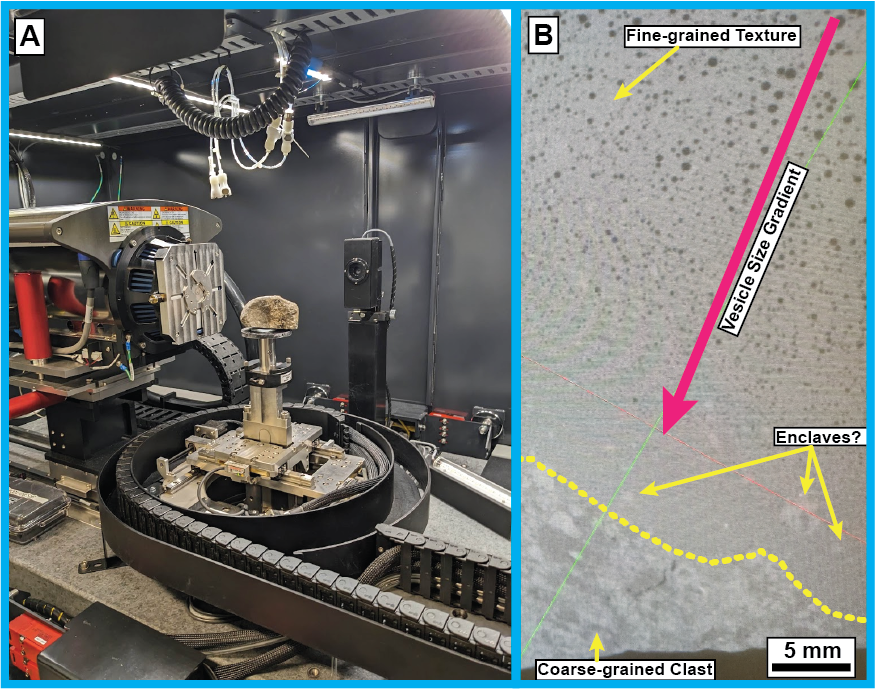
Fig.1: A) Jikharra 001 on the sampling stage within the Zeiss Xradia. B) CT-image of Jikharra 001 region highlighting the main features observed.
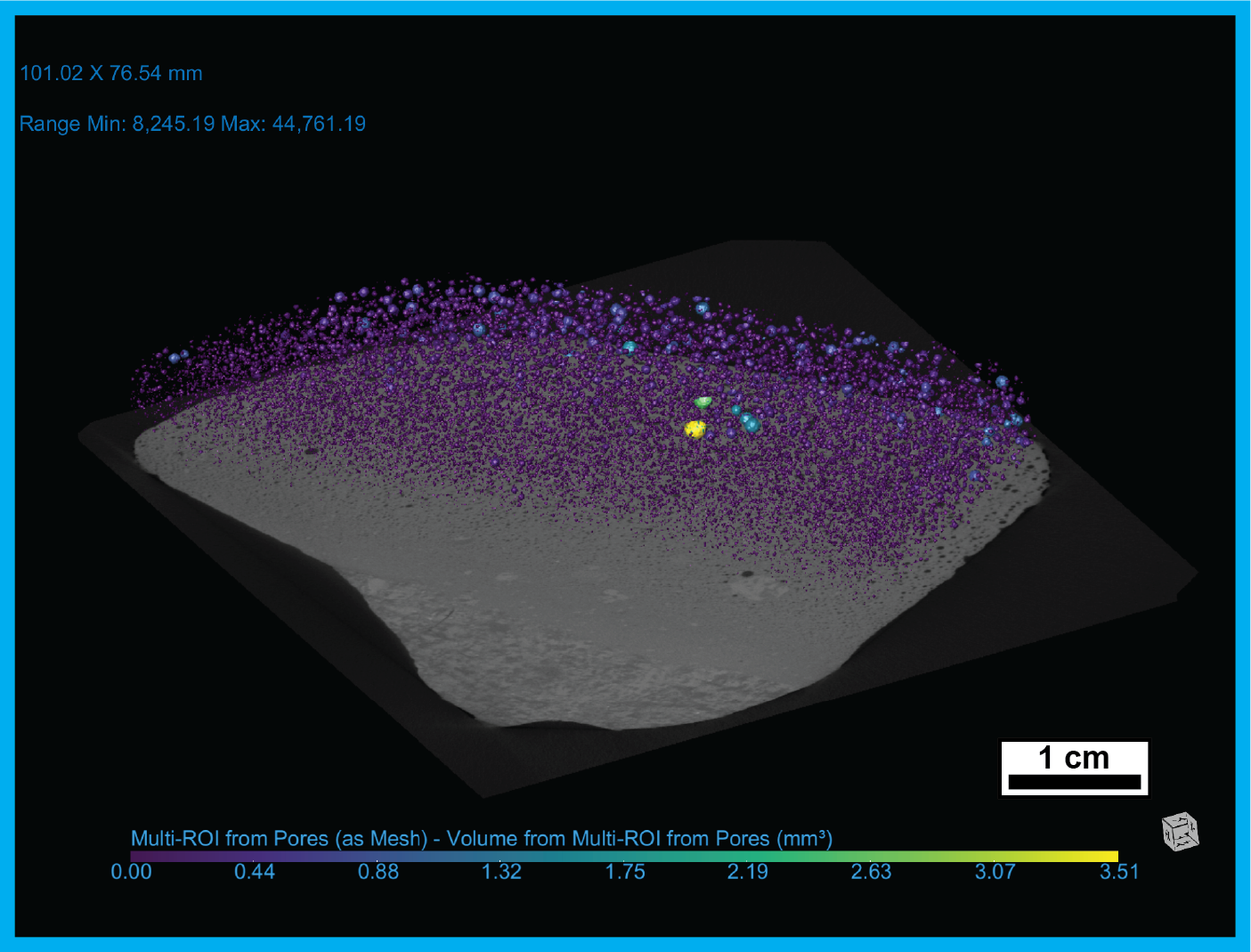
Fig.2: Mesh map of vesicles (‘pores’) in Jikharra 001 shown in relative positions. Colour scale bar represents volume, ranging from dark purple (0 mm3) to yellow (3.5 mm3). CT-scan slice shown for reference at the bottom of the combined image.
How to cite: Cartwright, J. and Douglas, G.: Investigating Rare Vesiculated Meteorite Jikharra 001, EPSC-DPS Joint Meeting 2025, Helsinki, Finland, 7–12 Sep 2025, EPSC-DPS2025-2032, https://doi.org/10.5194/epsc-dps2025-2032, 2025.


