
 1,2,5,6,6,8,9,10,11,
- 1Centre for Mars Meteorology Monitoring/Paneureka, Le Bourget-du-Lac, France
- 2Laboratoire de Météorologie Dynamique/IPSL/CNRS/Sorbonne Université, Paris, France
- 3Aurora-SSC, Spain
- 4Istituto de Astrofisica de Andalucia, Spain
- 5Aeolis Research, United Kingdom
- 6BIRA, Belgium
- 7Universidad del Pays Vasco, Spain
- 8Universita della Basilicata, Italy
- 9The Open University, United Kingdom
- 10University of Leicester, United Kingdom
- 11University of California at Berkeley, United States
- 12Tohoku University, Japan
- *A full list of authors appears at the end of the abstract
Scientific Rationale
Despite two decades of orbital observations, many fundamental questions about Mars’ atmosphere remain unanswered—especially regarding vertical coupling between atmospheric layers, diurnal and sub-diurnal variability, and interactions with the space environment. Existing missions, all based on single-point orbiter platforms, have lacked the capability to resolve these processes simultaneously at local and global scales across all local times.
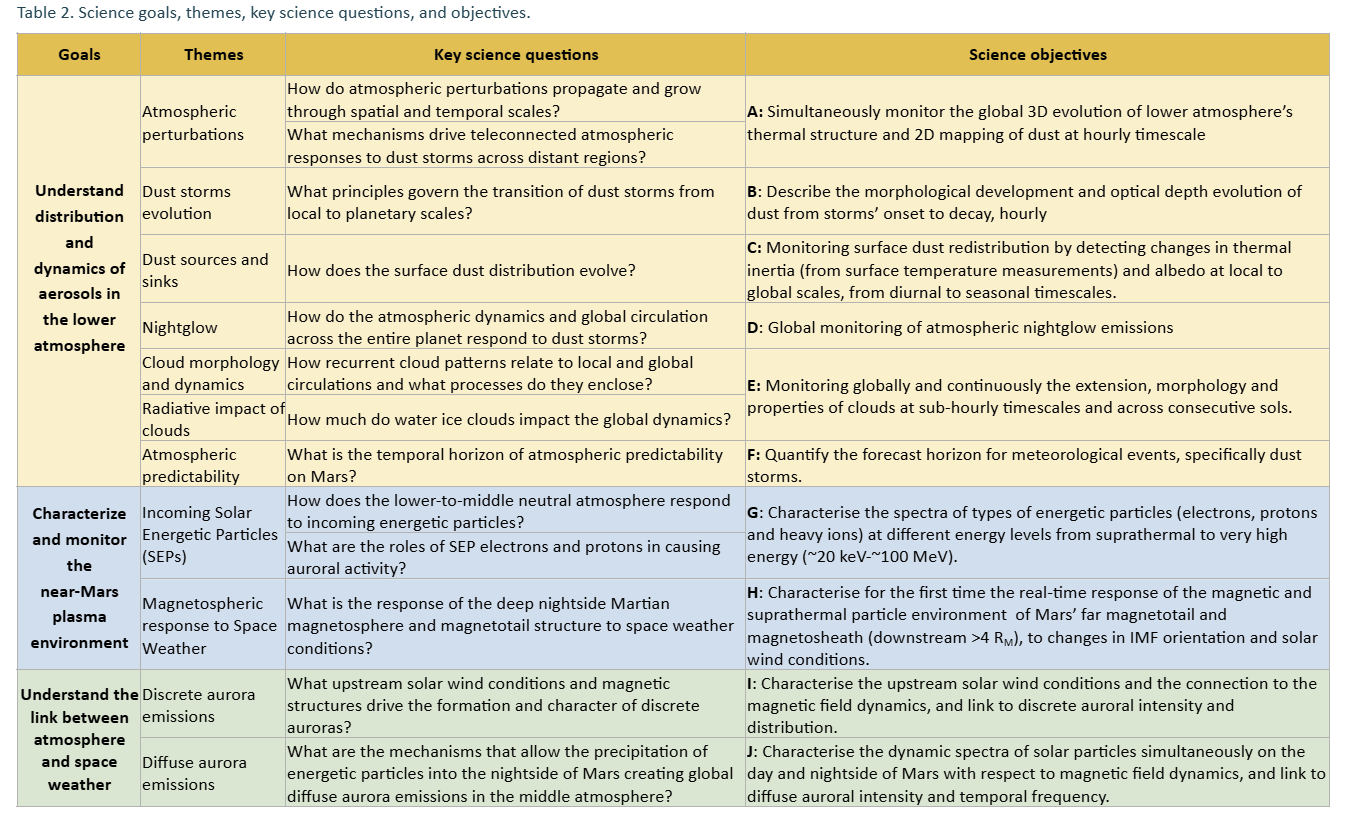
We have elaborated the MArs Constellation for Atmosphere and space Weather (MACAWS) mission concept to address these limitations using a novel constellation of three identical spacecraft in high altitude orbit (~17,000 km). MACAWS will, for the first time, enable global, simultaneous, high-cadence monitoring of Mars’ atmosphere and near-space environment over the full diurnal cycle. This mission is designed to deliver transformative science ahead of more comprehensive—but later—missions like M-MATISSE and the full LightShip constellation, whose first results are expected near the end of the next decade. MACAWS aligns with top priorities identified by the Mars science community and formalized in Table 1 (see Figure 1).
Goal 1: Understand the distribution and dynamics of aerosols in the lower atmosphere
Dust, water ice, and CO₂ ice aerosols dominate Martian meteorology through their radiative and thermodynamic effects. These aerosols shape circulation, modulate thermal structure, and define the appearance of Martian weather across scales. Dust, in particular, is a potent driver of temperature variability, absorbing solar radiation and emitting infrared energy. Through microphysical interactions, it influences cloud formation and atmospheric dynamics. MACAWS will provide the first planet-wide, hourly, simultaneous 3D thermal profiles and 2D dust maps, capturing the complexity of Martian weather [Objective A].
Dust storms, ranging from local to global scales, remain poorly understood in terms of initiation and decay. MACAWS will systematically track their evolution using visual imagery and optical depth retrievals [Objective B]. This will help identify physical mechanisms underlying storm growth and transitions across intensity and spatial scales. While the mission may not coincide with a planet-encircling extreme dust event, regional storms—common every Martian year— offer valuable insight into the transition from events spanning a few hundred kilometers to those extending over several thousand kilometers. Long-term, gap-free monitoring is essential to statistically characterize extreme events, yet no such dataset is currently guaranteed in the coming decade.
MACAWS will also investigate surface-atmosphere exchange by tracking changes in surface thermal inertia and albedo, potentially tied to dust lifting and deposition [Objective C]. The mission’s global daily imaging and surface temperature retrievals will help to identify active dust sources and map redistribution patterns following storms.
Dust-driven changes to global circulation can be traced to high altitudes. One striking signature is the recently detected nightglow at high latitudes during winter polar night, arising from recombination of atomic oxygen in the O₂ Herzberg II band. This visible emission offers a remote sensing diagnostic of meridional circulation and downwelling of oxygen-rich air from the upper atmosphere. MACAWS will globally map this emission to assess the impact of dust storms on large-scale circulation [Objective D].
Water ice clouds, besides tracing the water cycle, also exert radiative feedback that influence circulation. Their daily patterns show partial repeatability, suggesting links between local and global dynamics. MACAWS will monitor these clouds globally at sub-hourly cadence, across consecutive sols [Objective E], enabling improved understanding of cloud formation processes and their coupling with the dust cycle.
MACAWS will also deliver an unprecedented dataset for assimilation into Global Climate Models (GCMs). So far, the benefits of constellation-based assimilation have only been shown in synthetic Observing System Simulation Experiments (OSSEs). With its real data and assimilation-ready products, MACAWS will support forecasting of major atmospheric events, including dust storms [Objective F], advancing the goal of operational predictability for science and exploration.
Goal 2: Characterize and monitor the near-Mars plasma environment
Space weather, driven by solar emissions—fields, particles, and plasma—affects planetary upper atmospheres and magnetic environments. At Mars, these interactions produce auroras, ionospheric disturbances, and even surface-level effects during Solar Energetic Particle (SEP) events, which can heat and ionize the atmosphere and disrupt communications. Despite this, Mars’ plasma environment remains poorly monitored due to the lack of continuous upstream observations of the Interplanetary Magnetic Field (IMF).
MACAWS’ orbital altitude ensures that each spacecraft spends ~75% of its orbit in the upstream solar wind, acting as a dedicated plasma observatory. Simultaneously, at least one other spacecraft will be crossing the bow shock or sampling downstream regions—magnetosheath, magnetosphere, and tail—guaranteeing continuous, multipoint measurements.
The mission will characterize the spectra and temporal evolution of SEPs (electrons, protons, heavy ions) from ~20 keV to ~100 MeV [Objective G], identifying their role in auroral excitation and atmospheric ionization. In parallel, MACAWS will deliver the first real-time, continuous measurements of the deep Martian magnetotail, extending beyond four Mars radii, to assess how its structure and dynamics respond to solar wind and IMF conditions [Objective H].
Goal 3: Understand the link between atmosphere and space weather
A core innovation of MACAWS is its ability to simultaneously observe lower atmosphere dynamics and space weather impacts on the upper atmosphere. This allows the mission to explore the multi-scale coupling between dust activity, circulation, auroral processes, and space environment forcing.
Although MACAWS is a low-cost concept with intrinsic limitations compared to larger missions, it uniquely complements them by providing continuous, global coverage. The mission will explore links between the magnetotail, crustal magnetic anomalies, and auroral formation—both discrete and diffuse—by correlating three observational domains: (a) auroral occurrence and brightness; (b) energetic particle precipitation (day and night side) and upstream solar wind conditions; and (c) magnetic field structure and variability [Objectives I, J].
O. Karatekin, F. Oliva, J. Alday, Y. Williame, F. Forget, L. Soret, R. Young, J. Holmes, Y. Leseigneur, A. Stcherbinine, E. Millour, T. Bertrand, F. Daerden, S. Robert, C. Edwards, M. Wolff, M. Smith, J. Mason, M. Diaz-Michelena, O. Raukunen, S. Barabash, M. Wieser, M. Holmström, E. W. Knutsen, F. Gonzalez-Galindo, Y. Harada, S. Ivanovski, A. Mahieux, S. Viet, T. McConnochie
How to cite: Montabone, L., Cardesin-Moinelo, A., Newman, C., Neary, L., Hernandez-Bernal, J., Thomas, I., Liuzzi, G., Patel, M., Sanchez-Cano, B., Lopez-Valverde, M., Lillis, R., and Nakagawa, H. and the MACAWS team: The Science Case for the MArs Constellation for Atmosphere and space Weather (MACAWS) mission concept, EPSC-DPS Joint Meeting 2025, Helsinki, Finland, 7–12 Sep 2025, EPSC-DPS2025-2067, https://doi.org/10.5194/epsc-dps2025-2067, 2025.


