
 1,2
1,2- 1ESA Space Weather Office, Space Safety Programme, ESA ESOC, Robert-Bosch-Str. 5, 64293 Darmstadt, Germany
- 2Space & Planetary Physics Research Group, Physics Department, Lancaster University, Lancaster, Lancashire LA1 4YW, UK
- 3Centre for Astrophysics Research, Department of Physics, Astronomy and Mathematics, University of Hertfordshire – College Lane Campus, Hatfield, Hertfordshire AL10 9AB, UK
Asteroids show significant variation in the polarisation properties of their reflected light, which are diagnostic of their surface mineralogy, geometric albedo, and texture. These properties have historically been used to characterise them; however, this remains an under-explored method for their taxonomic classification. Potentially Hazardous Asteroids (PHAs) form a particularly important sample of observable asteroids due to their potential for collision with the Earth and their near passes, which offer opportunities for close study with telescopes or intercepting spacecraft.
Using the 2-metre Liverpool Telescope (LT) and its polarimeter, MOPTOP, robotic linear polarimetry was performed for five PHAs - Didymos, 2023 BU, 2014 HK129, 2010 XC15, and 2006 BE55 - and one Near-Earth Asteroid, 2015 RN35. For three of these objects, the author is not aware of any prior polarimetric data. At least one linear polarisation measurement was made for all six asteroids; depending on the number of observations, further properties could also be determined. For the three asteroids with greater than one data point, a phase-polarisation relationship was constructed, and the geometric albedos and inversion angles were calculated. Classifying asteroids is significantly easier at high phase angles, due to the phase-polarisation curve morphology diverging significantly between classes in this region [1]. Even a single measurement at a high phase angle (>40°) hence holds significant diagnostic power. A classification was therefore deduced for all six asteroids according to the established Tholen taxonomic system [2]. Inferences were thereafter made about their chemical composition.
The polarimetric properties of the binary asteroid Didymos-Dimorphos were characterised in detail, motivated by the impact of the DART spacecraft upon Dimorphos mere weeks prior to the commencement of this study’s observations. Didymos appeared to return to its pre-DART impact polarimetric behaviour within four weeks: no detectable polarimetric signature was observed from the impact’s debris tail, suggesting the tail had dissipated to the point of being undetectable by the LT+MOPTOP. In addition to the geometric albedo and inversion angle, the magnitude and phase angle of Didymos’ polarisation minimum were estimated. Remarkably, our results are very similar to those obtained with the VLT: a telescope four times the size of the LT.
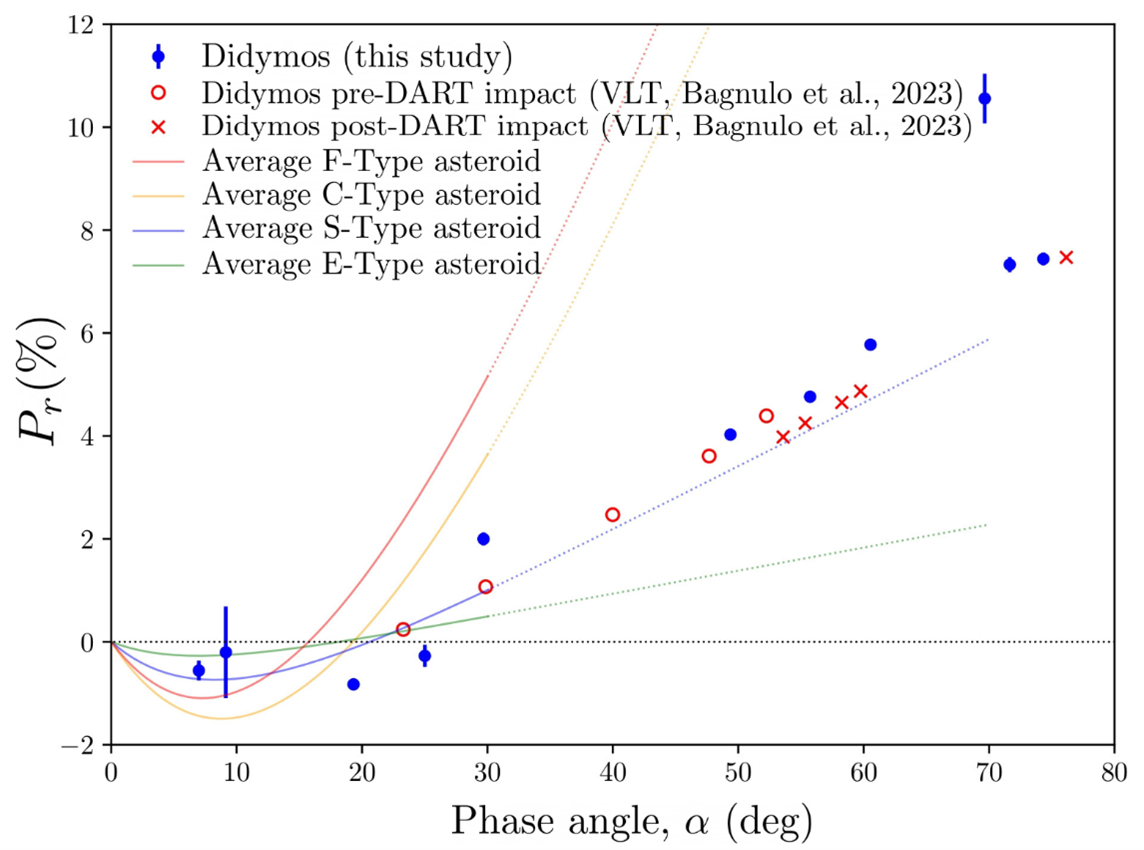
Figure 1: Coloured curves show the typical polarisation behaviour of four asteroid spectral classes commonly found among PHAs. The curves are digitised reproductions of averaged data for asteroids of low (C, F), moderate (S), and high (E) geometric albedos [2]. The dotted extensions to the curves are extrapolations beyond the low-phase angle domain in which they were observed and modelled (α ≤ 30° ); it is likely that the linear behaviour shown breaks down into a maximum at high phase angles. Blue symbols represent Didymos data taken with the LT+MOPTOP in the R band. Red symbols indicate reproduced VLT data [3], also in the R band. Empty circles show data taken prior to the impact of the NASA Double Asteroid Redirection Test spacecraft on Dimorphos, the binary partner of Didymos; crosses refer to data taken after the collision. Errorbars on these points would be of similar or smaller size to the symbols, therefore were not shown. Through visual inspection, we polarimetrically classified Didymos as an S-type asteroid .
The Liverpool Telescope and MOPTOP are shown to be ideally situated to expand the literature dataset of PHA polarimetry. The sample of objects observed in this study makes a significant contribution to the existing sample of PHAs studied with high-phase angle polarimetry. Our observation of asteroid 2023 BU was notable in several regards: it made one of the closest recorded approaches ever of an asteroid to Earth without impact (0.03 Lunar Distances), and we believe it to be one of the smallest asteroids ever to be measured with polarimetry. The variation of polarisation with wavelength was also tested via a multi-filter approach on 2015 RN35, and results suggested that the NEA may have an unusually high porosity.
References: [1] Tholen, D. J., 1984, PhD thesis, University of Arizona. [2] Belskaya, I. N. et al., 2017, Icarus, 283:30-42. [3] Bagnulo, S. et al., 2023, The Astrophysical Journal Letters, 945(2):L38.
How to cite: Wilson, R. and Wiersema, K.: Polarimetric Classification of Potentially Hazardous Asteroids with 2-m Liverpool Telescope, EPSC-DPS Joint Meeting 2025, Helsinki, Finland, 7–12 Sep 2025, EPSC-DPS2025-2083, https://doi.org/10.5194/epsc-dps2025-2083, 2025.


