

- Department of Geology, University of Maryland, College Park, Maryland, USA
Hundreds of sinuous rilles can be found across the maria of the Moon [1]. Nearly all of them were likely formed by lava flows at or near the surface and their morphometry has been used to model constraints on lava viscosity, flow rates, and flow duration [2–5]. Other common landforms on the maria are wrinkle ridges, shortening structures with distinct back-faults formed in the layered mare basalts by compressive stresses [6–9]. Although wrinkle ridges were thought to have formed not too long after maria emplacement during the Imbrian and Eratosthenian [10,11], more recent lines of observations suggest that wrinkle ridge formation might persist into the Copernican era [12–16]. This opens questions about potential hazards into the present day caused by seismic activity [17] which a better understanding of the tectonic evolution of wrinkle ridges could help to constrain. As the intersections of wrinkle ridges and rilles reveal complex stratigraphic relationships that can improve this understanding through the timing of tectonic and volcanic activities, we present a preliminary analysis.
General observations: After a preliminary global survey using wide and near-angle images by the Lunar Reconnaissance Orbiter Camera (LROC) as well as the SLDEM2015 [18,19], we found 64 intersections between rilles and wrinkle ridges (Fig. 1A): 34 in northern and central Oceanus Procellarum, 15 in southern Oceanus Procellarum, 12 in Mare Imbrium, and 3 in Mare Tranquilitatis. Intersections occur on almost the complete range of mare units including both high and low Titanium spectral domains with model ages ranging from 1.3 Ga to 3.7 Ga [19]. While there are two densely spaced clusters north of the Marius Hills volcanic complex and along the southern edge of Oceanus Procellarum, intersections tend to occur where the spatial densities of wrinkle ridges and rilles are the highest [1,11], thus not indicating any statistical anomaly.
Stratigraphy & Conclusions: In 34 cases, a wrinkle ridge clearly uplifted the intersecting rille (Fig.1D), including 3 unambiguous cases of rilles that cut through some scarps of a wrinkle ridge, but another compound scarp uplifted the rille floor. One example is Rima Mairan, which cuts through most of a wrinkle ridge just west of crater Gruithuisen R (Fig.1C). However, close inspection reveals that one compound scarp of the ridge complex uplifts the rille floor, albeit by only ~25 m (Fig.1C, white arrow) while the outside scarp relief is ~50 m. This implies syn-tectonic rille formation, i.e., Rima Mairan, for which model ages of ~1.4 Ga have been derived [20], formed after most of the wrinkle ridge had been uplifted but while one of its compound scarps was still active, potentially with ~25 m of relief forming before and another 25 m of relief after rille formation and therefore within the last ~1.4 Ga.
In 27 cases, a rille unambiguously cuts a wrinkle ridge. This includes 16 cases, where the rille’s path is not deflected by the broader rise (i.e., shallow back-arc) that the wrinkle ridge is located on and does not significantly and/or consistently deepen during its traverse across it (Fig.1E). Although pressurized lava tubes can ascend some obstacles, surface or near-surface lava flows should follow the longer-wavelength topographic gradient as the vast majority of lava tubes and lava channels on Earth, Mars, and the Moon do [1,21,22]. Therefore, this implies that the broader rise formed after the wrinkle ridge and after the rille.
Rilles #40 (~1 km wide) and #43 (~0.5 km wide) as catalogued by [1] at the western margin of the Marius Hills volcanic complex (Fig. 1B) intersect with the same wrinkle ridge, which the former cuts but the latter is uplifted by (Fig. 1B, white arrow). This implies either A) significant effusive activity on the volcanic complex both before and after a large wrinkle ridge was forming, thus potentially indicating crustal shortening occurred alongside voluminous volcanism or B) a localized re-activation of the wrinkle ridge that uplifted rille #40 but not #43, which would indicate uneven wrinkle ridge formation over extended timeframes.
Outlook: While crater size-frequency-based model ages (AMAs) have been presented for select rilles (e.g., Rimae Sharp and Mairan [20]), we are going to derive more AMAs for rilles that provide suitable count areas, i.e., with relatively flat, at least ~0.5 km wide floors (e.g., rilles #40 & #43). This will enable us to bracket wrinkle ridge formation timing and estimate relief growth rates.
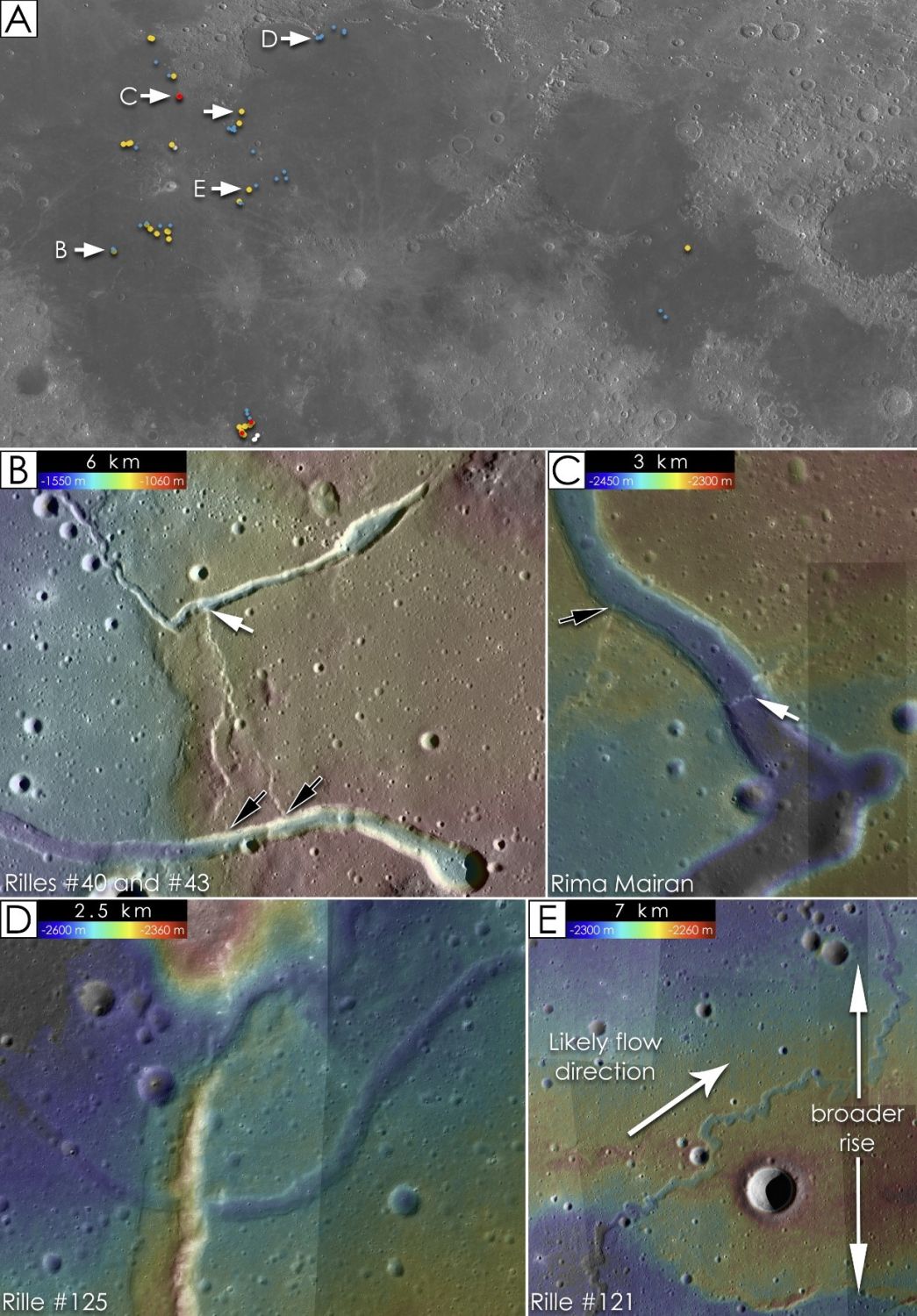
Figure 1: A) Map of part of the lunar nearside showing all catalogued intersections of lunar rilles and wrinkle ridges. Red dots are clearly syn-tectonic rilles, yellow dots are rilles clearly cutting a wrinkle ridge, blue dots are wrinkle ridges clearly uplifting a rille floor, and white dots are ambiguous cases. B) Rilles #40 (bottom) and #43 (top) as numbered by [1]. The white arrow marks where a wrinkle ridge compound scarp uplifted the floor of rille #43, while rille #40 completely cuts the same wrinkle ridge (black arrows). C) Rima Mairan cuts most of a wrinkle ridge (black arrow), but its floor is slightly uplifted by one of its compound scarps (white arrow). D) Rille #125 as numbered by [1] being uplifted by a narrow wrinkle ridge. E) Rille #121 as numbered by [1]. It cuts a wrinkle ridge, but the path of the rille is not visibly affected by the broader rise around the ridge.
References: [1] Hurwitz et al., Planet.Space Sci. 79–80 (2013) [2] Wilson, Head, Planet.Sci. J. 4 (2023). [3] Cataldo et al., (2019). [4] Carr, Icarus (1974). [5] Sehlke, Whittington (2015). [6] Plescia, Golombek, Geol.Soc.Am.Bull. (1986). [7] Schultz, J.Geophys.Res. (2000). [8] Golombek et al., J.Geophys.Res. (2001). [9] Karagoz et al., EarthPlanet.Sci.Lett. (2022). [10] Watters, J.Geophys.Res.SolidEarth 93 (1988) 10236–10254. [11] Yue et al., EarthPlanet.Sci.Lett. 477 (2017). [12] Nypaver et al., Planet.Sci.J. (2025) [13] Nypaver et al., LunarPlanet.Sci.Conf., 2025, 1450. [14] Nypaver et al.,Planet.Sci.J. (2024). [15] Clark et al., LunarPlanet.Sci.Conf., 2024. [16] Frueh et al., J.Geophys.Res.Planets (2023). [17] Watters et al., Planet.Sci.J. (2024). [18] Barker et al., Planet.SpaceSci. (2020). [19] Robinson et al., SpaceSci.Rev. 150 (2010). [20] Xu, Qiao, Astron.Astrophys. 657 (2022). [21] Sauro et al., Earth-Sci.Rev.(2020). [22] Kempe, in: Encycl.Caves., AcademicPress, 2019.
How to cite: Bernhardt, H. and Clark, J. D.: Long-Term Tectonic Activity On The Moon: Multiple Episodes Of Uplift Along Lunar Wrinkle Ridges Implied By Intersections With Sinuous Rilles, EPSC-DPS Joint Meeting 2025, Helsinki, Finland, 7–12 Sep 2025, EPSC-DPS2025-2110, https://doi.org/10.5194/epsc-dps2025-2110, 2025.


