
 1,1,2,1
- 1Department of Physics and Astronomy, Western University, London, ON, Canada
- 2Institute for Earth and Space Exploration, Western University, London, ON, Canada
The size distribution of small Transneptunian objects (TNOs) approximately follows a power law n(D)∝D-q with logarithmic slope q that can adopt several values at different diameter ranges. The value of q for small TNOs is largely unconstrained due to the difficulty of imaging them directly. Observing serendipitous stellar occultations (SSOs) of stars by TNOs is currently the most promising method for measuring the size distribution of smaller kilometre-sized TNOs. Because of the rarity of SSO events occurring, millions of star-hours worth of observations are required to produce enough detections to form reasonable constraints on the values of q. Dedicated SSO surveys are therefore the ideal method for measuring the small size distribution.
Western University’s Colibri Telescope Array [1] is a fast photometry wide-field observatory dedicated to detecting small kilometre-sized TNOs via SSOs. Colibri consists of three identical 0.5-meter prime-focus telescopes produced by Hercules Telescopes (Montréal, Canada), each equipped with a Kepler KL4040 sCMOS camera from Finger Lakes Instruments capable of acquiring 2×2 pixel-binned images at rates of up to 40 frames per second. This rate is matched to the Nyquist rate for observing the anticipated Fresnel diffraction pattern produced by kilometre-sized SSOs at opposition [2]. The system provides a field of view of 1.43◦×1.43◦ at 2.52′′ per binned pixel. The three telescopes monitor the same stellar fields for SSOs simultaneously, so that candidate events can be separated from false positives by coincidence checking. The Colibri Telescope Array is located at Elginfield Observatory (43◦11′33′′ N, 81◦18′57′′ W), north of London, Ontario, Canada. The observatory is operating semi-regularly with full robotic operations under development. Images of the facility and one of the telescopes are shown in Figures 1 and 2, respectively.
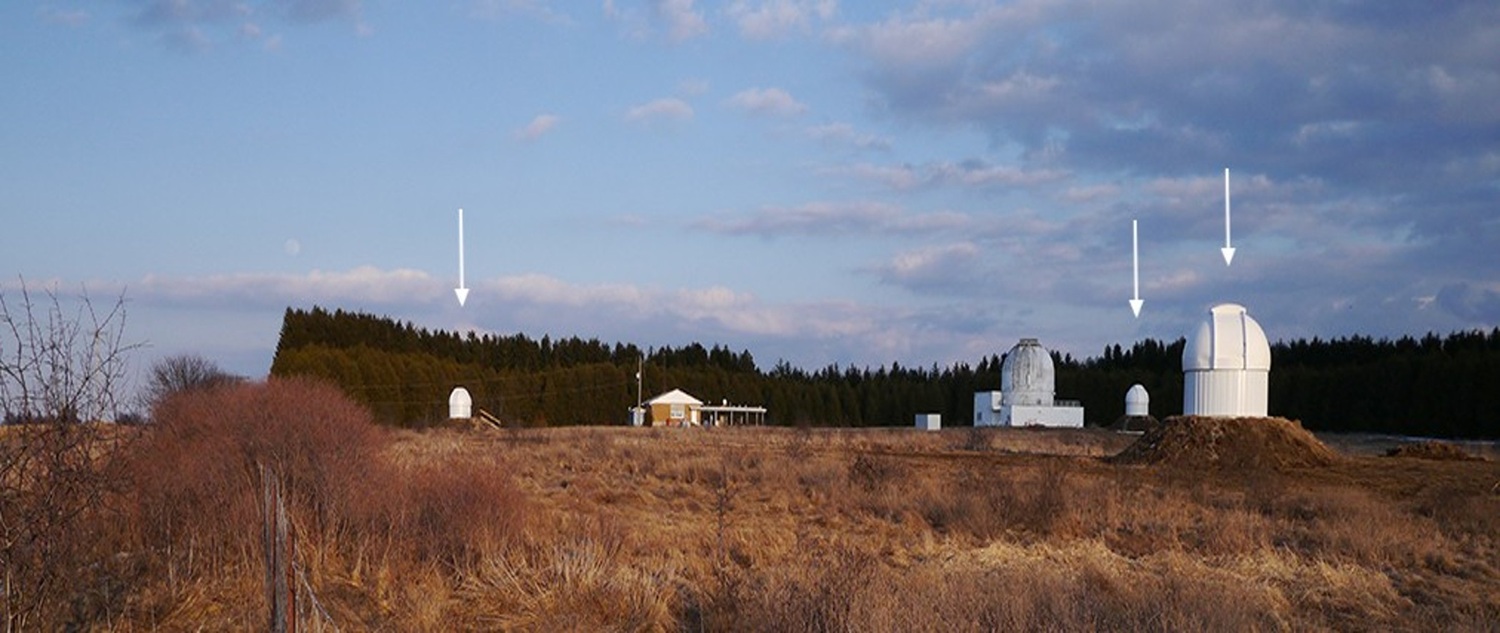
Figure 1: Elginfield Observatory. The arrows indicate the three domes of the Colibri Telescope Array. The no-arrow dome is for the no longer used 1.2 m Ritchey–Chrétien telescope. The observatory is 25 km north of London, Ontario, Canada.
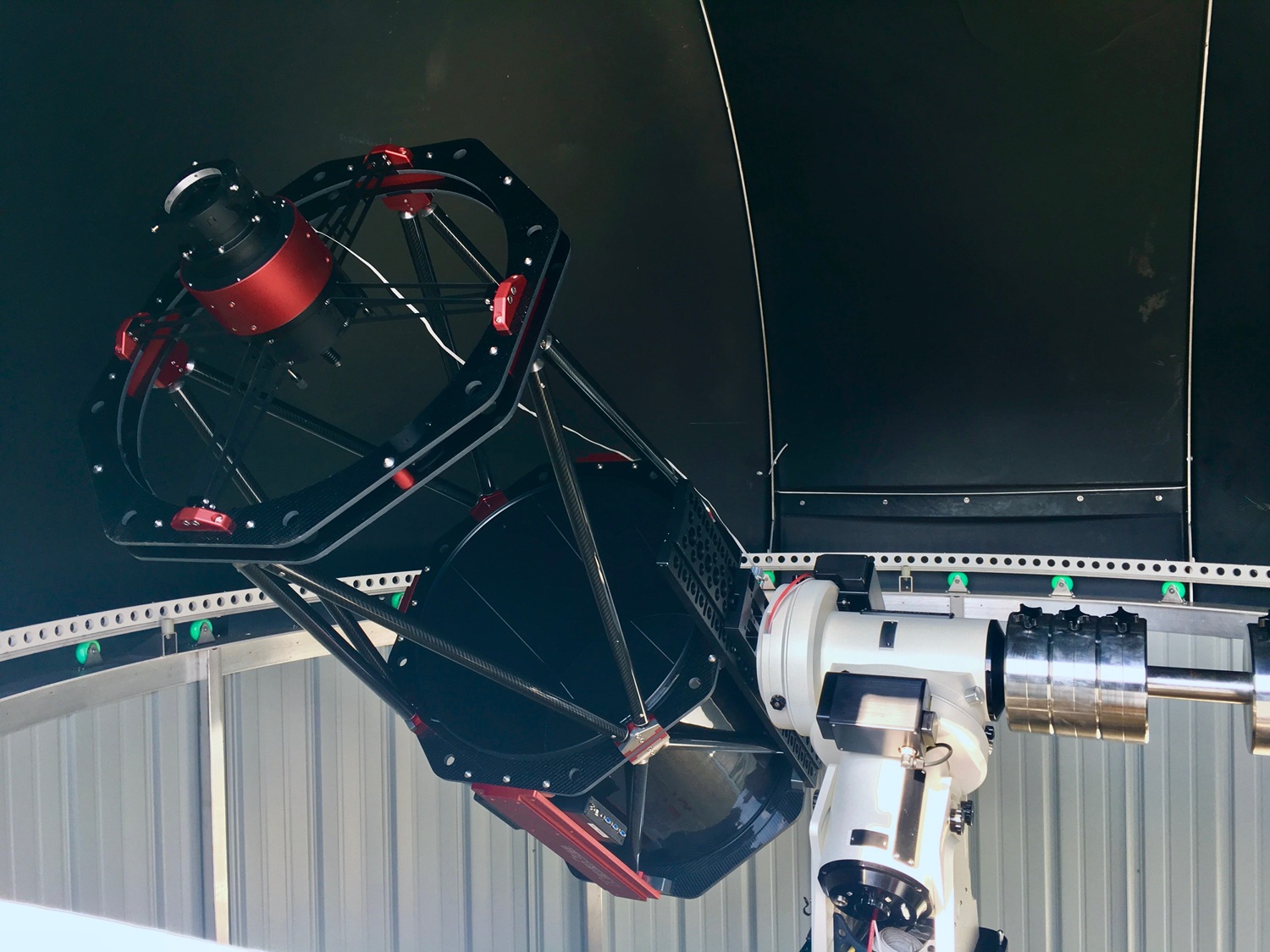
Figure 2: One of the three Colibri telescopes: a Hercules 50 cm f/3 telescope with a Wynne corrector in prime focus, set on an Astro-Physics AP1600 GTO mount.
We present a trade study of imaging frequency vs. sensitivity to SSOs tailored to the Colibri Telescope Array. Observing at imaging rates below the Nyquist rate will increase the photometric sensitivity of the system at the cost of decreased temporal resolution. This has the effect of potentially under-sampling individual occultation events, while increasing the likelihood of detecting an occultation within the FOV because of increased sensitivity to fainter stars. To explore the optimal compromise between temporal resolution and photometric sensitivity, we have conducted comprehensive simulations of Colibri's observing program while operating at imaging cadences between 5 Hz and 40 Hz.
The simulations realistically model important aspects of the observing program. Data-driven models of atmospheric extinction, the instrument's sensitivity, and weather losses at Elginfield are incorporated. We perform dynamic scheduling of target fields chosen from a pre-selected set of high stellar density fields that span the sky in RA to facilitate year-round observing. Our scheduling algorithm chooses the optimal field to observe at a given time based on predictions of the SSO detection rate of each field. Each simulation run consists of 10 years' worth of Colibri observations.
Simulations were performed assuming an unbroken power law for the size distribution of TNOs that corresponds to upper limits from the TAOS I survey [3], sampling objects with 1 km < D < 90 km. The results are shown in Figure 3. The change in the total number of detections with imaging cadence shows complex behaviour without any clear trends. Concrete explanations for this behaviour are currently being investigated. We find that rapid imaging rates (≥ 30 Hz) seem to be required to optimize the number of small (D < 2 km) detections. Sensitivity to D < 2 km objects appears to decrease with decreasing imaging rate, as may be expected from sub-Nyquist sampling of the Fresnel diffraction pattern. Slower rates (e.g., 10 Hz) may be optimal for maximizing the total number of detections at the expense of sensitivity to small objects.
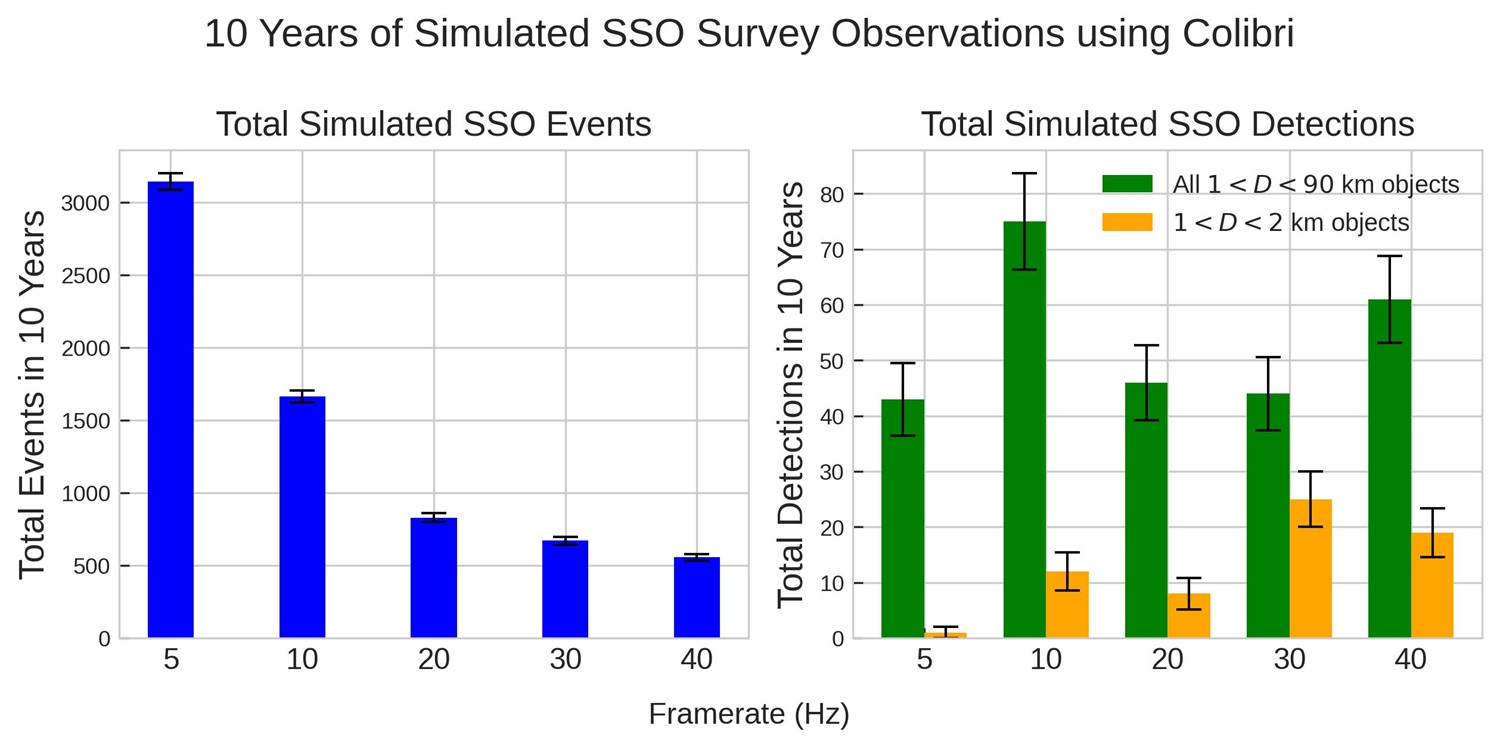
Figure 3: Results from 10 years of simulations of Colibri observations by framerate. Error bars correspond to √(NTotal). (Left) The total number of simulated SSO events that occur within Colibri’s FOV during observation. The total number of occultations increases with decreasing imaging cadence as sensitivity to fainter stars increases. (Right) The total number of simulated SSOs detected by framerate. The total number of detections is highest at 10 Hz, possibly suggesting that imaging at rates moderately below the Nyquist rate may be an optimal compromise between sensitivity and temporal resolution for maximizing the overall number of detections. Imaging cadences < 30 Hz show decreased sensitivity to small (D < 2 km) objects. Rapid imaging is required to maintain sensitivity to small TNOs at the possible expense of the total number of detections.
Our results suggest that Colibri can detect a significant number of kilometre-sized TNOs when fully operational, and that SSO surveys in general will be able to further constrain the values of q for small TNOs.
References:
[1] Michael J. Mazur, Stanimir Metchev, Rachel A. Brown, Ridhee Gupta, Richard Bloch, Tristan Mills, and Emily Pass. The colibri telescope array for kbo detection through serendipitous stellar occultations: A technical description. Frontiers in Astronomy and Space Sciences, 9, 2022.
[2] S. J. Bickerton, D. L. Welch, and J. J. Kavelaars. Kuiper Belt Object Occultations: Expected Rates, False Positives, and Survey Design. , 137(5):4270–4281, May 2009.
[3] Z. W. Zhang, M. J. Lehner, J. H. Wang, C. Y. Wen, S. Y. Wang, S. K. King, ´A. P. Granados, C. Alcock, T. Axelrod, F. B. Bianco, Y. I. Byun, W. P. Chen, N. K. Coehlo, K. H. Cook, I. de Pater, D. W. Kim, T. Lee, J. J. Lissauer, S. L. Marshall, P. Protopapas, J. A. Rice, and M. E. Schwamb. The TAOS Project: Results from Seven Years of Survey Data. , 146(1):14, July 2013.
How to cite: Girmenia, A., Metchev, S., Almeida, T., Martz, C., and Mazur, M.: The Colibri Telescope Array for TNO Detection through Serendipitous Stellar Occultations: Simulation of Scientific Performance, EPSC-DPS Joint Meeting 2025, Helsinki, Finland, 7–12 Sep 2025, EPSC-DPS2025-227, https://doi.org/10.5194/epsc-dps2025-227, 2025.


