
 1,1
1,1- 1Trieste Astronomical Observatory, INAF, Trieste, Italy
- 2Palermo Astronomical Observatory, INAF, Palermo, Italy
Introduction: Space Weather (SWE) has a profound impact on Earth’s atmospheric chemistry and climate. Compared to the present-day Sun, the young Sun was more magnetically active and experienced more frequent extreme space weather events (e.g., [1,2,3,4,5]), such as coronal mass ejections (CMEs) and solar energetic particles (SEPs), which steadily bombarded Earth’s upper atmosphere. These particles enhanced atmospheric chemistry, potentially resulting in large amounts of kinetically produced greenhouse gases, such as CO, H2, N2O, and HCN [6,7,8,9,10,11]. In this work, we used a chain of three models – (i) a thermochemical and photochemical kinetic model [12,13], (ii) a radiative-convective model (EOS) [14], and (iii) an energy balance model (ESTM) [15,16] – to explore the impact of an extreme SWE event on Earth’s atmosphere, in terms of variation of atmospheric species and the consequences on Earth’s climate. Specifically, we tested whether the Sun-Earth interaction could address the Faint Young Sun Paradox (FYSP), as proposed by [3].
Method: To conduct this analysis, the first step involves using a one-dimensional thermochemical and photochemical kinetics model to simulate the interaction between atmospheric gases and ionizing stellar radiation. This model utilizes the energy spectrum of proton fluences for the Carrington event [3] and the XUV flux of the young Sun [3] to calculate ionization, excitation, and dissociation rates. By integrating stellar particle interactions, the model yields detailed vertical chemical profiles of atmospheric components. These vertical profiles are then used as inputs to our radiative-convective model, which calculates the outgoing longwave radiation (OLR) and the top-of-atmosphere (TOA) albedo for a set of atmospheric columns with different surface pressures and chemical compositions. The radiative lookup tables compiled by EOS are included in our energy balance model to derive the seasonal evolution of surface temperature in each latitudinal band. We also applied this modeling pipeline to the present-day Earth atmosphere to assess the potential impact of a prolonged period of intense solar activity.
Results: First, we found that for each atmosphere considered, due to the dissociation of N2 by SEPs, N(2D) is produced, giving rise to a rich chemistry that results in the production of greenhouse gases such as N2O and HCN (Figure 1). H2 is also produced. Additionally, another greenhouse gas, CO, is thermochemically produced. Finally, we observed that in the case of secondary atmospheres, the chemical abundances of the species are dominated by SEP-driven chemistry, while high-energy radiation plays a marginal role. Second, for an Archean Earth-like atmosphere of 90% N2, 10% CO₂, and trace amounts of either CH4 or H2, the two most abundant species produced are CO (71 ppm) and H₂ (0.03 ppm). In this condition, the surface temperature increase is no larger than 0.3 K, which makes this solution to the FYSP unviable. Notably, the contribution of nitrogen species (N2O and HCN) to this temperature increase is negligible. Third, revisiting the atmospheric scenario proposed by [3], we found a modest temperature increase (∼0.2 K). Even when the SEP flux is enhanced by a factor of 10 with respect to Carrington-like conditions, the chemical composition of the atmosphere remains unchanged. This indicates that even under stronger space weather conditions, the impact on the planetary thermal state is minimal. Lastly, under present-day conditions, the cumulative effects of a prolonged period of intense solar activity, in terms of frequent Carrington-like SEP events, would decrease the surface temperature by ∼4 K (Figure 2).
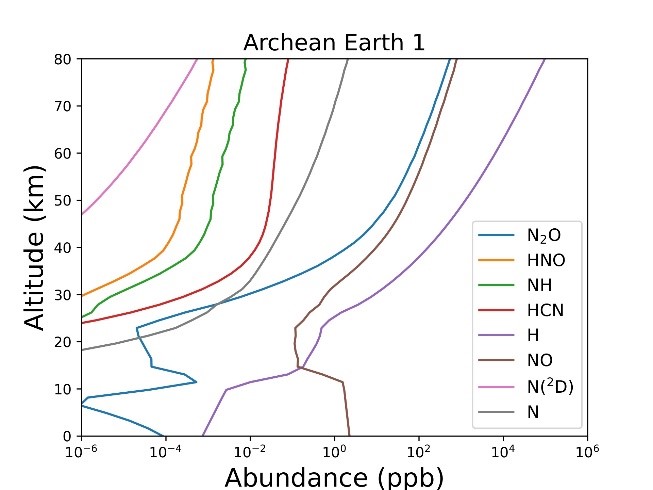
Figure 1. Chemical profiles of some key molecules for one of the scenarios studied in this work, corresponding to an initial Archean Earth-like atmosphere of 90% N2, 10% CO2 and trace amounts of CH4. Credits: [17].


Figure 2. Seasonal and latitudinal variations of surface temperature. Top panel: unprocessed atmosphere. Bottom panel: processed atmosphere. Black contour lines highlight the regions of the parameter space for which pure liquid water can be liquid. Credits: [17].
References:
[1] Shibayama T. et al. (2013) ApJS, 209, 5.
[2] Airapetian V., Glocer A., Gronoff G. (2015) Proceedings of the International Astronomical Union, 11, 409.
[3] Airapetian V. S., Glocer A., Gronoff G., Hébrard E., Danchi W. (2016) Nature Geoscience, 9, 452.
[4] Airapetian V. (2016) Proceedings of the International Astronomical Union, 12, 315.
[5] Airapetian V. S. et al. (2020) International Journal of Astrobiology, 19, 136.
[6] Solomon S., Roble R. G., Crutzen P. J. (1982) J. Geophys. Res., 87, 7206.
[7] Solomon S., Reid G. C., Rusch D. W., Thomas R. J. (1983) Geophys. Res. Lett., 10, 257.
[8] Jackman C. H., McPeters R. D. (2004) in Solar Variability and its Effects on Climate. Geophysical Monograph, 141, 305
[9] Jackman C. H. et al. (2001), Geophys. Res. Lett., 28, 2883
[10] Jackman C. H. et al. (2005) Journal of Geophysical Research (Space Physics), 110, A09S27
[11] von Clarmann T. et al. (2013) Geophys. Res. Lett., 40, 2339.
[12] Locci D. et al. (2022) Planetary Science Journal, 3, 1.
[13] Locci D. et al. (2024) Planetary Science Journal, 5, 58.
[14] Simonetti P. et al. (2022) ApJ, 925, 105.
[15] Vladilo G. et al. (2015) ApJ, 804, 50.
[16] Biasiotti L. et al. (2022) MNRAS, 514, 5105–5125.
[17] Biasiotti L. et al. (2025) MNRAS (under review).
How to cite: Biasiotti, L., Simonetti, P., Locci, D., Cecchi-Pestellini, C., Vladilo, G., Calderone, L., Dogo, F., Monai, S., and Ivanovski, S.: The impact of extreme space weather events on Earth's atmosphere, EPSC-DPS Joint Meeting 2025, Helsinki, Finland, 7–12 Sep 2025, EPSC-DPS2025-263, https://doi.org/10.5194/epsc-dps2025-263, 2025.


