
 1,2,3,1,2,1,2,6,1,2,3
- 1Konkoly Observatory, HUN-REN Research Centre for Astronomy and Earth Sciences, Konkoly Thege 15-17, H-1121 Budapest, Hungary
- 2CSFK, MTA Centre of Excellence, Budapest, Konkoly Thege 15-17, H-1121, Hungary
- 3ELTE Eötvös Loránd University, Institute of Physics and Astronomy, Budapest, Hungary
- 4ELTE Eötvös Loránd University, Gothard Astrophysical Observatory, Szent Imre h. u. 112, 9700, Szombathely, Hungary
- 5MTA-ELTE Exoplanet Research Group, Szent Imre h. u. 112, 9700, Szombathely, Hungary
- 6Department of Astrophysical Sciences, Princeton University, 4 Ivy Lane, Princeton, NJ 08544, USA
The rotational characteristics of small bodies in the Solar System serve as critical constraints on their internal structure, composition, and collisional evolution[1,2]. The break-up rotation rate of asteroids defines an upper bound on their bulk density or necessary cohesion if they are to remain gravitationally bound. While most medium-sized Hilda and Jovian Trojan asteroids exhibit relatively slow rotation, recent observations with the Transiting Exoplanet Survey Satellite (TESS) reveal a handful of exceptions that stretch the boundaries.
We present the discovery and analysis of the three fastest-spinning Hilda asteroids and the three fastest-spinning Jovian Trojans identified. These findings provide new constraints on the bulk densities and required cohesion for structural integrity in these populations.
Our analysis is based on TESS photometric light curves processed using refined techniques for asteroid photometry, including adaptive aperture photometry and correction for systematics and background contamination[3]. For all targets, rotation periods were confirmed using Lomb-Scargle periodograms and Fourier series fits, with additional validation from Zwicky Transient Facility (ZTF) data when available. Physical parameters were derived assuming triaxial ellipsoid shapes, with estimates of cohesion based on the Drucker–Prager failure criterion.
Among Hildas, we identified three asteroids — (42237), (91273), and (237321) — with rotation periods in the 3.2–3.7 hour range, well below the previously established ~5-hour threshold for this population. Two additional fast rotators from the K2 mission were reanalysed using TESS data. These objects exhibit light curve amplitudes between 0.2 and 0.5 mag and diameters ranging from 7 to 19 km. The implied densities, assuming a strengthless structure, span 1.1–1.9 g/cm³. For the largest asteroid in the sample, cohesion of ~1–3 kPa is required for densities below 1.5 g/cm³.
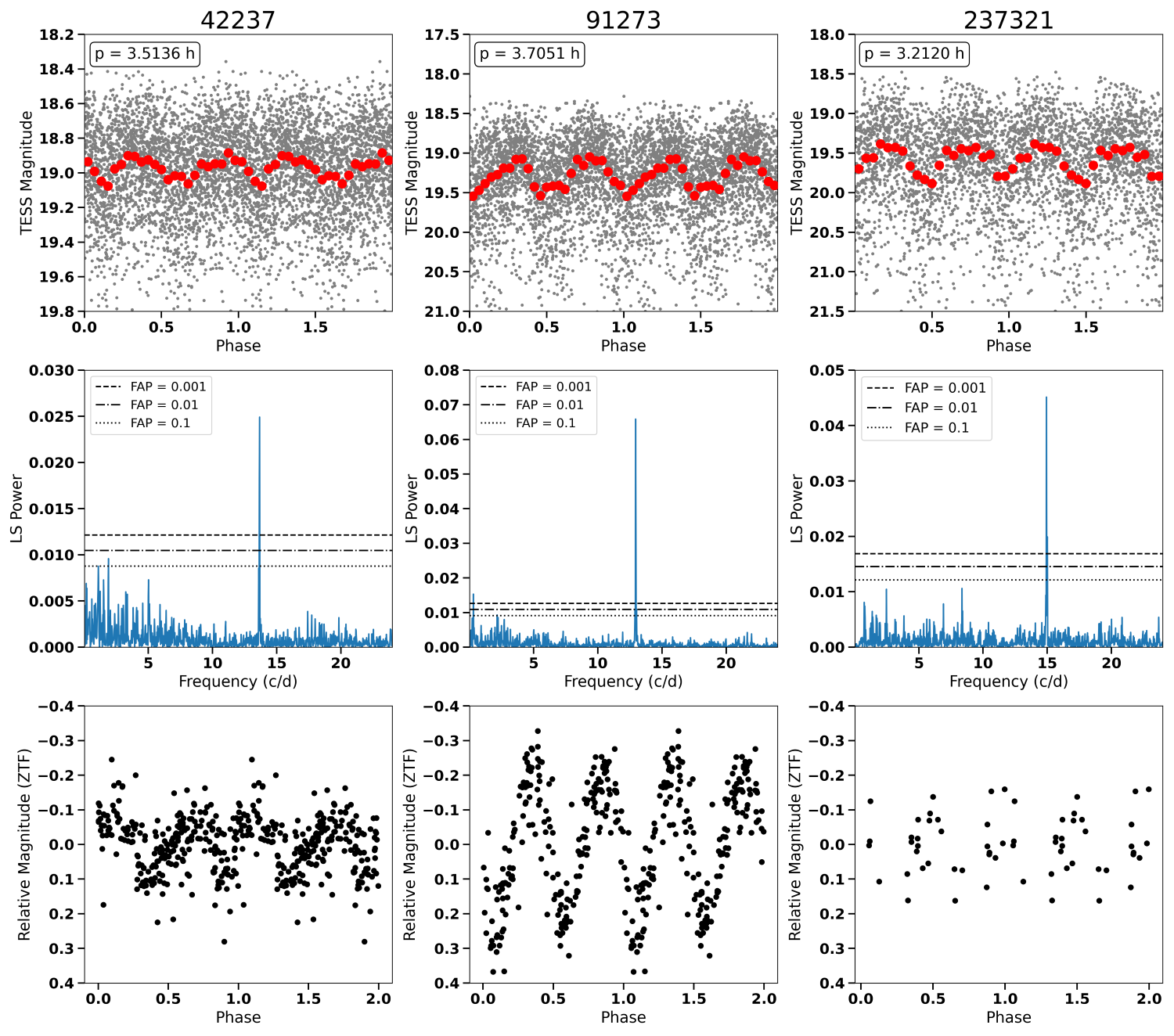
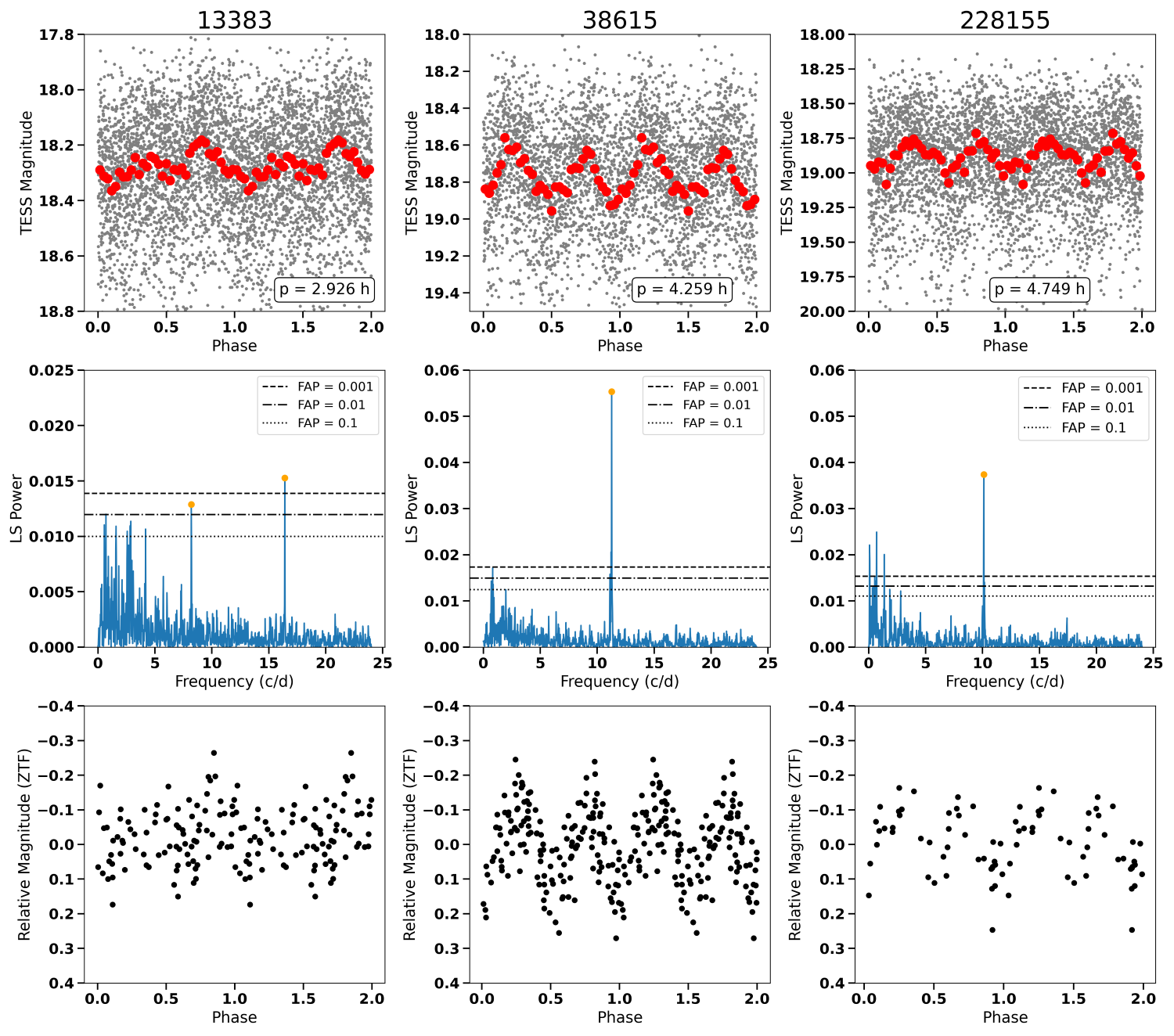
Figure 1. Folded TESS light curves and corresponding rotational frequency spectra for the three fast-rotating Hilda asteroids on the left three panels and the three fast-rotating Jovian Trojan asteroids on the right three panels. Top panels: phase-folded light curves using the derived rotation periods, with observations binned into 24, 26, and 22 bins for (42237), (91273), and (237321), respectively and with 36 phase bins in the case of (13383), (38615), and (228155). Middle panels: Lomb-Scargle power spectra with dashed lines indicating false alarm probability levels. Bottom panels: independent light curves from ZTF, folded with the same rotation periods for comparison.
For Jovian Trojans, we report fast rotation in three ~15–24 km bodies: (13383), (38615), and (228155), with periods of 2.926, 4.259, and 4.749 hours, respectively[4]. Notably, (13383) rotates significantly faster than the nominal ~5-hour breakup limit for Trojans, requiring a density of ~1.6 g/cm³ or cohesion exceeding several kPa. The other two Trojans imply lower critical densities (~0.7–0.8 g/cm³), consistent with the traditionally assumed porous, icy rubble-pile structures.
The obtained rotation periods and the derived densities are presented in Fig. 1, together with data from large databases, including Jovian Trojans and Hildas from the K2 mission, and the FOSSIL survey.
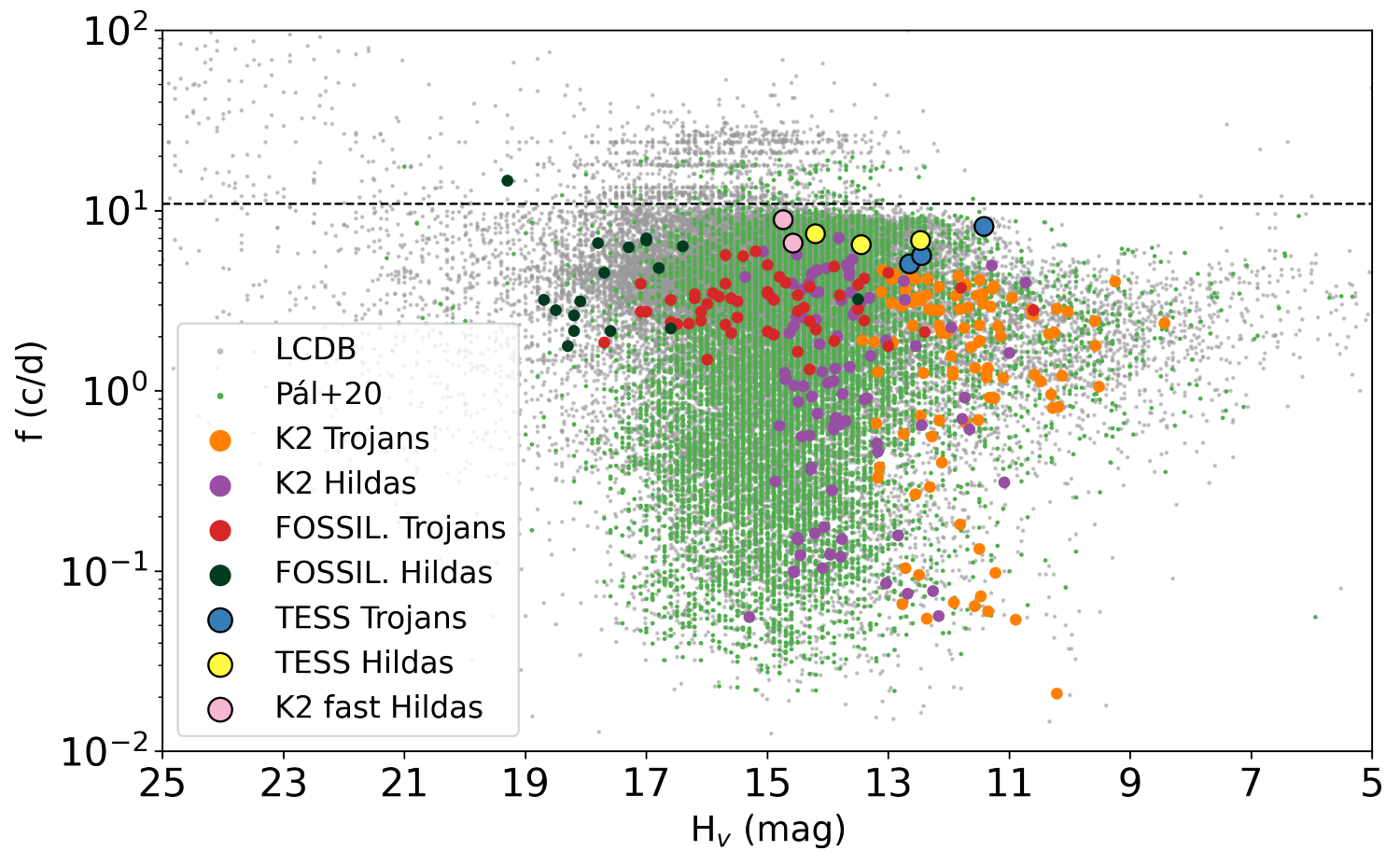
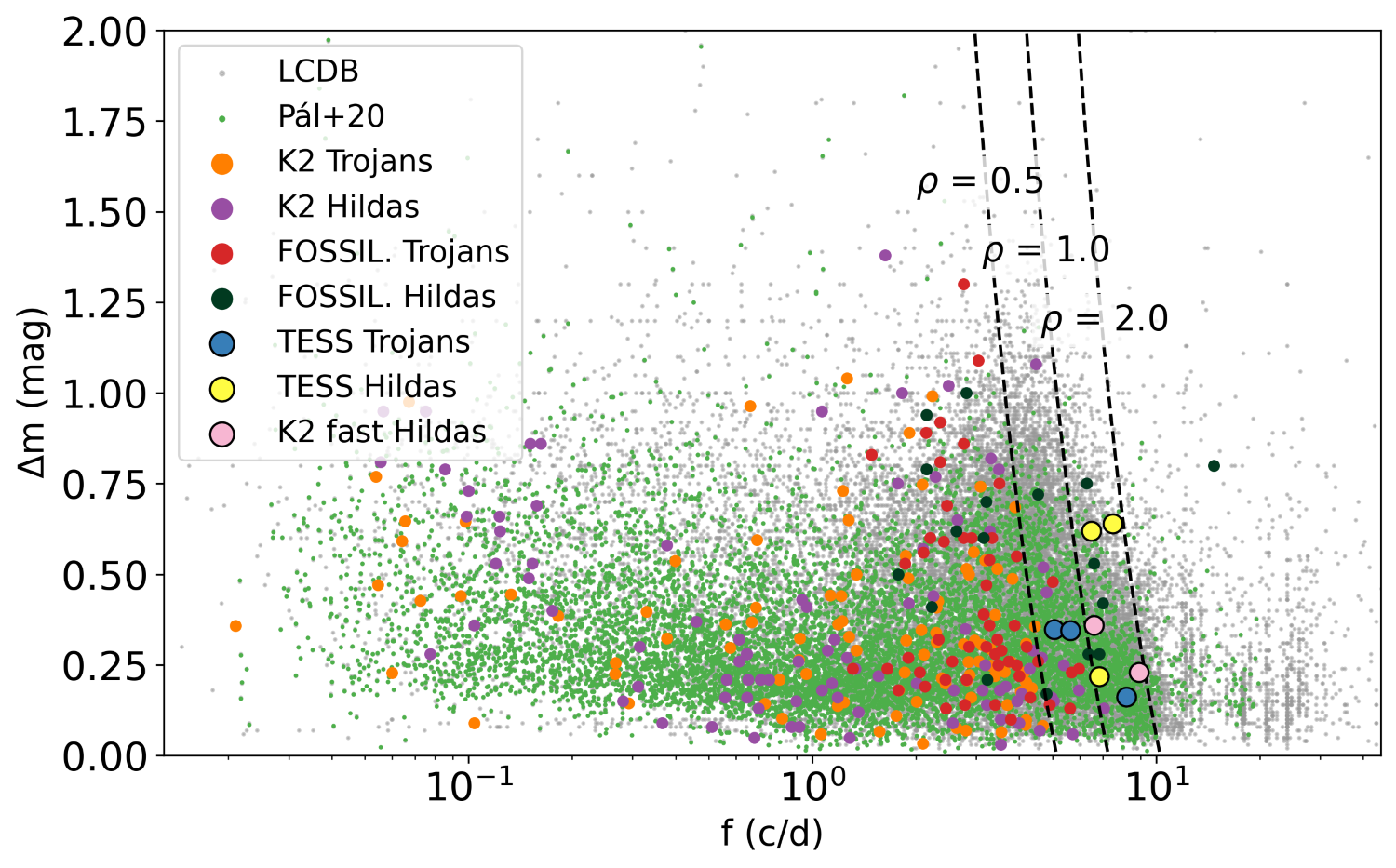
Figure 2. Rotational properties of inner Solar System asteroids. The top panel shows rotational frequency versus absolute magnitude, with the dashed horizontal line indicating the traditional rotational breakup limit corresponding to a 2.2 hours of period. The bottom panel plots light curve amplitude against rotational frequency, with dashed curves representing lines of constant critical density. Colored points denote asteroids from various observational surveys. The three Hilda asteroids are shown as large yellow symbols, the fast-spinning Jovian Trojans are highlighted in blue and pink symbols represent two previously known fast-rotating Hildas from the K2 mission.
The occurrence of fast rotators among Hildas (~1\%) is notably higher than among Jovian Trojans, possibly reflecting a higher fraction of denser C-type asteroids within the Hilda population. A two-component Maxwellian distribution model incorporating a fast-rotating C-type subpopulation among Hildas supports this interpretation. In contrast, most Jovian Trojans are D-types with lower densities and porosities that preclude such fast spins without significant internal strength.
The extreme spin rate of (13383), paired with its relatively high albedo (~0.11), may indicate a collisional spin-up event that exposed bright material at the surface. This, along with its elevated density requirement, challenges the notion that all Jovian Trojans are loosely bound, low-density remnants of the outer Solar System.
Our results expand the known rotational parameter space of both Hilda and Jovian Trojan asteroid populations. These fast-spinning objects provide rare insights into the material properties and evolutionary histories of small Solar System bodies beyond the main belt. Continued TESS monitoring and complementary surveys (e.g., ZTF, LSST) will be essential for building statistically meaningful samples of fast rotators in resonant populations.
References:
[1] Mottola, S., Britt, D. T., Brown, M. E., et al. 2024, Space Sci. Rev., 220, 17
[2] Vokrouhlický, D., Nesvorný, D., Brož, M., et al. 2025, arXiv e-prints, arXiv:2503.04403
[3] Takács N., Kiss C., Szakáts R., Pál A., 2025, PASP, 137, 044401
[4] Kiss, C., Takács, N., Kalup, C. E., et al. 2025, A\&A, 694, L17
How to cite: Takács, N., Kiss, C., Szakáts, R., Plachy, E., Kalup, C. E., Szabó, G. M., Molnár, L., Sárneczky, K., Szabó, R., Bódi, A., and Pál, A.: Probing Internal Structure Through Extremes: The Fastest Rotators Among Hilda and Jovian Trojan Asteroids, EPSC-DPS Joint Meeting 2025, Helsinki, Finland, 7–12 Sep 2025, EPSC-DPS2025-266, https://doi.org/10.5194/epsc-dps2025-266, 2025.


