
 1,2,1,3,1,4,1,2,1,1
- 1LIRA, Observatoire de Paris, Université PSL, CNRS, Sorbonne Université, Université Paris Cité, CY Cergy Paris Université, 5 place Jules Janssen, Meudon, 92195, France (antonin.wargnier@obspm.fr)
- 2LATMOS, CNRS, Université Versailles St-Quentin, Université Paris-Saclay, Sorbonne Université, 11 Bvd d’Alembert, Guyancourt, 78280, France
- 3Laboratoire d’Astrophysique de Marseille (LAM), France
- 4Institute of Space Science, German Aerospace Center (DLR), Rutherfordstrasse 2, 12489, Berlin, Germany
For more than 21 years, the Mars Express mission (MEx) has been orbiting the Martian system, acquiring data on Mars' surface and atmosphere, as well as on its two moons, Phobos and Deimos. The origin of the Martian moons remains a matter of debate. Deimos is the smallest of the two moons and orbits Mars at a much greater distance than Phobos. Previous photometric analyses [1] show that the surface of Deimos is smoother and more homogeneous than that of Phobos, but with overall similar photometric properties.
We analyzed images of Deimos taken with both the High Resolution Stereo Camera (HRSC) and the Super Resolution Channel (SRC) instruments. HRSC is a pushbroom camera with nine filters, including five panchromatic and four color filters (blue, green, red, and infrared), while the SRC is a framing camera with one panchromatic filter centered at 650 nm and covering from 400 to 900 nm [2,3]. The HRSC Deimos dataset is relatively limited with only 18 images available in each filter, acquired between January 2018 and January 2025, with a spatial resolution ranging from 390 m/px to 800 m/px. Conversely, the SRC dataset of Deimos contains more than 3500 images covering more than 20 years of observations, from October 2004 to December 2024. The spatial resolution varies from 85 m/px to 300 m/px, while the phase angle ranges from 0.06 to 120°. For the very first time, we have calibrated the absolute response of SRC using images of stars and Jupiter. We performed both disk-integrated and disk-resolved photometry. From the retrieved phase curve, we applied the Hapke IMSA [4] model to characterize the physical properties and the texture of the surface.

Figure 1: Disk-integrated phase curve of Deimos, compared with that of Phobos derived in [5] with the same HRSC filter.
The results obtained in the four HRSC color filters indicate that Deimos is photometrically similar to Phobos, while slightly brighter in the blue and green filters (Fig.1). Looking at the images, a bright region – corresponding to the streamers on the equatorial ridge – is evident (Fig. 2). Except for this feature, the surface of Deimos appears to be relatively homogeneous. In particular, the equatorial ridge, corresponding to higher geopotential height, is about 35% brighter (and up to 58%) than the average surface of Deimos. It is also notable that the craters (e.g., Voltaire (22°N; 3.5°E) and Swift (12.5°N; 358°E) craters) appear to exhibit no discernible increase in reflectance compared to the average surface. This contrasts with Phobos, where the crater rims are significantly brighter (up to 50%) than the average surface, at least in the area dominated by, or close to the blue unit. This suggests that the craters on Deimos are likely relatively old.
The derived Hapke parameters (considering a one-term Henyey-Greenstein function) have very similar values compared to those derived for Phobos in [5]: ω = 0.068 +/- 0.001, g = - 0.27 +/ 0.01, Bsh,0 = 2.14 +/- 0.14, hsh = 0.065 +/- 0.004, and θ = 19.4 +/- 0.1°. From these parameters we derived a porosity for the very first layer (typically few microns) of the surface of about 86%, indicating that the surface of Deimos is likely to be composed of complexly shaped grains and/or fractal aggregates. The parameters also suggest that Deimos has a strong opposition surge, which is mainly due to shadow hiding. We found that the coherent backscattering process is negligible on Deimos.
Based on the HRSC images, we have tentatively identified a blue unit on Deimos. This blue spectral behavior has already been noticed by [6]. Here we have shown that this blue unit is observed at least on the equatorial ridge (streamers). We found a decrease in the spectral slope of about 50% associated with this brighter region, compared to the average surface. The spectroscopic variations between the blue and red units on the two Martian moons are similar. This blue unit may be associated with changes in surface texture, such as grain size and porosity [7].
This work is the first extended study of the photometric properties of Deimos, in particular covering the opposition effect. The results are of significant interest for JAXA’s Martian Moon eXploration (MMX) mission [8], which will be launch in 2026 and return samples from Phobos to determine the origin of the Martian moons.
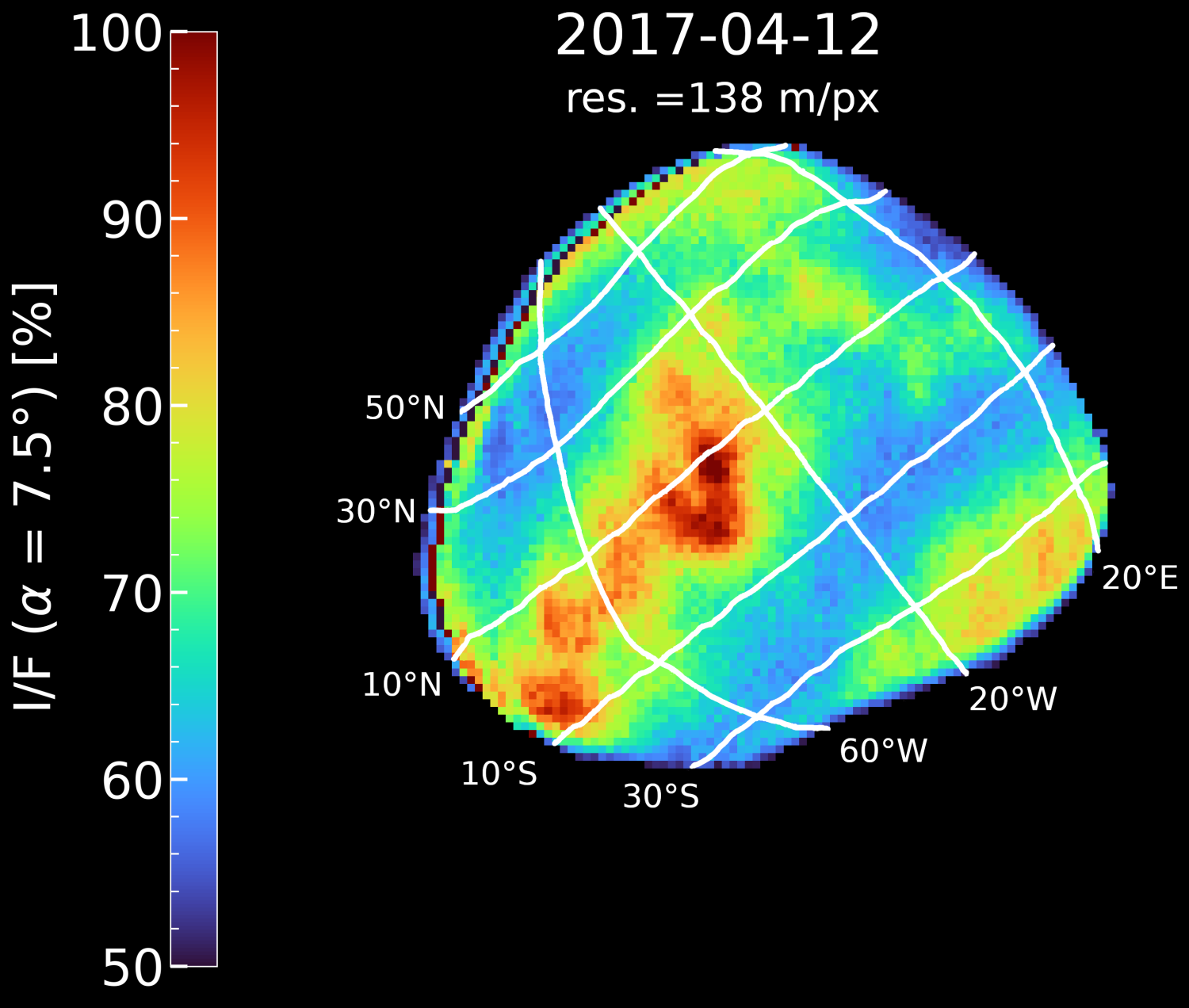
Figure 2: SRC Deimos image corrected by the Lommel-Seeliger disk-function.
Acknowledgements: The authors acknowledge the Centre National d’Etudes Spatiales (CNES) for the continuous support.
References: [1] Thomas et al. (1996),Icarus,123, 536-556 [2] Jaumann et al., PSS, 55, 928-952 [3] Oberst et al. PSS, 56, 473-491 [4] Hapke (2012), Cambridge University Press [5] Fornasier et al. (2024), A&A , 686, A203[6] Thomas et al. (2011), PSS, 59, 1281[7] Wargnier et al. (2025), accepted for publication in Icarus [8] Kuramoto et al. (2022), EPS, 74, 1, 12
How to cite: Wargnier, A., Fornasier, S., Simon, P., El-Bez--Sébastien, N., Tirsch, D., Matz, K.-D., Gautier, T., Doressoundiram, A., and Barucci, A.: Deimos photometric properties from Mars Express HRSC/SRC observations, EPSC-DPS Joint Meeting 2025, Helsinki, Finland, 7–13 Sep 2025, EPSC-DPS2025-276, https://doi.org/10.5194/epsc-dps2025-276, 2025.


