
 1,
1,- 1Grupo de Dinâmica Orbital e Planetologia, UNESP, Guaratinguetá (SP), Brasil (rai.machado@unesp.br)
- 2LIRA, Observatoire de Paris, Université PSL, CNRS, Sorbonne Université, France, Paris
- 3Faculdade de Engenharia e Ciências - Unesp - Guaratinguetá
The New Horizons probe approached (486958) Arrokoth in January 2019, producing remarkable information about a trans-Neptunian object. The first images revealed a "snowman" shape with notable pits and craters on the surface, composed of a small lobe and a large lobe attached by a narrow neck. Thus, the elongated bilobate shape was classified as a contact binary (Fig. 1).
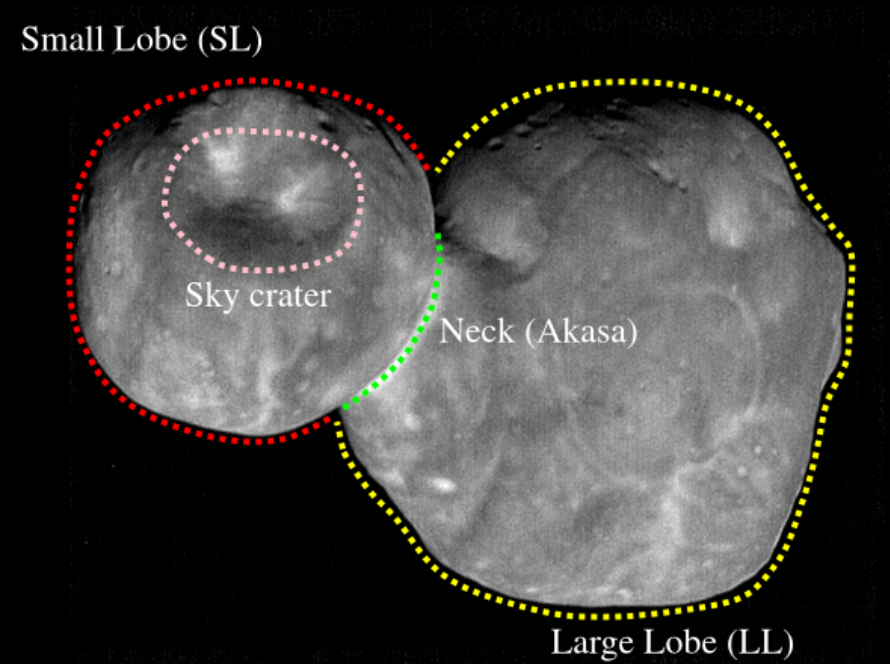
Fig. 1. (486958) Arrokoth surface. The red dashed line encompasses the Small Lobe (SL), and the yellow one, the Large Lobe (LL). The pink dashed line indicates the Sky crater on the SL. The green dashed line is noticed at the neck (also called Akasa). Adapted from: NASA/Johns Hopkins University Applied Physics Laboratory/Southwest Research Institute/ESA.
Several studies have been conducted to analyze Arrokoth’s near environment and surface characteristics. However, its internal structure remains an open question, with aspects yet to be explored. Meyer and Scheeres (2024) studied the cohesive strength of Arrokoth and other contact binaries, fitting two ellipsoids to represent the bodies. Kim et al. (2024) investigated the cohesive strength regime of Arrokoth under the assumption that the Sky crater-forming event occurred after the formation of its bilobate shape. Geomorphological analysis from the mission images revealed structural feature differences between the two lobes, indicating the possibility that each lobe has distinct physical properties. Thus, this study aims to analyze its internal structure by considering a range of density values in each lobe and a constant spin period, assuming that all pits and craters were formed before the contact-binary attachment. Keane et al. (2022), considering a possible density range of 155–600 g/cm3, determined an optimal homogeneous bulk density of 235 g/cm3 for Arrokoth. In this work, we use the Finite Element Method to investigate static stress propagation in an elastic-plastic body under self-gravitational and centrifugal forces. The self-gravitational forces at each lobe were computed considering the density range proposed by Keane et al. (2022) (Fig. 2).

Fig. 2. Schematic representation of the densities in Arrokoth’s lobes under the xy plane view. We split the two lobes simply considering a division in x = -3900, y = z = 0. When it was assumed heterogeneous bulk density d1 ≠ d2, whilst on the homogeneous bulk density d1 = d2.
Our analysis was performed using the irregular shape of the object, creating a mesh with 34,575 elements and 51,674 nodes. Hooke’s law behavior was assumed to compute the stress-strain relationship in the elastic state. In the plastic state, we employed the Drucker–Prager criterion. In both elastic and plastic states, we assume icy parameters (i.e., Young’s modulus, Poisson’s ratio, and friction angle) to represent the object’s material properties. From the analysis, the minimum cohesion required to maintain the object’s structural integrity was defined. The results showed a tendency for failure propagation around the neck of the object, caused in most cases by compressive stress. We also identified the lowest cohesion when each lobe had different density values. Finally, we generated a global cohesion map for each assumed density (Fig. 3) and identified potential failure regions on the Arrokoth shape structure.

Fig. 3. Arrokoth cohesion map. The x-axis represents the density of the small lobe, while the y-axis represents the density of the large lobe. The color bar indicates the minimum cohesion required for the object.
Acknowledgements
This study was financed by CAPES, International Cooperation Project number 3266, FAPESP - Proc. 2022/01678-0 and CNPq - Proc. 316991/2023-6.
References
KEANE, James T. et al. The geophysical environment of (486958) Arrokoth—A small Kuiper belt object explored by New Horizons. Journal of Geophysical Research: Planets, v. 127, n. 6, p. e2021JE007068, 2022.
KIM, Yaeji; HIRABAYASHI, Masatoshi; BAUER, James. Numerical Investigation of the Cohesive Strength Regime of the Bilobated Arrokoth after the Sky-crater-forming Impact Event. The Planetary Science Journal, v. 5, n. 11, p. 241, 2024.
MEYER, Alex J.; SCHEERES, Daniel J. The strength and shapes of contact binary objects. The Astrophysical Journal Letters, v. 963, n. 1, p. L14, 2024.
How to cite: Machado, R., Winter, O., Sfair, R., Amarante, A., and Azevedo, F.: On the cohesion of the TNO Arrokoth across different density ranges, EPSC-DPS Joint Meeting 2025, Helsinki, Finland, 7–12 Sep 2025, EPSC-DPS2025-312, https://doi.org/10.5194/epsc-dps2025-312, 2025.


