
 1,1,2,1,3,1,3,1,4,6,7,
- 1LTE Observatoire de Paris, Université PSL, CNRS, Sorbonne Université, Université de Lille, 75014 Paris, France
- 2Institut Polytechnique des Sciences Avancées IPSA, (94200) Ivry-Sur-Seine, France
- 3Laboratoire Lagrange, Université Côte d’Azur, OCA, CNRS, (06304) Nice, France
- 4Ciel & Espace, Association Française d’Astronomie, (75014) Paris, France
- 5Club d’astronomie OCTAN, (42285) Saint-Romain-le-Puy, France
- 6Uranoscope de l’Ile de France, (77215) Gretz-Armainvilliers, France
- 7Instituto de Astrofísica de Andalucía (CSIC), (18008) Granada, Spain
- *A full list of authors appears at the end of the abstract
According to Pravec et al. [1], 15% of the population of the main belt asteroids are binary asteroids. These systems are essential to assess our knowledge about the origin and dynamical evolution of our solar system [2]. However, due to our current observational techniques, we estimate that the actual known samples identify only 2% of this population. Moreover, traditional observational techniques like direct imaging (revealing large object with small satellite) or optical and radar photometry (revealing close and icy objects) limit the variety of the current available sample, leading to a biased database. To enhance the current sample and fill this gap, the GAIAMOONS project has been launched in 2023. Its scope is to identify binary candidates using Gaia astrometric data and validating asteroid companions through stellar occultation observations. Gaia’s astrometric measurements are in fact that of the photocenter moving around the system’s center of mass [3]. Through data analysis, a list of 358 binary candidates has been established [4,5] and observational campaigns are underway to confirm the binary nature of these systems using the stellar occultation observation method [5].
Stellar occultation is a ground-based method that led to very exciting results. Indeed, this method allows to have access to its physical parameter such as its volume with a kilometric precision [6] as well as topographic details [7]. In fact, thanks to dynamic information about the asteroid pair, provided by the occultation observations, it is possible to trace the mass of the primary precisely and thus derive its density [8]. This way, coupled with infrared and spectrometric data, physical and dynamical conditions of the pair can be precisely determined.
To date, we predicted and observed 51 different stellar occultation events within the framework of the GAIAMOONS project. Each event, even with a single positive station, is of particular importance because it enables us to track the position of the occulting asteroid continuously and accurately refine its orbit. So, with continuous tracking, it is possible to get indirect clues about the existence of a companion with the deviation from the prediction. This way, some objects have already been followed through several new stellar occultation events and publicly available data from previous occultation observations.
A successful observation involving 30 stations—both amateur and professional astronomers—in Portugal, Spain, France, the Netherlands, Belgium, and Germany on October 23, 2024, revealed a detailed shape of (5044) Shestaka (Figure 1), showing the asteroid is shifted by 5.3 ± 0.047 km from its predicted ephemeris. Predictions indicated the satellite would lie outside the central zone, making double drops unlikely. Due to observation conditions, a large area wasn't covered, and no satellite was detected. This constrains its environment and eliminates probable satellite positions. Some topographic features on the primary were also revealed. The next occultation window is October 28, 2025, in southern Europe.
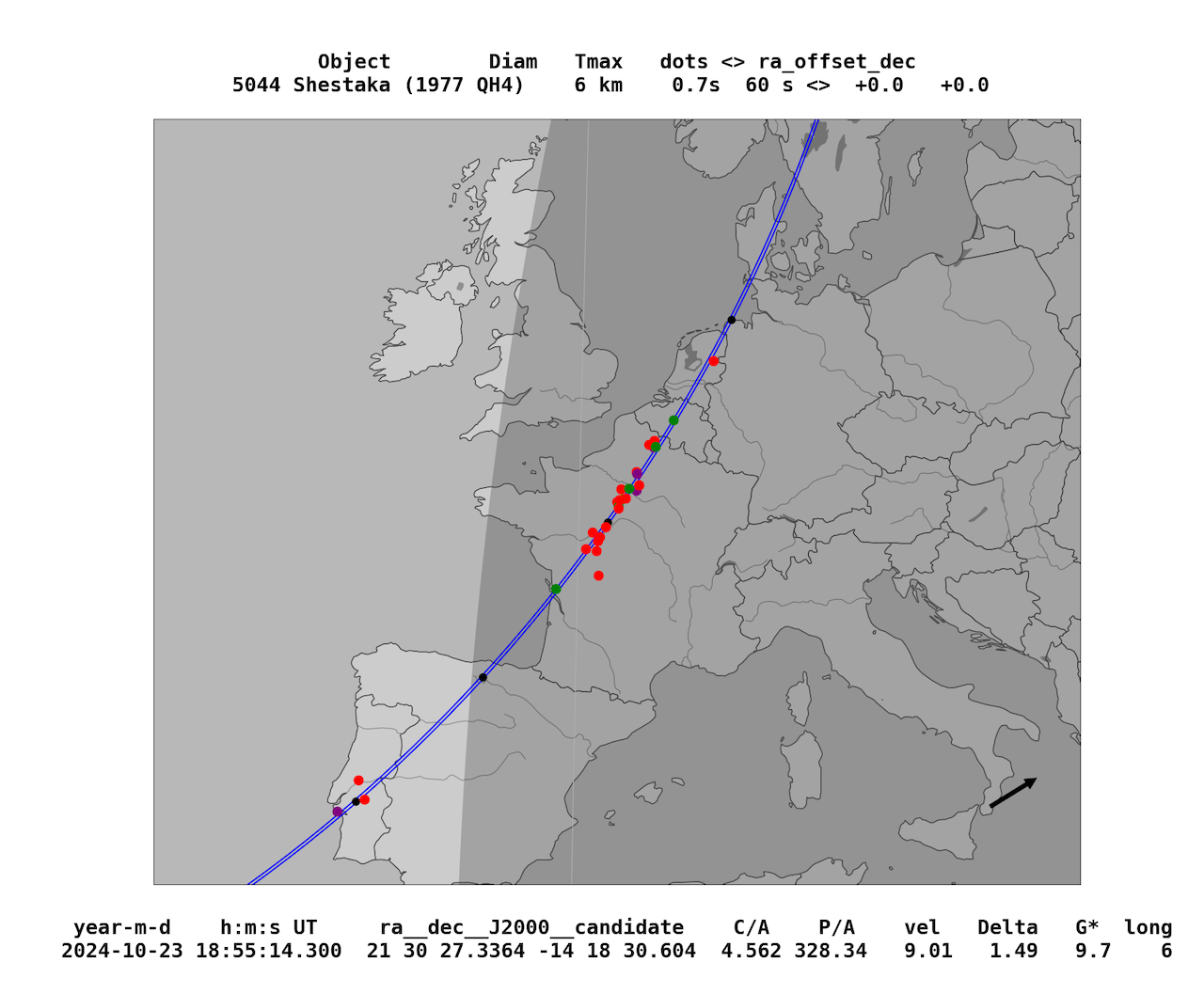
Figure 1: Post-occultation map showing the location of each station that participated in the
October 2024 occultation campaign by (5044) Shestaka
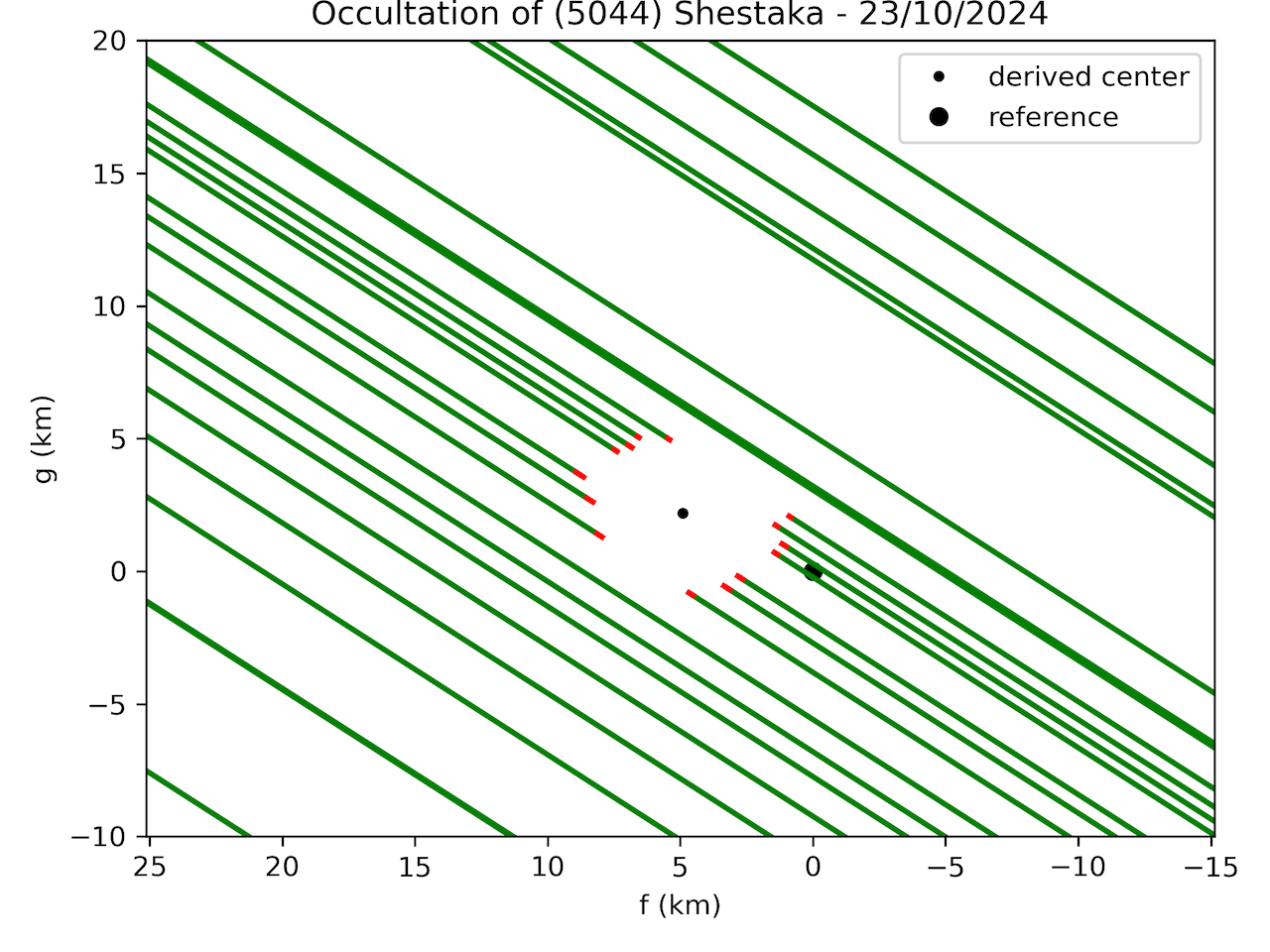
Figure 2: Green lines show observations from different stations. Solid parts indicate when the star was visible; hollow parts mark the occultation. Red segments represent timing uncertainties for immersion and emersion.
Distinct results were obtained for objects of varying sizes. In particular, asteroid (35420) 1998 AG6 exhibited signatures suggestive of the potential presence of a satellite or an unusual shape. Additionally, (1127) Mimi, which was the subject of four separate observations, showed a clear deviation, pointing to a possible interaction with its surrounding environment. Similarly, to name the most recurrent ones, (550) Senta, (247) Eukrate, and (1237) Genevieve underwent comparable observational approach, enabling improved constraints on their shape and positional parameters for subsequent studies. Overall, this presentation will highlight the main results obtained to date from past campaigns, including refined astrometric measurements, derived shape models and surface topographies, the identification of potential satellite candidates, and a critical evaluation of existing 3D models for selected objects.
Acknowledgments
The organisation of the observation campaigns was supported by Occultation Portal - Kilic et al. (2022). Occultation Portal: A web-based platform for data collection and analysis of stellar occultations. MNRAS, Volume 515, Issue 1, pp. 1346-1357. This work made use of the SORA package - Gomes-Júnior et al. (2022). SORA: Stellar occultation reduction and analysis. MNRAS, Volume 511, Issue 1, March 2022, Pages 1167–1181. This work made use of the PRAIA package - Assafin M., 2023a, Differential aperture photometry with PRAIA, Planetary and Space Science Planetary and Space Science, Volume 239, article id. 105816. This work made use of the Pymovie package - Anderson, B. (2019) PyMovie – A Stellar-Occultation Aperture-Photometry Program, Journal for Occultation Astronomy (ISSN 0737-6766), Vol. 9, No. 4, p. 9-13. This work is funded by the French national agency Agence National de la Recherche (ANR-22-CE49-0002). This work has made use of data from the European Space Agency (ESA) mission Gaia (https://www.cosmos.esa.int/gaia), processed by the Gaia Data Processing and Analysis Consortium (DPAC, https://www.cosmos.esa.int/web/gaia/dpac/consortium). Funding for the DPAC has been provided by national institutions, in particular the institutions participating in the Gaia Multilateral Agreement.
References
[1] Pravec et al., 2007 Icarus, Binary asteroid population. 1. Angular momentum content
[2] Nesvorny et al., 2021 The Planetary Science Journal, Binary Planetesimal Formation from Gravitationally Collapsing Pebble Clouds
[3] Braga-Ribas et al. 2013, The Astrophysical Journal, THE SIZE, SHAPE, ALBEDO, DENSITY, AND ATMOSPHERIC LIMIT OF TRANSNEPTUNIAN OBJECT (50000) QUAOAR FROM MULTI-CHORD STELLAR OCCULTATIONS
[4] Tanga et al., 2023 Astronomy and Astrophysics, Gaia Data Release 3 The Solar System survey
[5] Liberato et al., 2024 Astronomy and Astrophysics, Binary asteroid candidates in Gaia DR3 astrometry
[6] Lallemand et al. 2024, SF2A Proceedings 2024, GAIAMOONS: Study of binary asteroids with stellar occultation and GAIA astrometry
[7] Rommel et al. 2023, Astronomy and Astrophysics, A large topographic feature on the surface of the trans-Neptunian object (307261) 2002 MS4 measured from stellar occultations
[8] Liu et al. 2024, Astronomy and Astrophysics, Asteroid (4437) Arecibo: Two ice-rich bodies forming a binary-Based on Gaia astrometric data
Ryan Dahoumane, Aisha Ashimbekova, Pierre-Louis Phan, Carole Lavault, Gilles Vanwalleghem, Rui Gonçalves, Daniel Hestroffer, Jeremie Vaubaillon, Vincent Lapeyrère, Miguel Montargès, Jordan Raffard, Karim Hussein, Olivier Schreurs, Manon Lecoissois, Frederic Denjean, Thomas Salomon, Joel Souchu, Alain Vienne, Frédéric Vachier, Stéfan Renner, Jean-Pierre Masini, Lionel Rousselot, Benoit Lott, Stephane Kindt, Philippe Lemoine, Yueh-Ning Lee, Zhong-Yi Lin, Serge Quinet, Henk de Groot, Thierry Legault, Jean-Louis Dumont, Pierre-Jean Mercier, Pierre Le Cam, Eric Vauthrin, Pierre Barroy, Alex Siakas, Rodrigo Leiva, Stefano Sposetti, Philip Stuart, Carsten Ziolek, Oscar Canales, Christophe Rizan, Estéban Jacquet, Anna Marciniak, Deborah Smith, Eric Smith, S. Chairetas, Philip Denyer, Philippe Couvée, Jean-Paul Nombret, Paolo Fini, Stefan Meister, Albert Ossola, Wolfgagn Beisker, Roland Boninsegna, Ferrando Casarramona, Matthieu Conjat, Patrice Le Guen, Javier Prat, Jean Bourgeois, Philippe Henarejos, Corine Yahia, Denirs Bourdens, Eric Barbotin, Carles Schnabel, R. Szakats, A. Pal, N. Takács, Á. Sódor, Cs. Kiss, Julio Spagnotto, Yanzhe Liu, Rick Liu, W. Hanna, Michel Turchenko. Katsumasa Hosoi, Katsuhiko Kitazaki, Hiraku Togashi, Ken Nemoto, Asumi Takimoto, Hidehito Yamamura, Akira Asai, Miyoshi Ida
How to cite: Lallemand, R., Desmars, J., Sicardy, B., Tanga, P., Liu, Z., Liberato, L., Mary, D., Hestroffer, D., Langin, G., Dauvergne, J.-L., Saillenfest, M., Stachowicz, A., Leroy, A., and Kiliç, Y. and the co-authors: Stellar Occultations as a Tool to Detect and Characterize Binary Asteroids , EPSC-DPS Joint Meeting 2025, Helsinki, Finland, 7–12 Sep 2025, EPSC-DPS2025-340, https://doi.org/10.5194/epsc-dps2025-340, 2025.


