
 1,1,2,
- 1Centro de Astrobiologia (INTA-CSIC), Dept Planetology and Habitability, Torrejon de Ardoz, Spain (ormoj@cab.inta-csic.es)
- 2Museum für Naturkunde Berlin, Leibniz Institute for Evolution and Biodiversity Science, Germany
- 3Freie Universität Berlin, Germany
- 4Space Research and Planetary Sciences, University of Bern, Switzerland
The "rubble-pile" structure of several asteroids recently examined by space missions—such as Dimorphos, Itokawa, Bennu, and Ryugu—has drawn significant attention to these types of celestial bodies. However, their internal composition remains largely uncertain, but a strength-stratification with a weaker exterior compared with the interior has been suggested for at least some of them (e.g., Daly et al. 2022). To explore a possible explanation for this strength stratification in rubble-pile asteroids, an impact experiment was conducted at the Experimental Projectile Impact Chamber (EPIC) at Centro de Astrobiología (CAB), CSIC-INTA, Spain (cf. Ormö et al., 2015). The target was prepared in a 60 ‐cm wide, half‐spherical metal bowl that had been cut in half and mounted to the camera chamber window for quarter space setup. The bowl was filled with porous, ceramic balls of nearly equal diameter and density as the projectile, which were of the polymer Delrin (20mm diameter, 5.7g) impacting vertically at ̴0.4km/s. High-speed video recordings showed that crushed target and projectile material rapidly penetrates deep into the substrate, dispersing radially beneath the crater floor (Fig. 1). If such impacts occur repeatedly over time in a porous and easily crushable material, this process could lead to the accumulation of fine-grained, compacted, and increasingly cohesive material at deeper layers. Meanwhile, impact-induced seismic activity on the asteroid, causing granular convection (the "Brazil Nut Effect"), along with rotational centrifugal forces, could promote the segregation of finer material beneath coarser layers—potentially making this effect more pronounced at the poles.
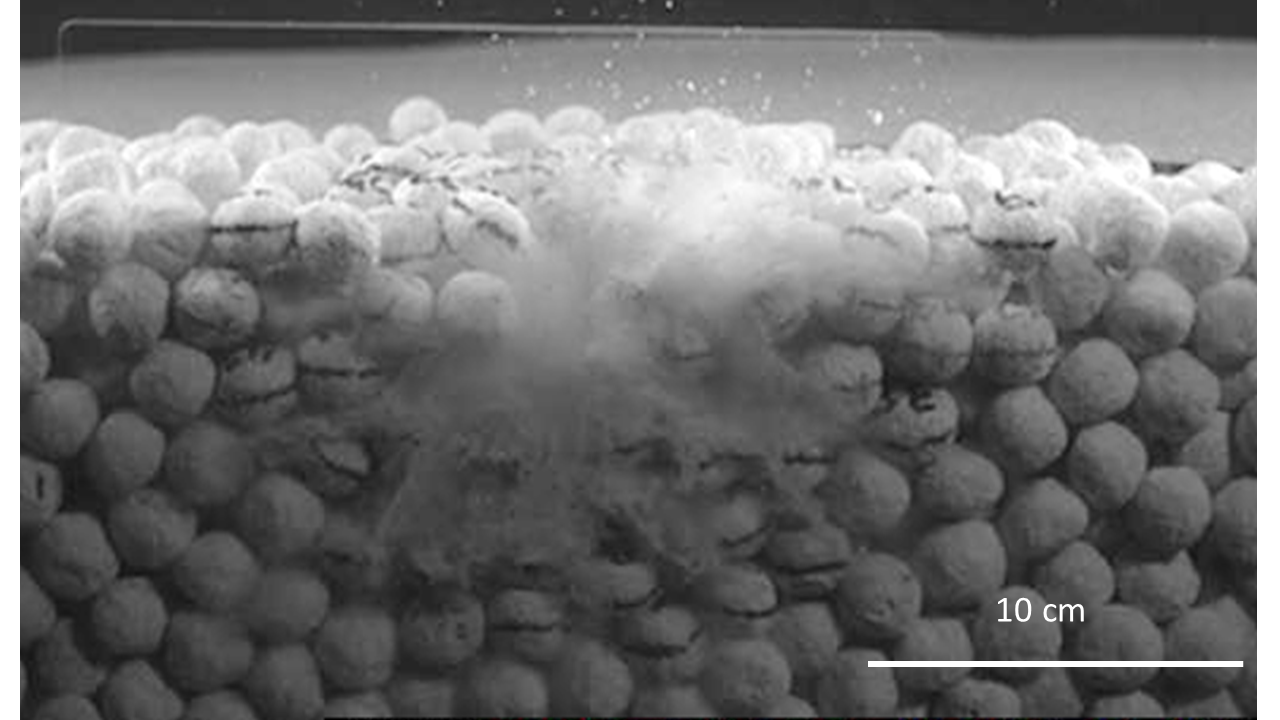
Fig. 1. Radial clastic injections of crushed impactor and target material shortly after impact into a "boulder" target. Also note the poor development of an excavated cavity in this porous target.
References
Daly, T. R., et al. (2022), Icarus 384, https://doi.org/10.1016/j.icarus.2022.115058
Ormö, J. et al., (2015), Meteorit. Planet. Sci. 50(12), https://doi.org/10.1111/maps.12560
Acknowledgements
The study was supported by grant PID2021-125883NB-C22 by the Spanish Ministry of Science and Innovation/State Agency of Research MCIN/AEI/ 10.13039/501100011033 and by ‘ERDF A way of making Europe’, and Spanish National Research Council CSIC (Project ILINK22061). SDR, MJ, RL and KW have received funding from the EU’s H2020, grant agreement No. 870377 (NEO-MAPP). SDR. and MJ acknowledge support from the Swiss National Science Foundation (project number 200021_207359).
How to cite: Ormö, J., Herreros, I., Luther, R., Wünnemann, K., Raducan, S., and Jutzi, M.: Impact-Generated Clastic Injections as a Cause for Stratification in Rubble-Pile Asteroids, EPSC-DPS Joint Meeting 2025, Helsinki, Finland, 7–12 Sep 2025, EPSC-DPS2025-348, https://doi.org/10.5194/epsc-dps2025-348, 2025.


