
 1,2,1,1
- 1Istituto di Astrofisica e Planetologia Spaziali (INAF-IAPS), Rome, Italy (samuel.durzo@inaf.it) (andrea.raponi@inaf.it) (mariacristina.desanctis@inaf.it)
- 2Sapienza Università di Roma, Rome, Italy (samuel.durzo@uniroma1.it)
Ceres, the largest object in the Main Asteroid Belt, is a crucial target for astrobiological research due to its complex surface composition, characterized by dark, carbon-rich materials, phyllosilicates, carbonates, and localized organics [1] [2] [3]. Previous discoveries of aliphatic organics in the Ernutet region [4] motivated a search for new organic-rich areas. Recent Framing Camera analyses identified bright areas within the Yalode crater (BS1, BS2 and BS3 in Fig. 1) characterized by a red spectral slope, typical of organic-rich regions [5]. This study focuses on detailed spectroscopic characterization of these areas using Dawn’s VIR spectrometer data covering VIS and IR wavelengths from 0.25-1 µm to 1-5 µm [6].
Pixels of the hyperspectral VIR cubes were selected based on specific spectral criteria that can highlight the organic content. Three indicators were computed: 1) Band Depth (BD) around 3.4 µm, associated with C-H stretching absorptions characteristic of organic compounds; 2) Band Area (BA) around 3.4 µm, integrated to provide a robust measure of absorption strength [7]; 3) Spectral Slope (SL) between 1.0 and 1.4 µm, as a proxy for the red slope typically observed in organic-rich spectra [8]. Pixels exceeding a threshold value for these parameters were selected for further analysis. In Fig. 2 we show the distribution of these parameters for the BS1 spot. Spectral analysis revealed that all three bright spots exhibit strong absorption features around 3.4 µm, consistent with the presence of organic compounds. Additionally, a strong absorption near 3.9 µm, typical of carbonates, was also detected (Fig. 3). Carbonates exhibit an absorption feature near 3.4 µm, which overlaps with the characteristic absorption of organic materials in the same spectral region. This spectral overlap complicates the interpretation of the 3.4 µm band, making it challenging to discern whether the observed feature is attributable to carbonates, or if it also indicates the presence of organics.
Since the two VIR channels do not operate simultaneously [6], in the lasts orbital phases, to reconstruct a continuous spectral profile across the VIS and IR ranges, we applied a bridging procedure, excluding spectral regions heavily affected by noise around 1 µm. Thermal emission, significant beyond ~3.2 µm, was removed by modeling a Planck function based on an effective surface temperature and emissivity parameterization [9].
Spectral modeling of the reflectance data was performed using Hapke’s radiative transfer theory [10]. We assumed an intimate mixture model, where the single scattering albedo (SSA) of the surface was represented as a weighted sum of the SSAs of different endmembers. The selected endmembers were: Magnetite as a darkening agent [11], Carbonaceous Chondrite MAC 87300 as a primitive exogenous material, NH4-Montmorillonite and heated Antigorite as phyllosilicates, Dolomite and Siderite as carbonates, all taken from RELAB dataset, and Semianthracite as a spectral analog for complex aromatic organic matter [12] [13]. The model included free parameters: Abundances and grain sizes of each component, a multiplicative scaling factor to account for photometric uncertainties, an artificial spectral slope term to correct residual instrumental effects [14], the surface temperature and emissivity factor to refine the thermal correction [15]. The best fit was determined by minimizing the reduced chi-square value using a Levenberg-Marquardt optimization algorithm [7].
Spectral modeling consistently required the inclusion of siderite (Fe-carbonate) and an aromatic organic component analogous to semianthracite to satisfactorily reproduce the observed features (Fig. 4). The bright areas in Yalode crater are characterized by a notable presence of both siderite and complex, likely aromatic, organic material. These signatures distinguish them from previously analyzed regions on Ceres, like Ernutet, where predominantly aliphatic organics were detected [4]. The identification of siderite supports the hypothesis of pervasive aqueous alteration on Ceres [16], under specific chemical conditions favoring Fe-carbonate formation. The detection of semianthracite-like organic material indicates a more evolved or differently processed organic component compared to earlier discoveries of aliphatic compounds. This could reflect longer exposure to space weathering, different thermal histories, or distinct sources of organic matter.
These results highlight the chemical and mineralogical complexity of Ceres' surface. Future studies integrating laboratory measurements of organic spectral analogs, improved modeling, and global mapping of organics across Ceres’ surface could be the key to understanding the origin and evolution of organic material on Ceres.
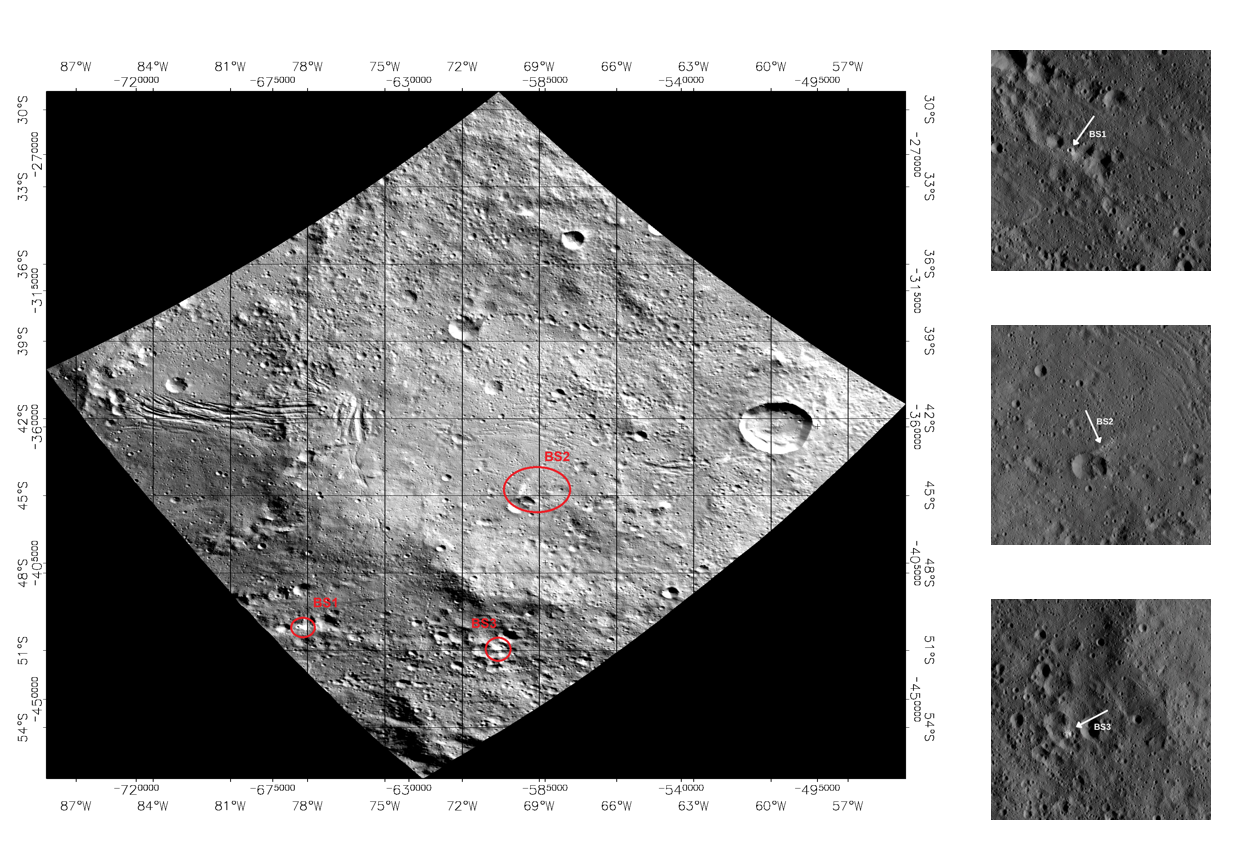
Figure 1. Projected FC image of bright spots located in Yalode crater and indicated by [5] as potentially hosting organics: BS1 (50 °S-78.35 °W), BS2 (44.7 °S-69.7 °W), BS3 (50.9 °S-70.7 °W).
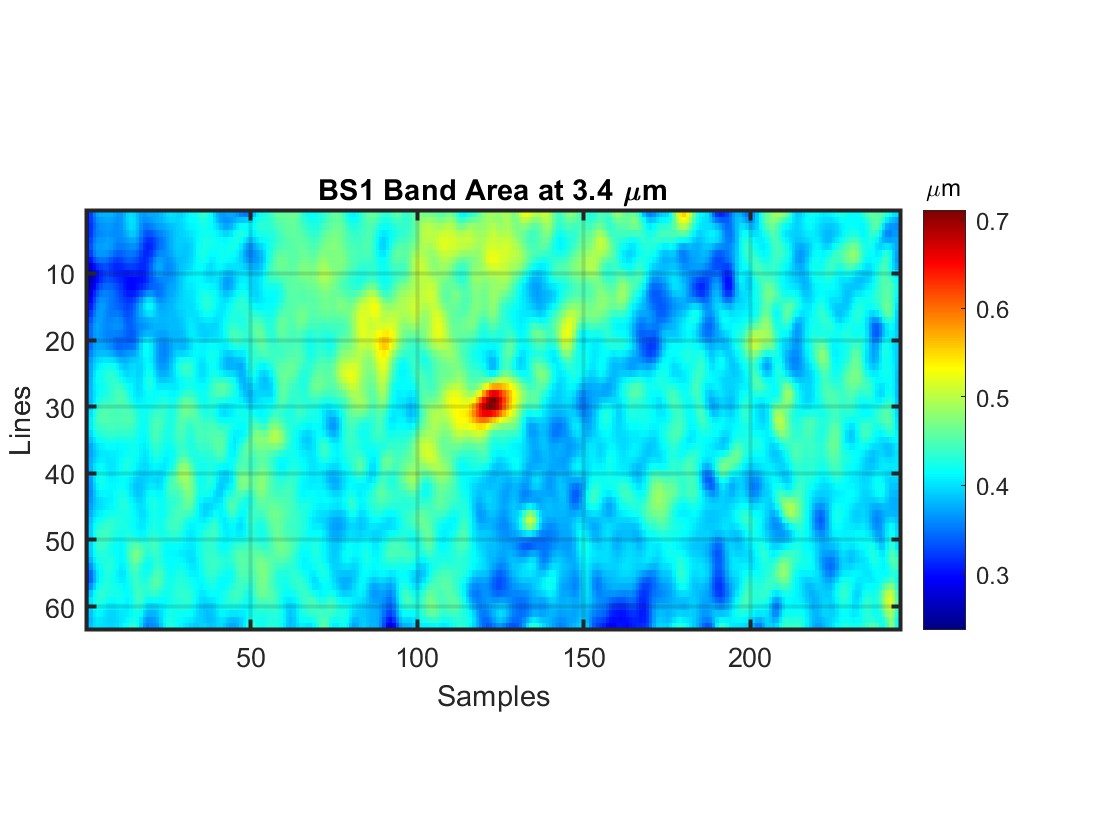
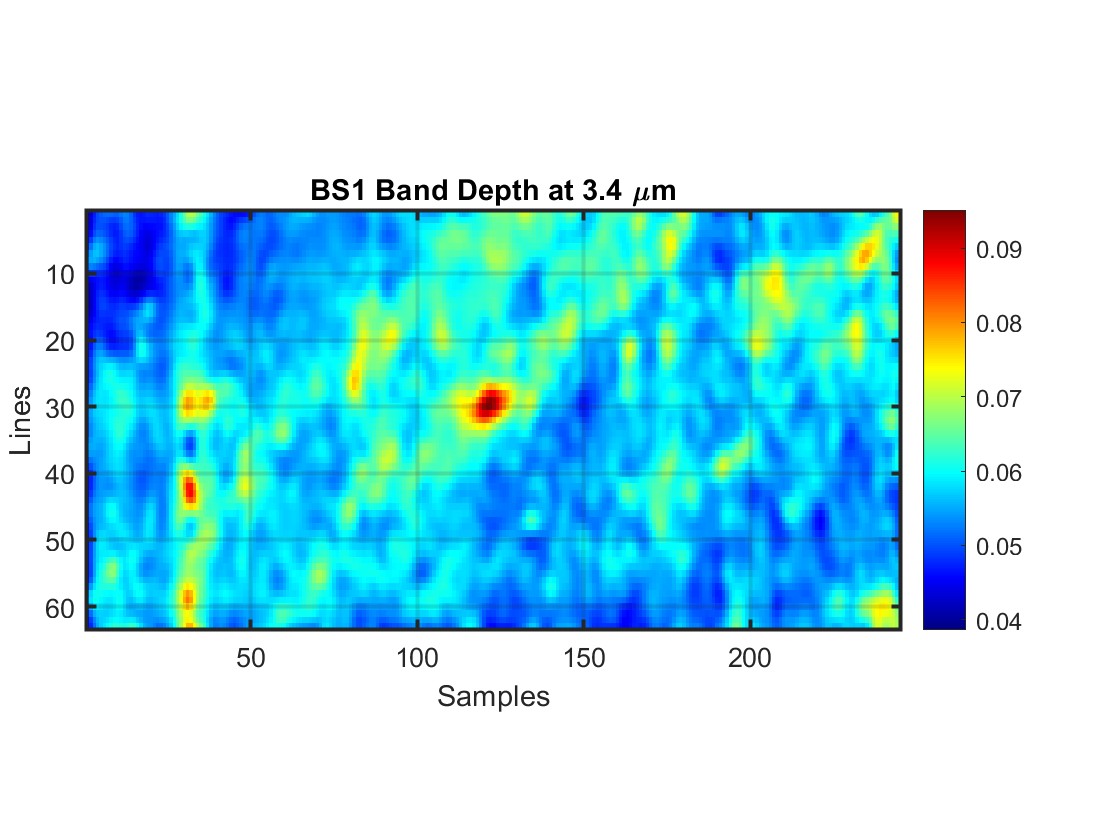
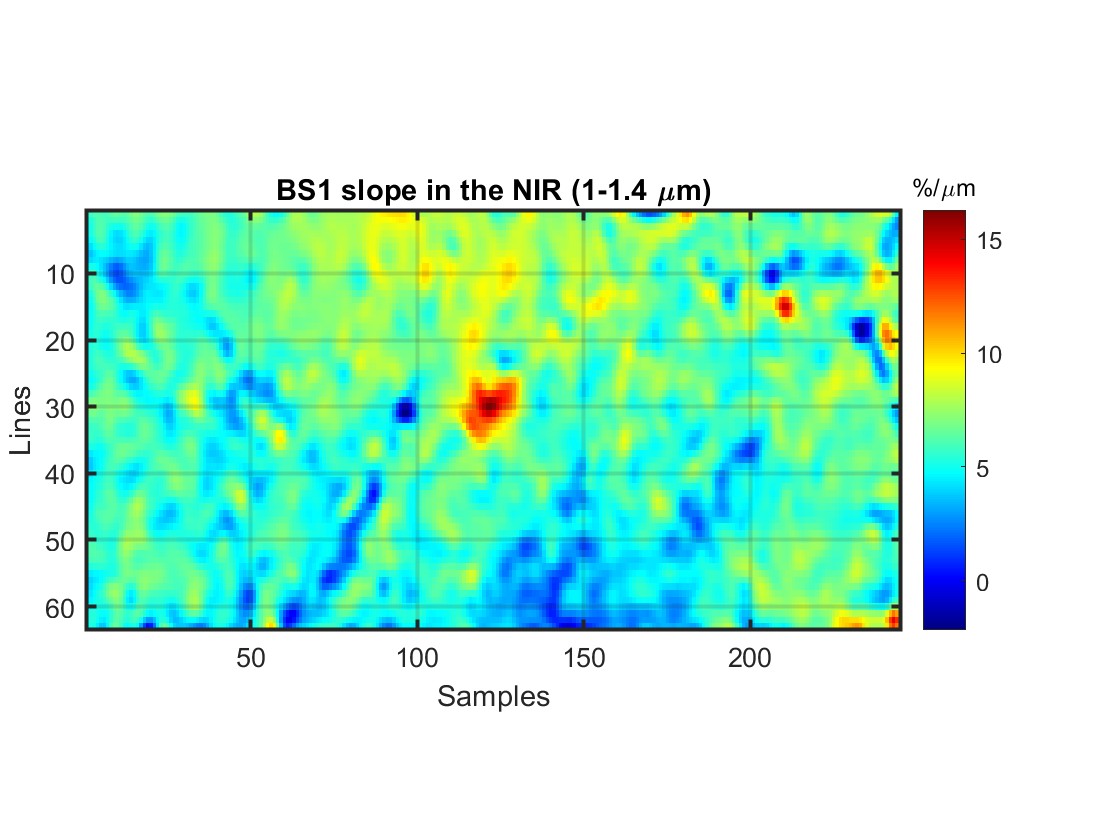
Figure 2. For BS1 from left to right: Band Area and Band Depth distribution calculated at around 3.4 𝜇m. Slope calculated from 1 to 1.4 𝜇m. The points colored in red have the highest values of the three spectral indicators and are the pixels chosen for the analysis.
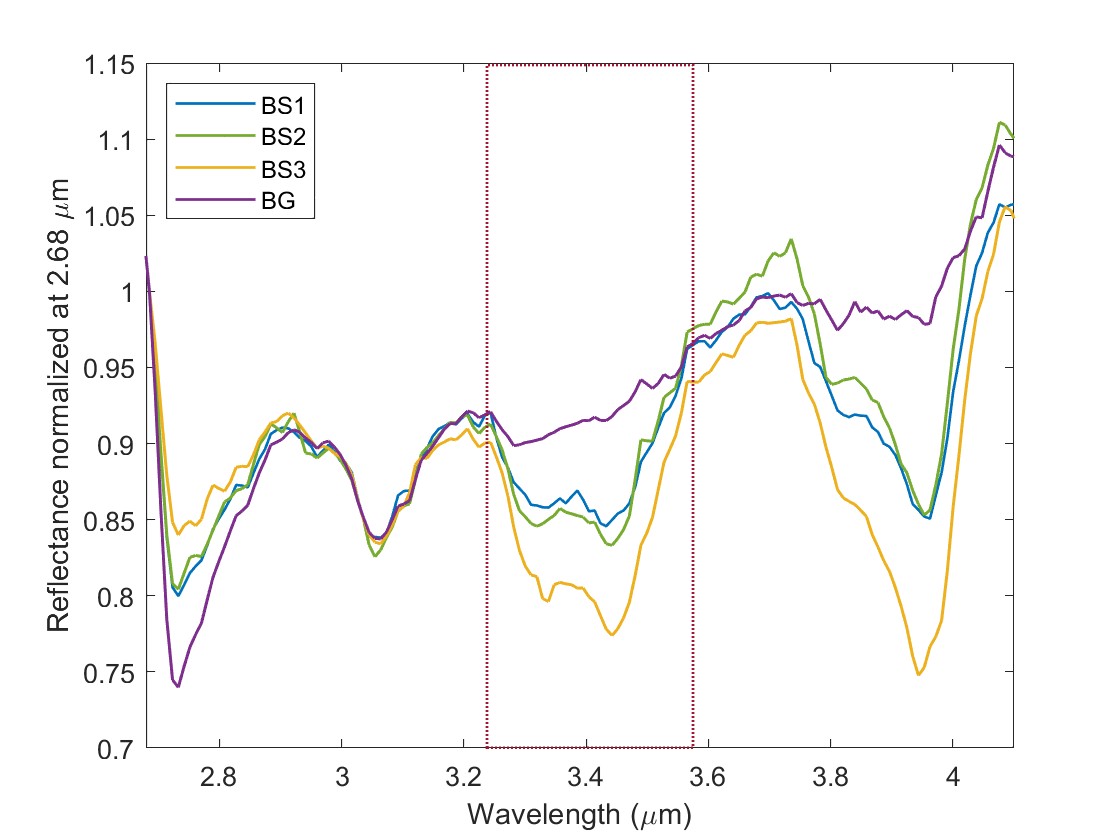
Figure 3. Comparison between background (BG), BS1, BS2 and BS3 spectra in the IR range. Mean spectra of the areas are normalized at 2.68 𝜇m.
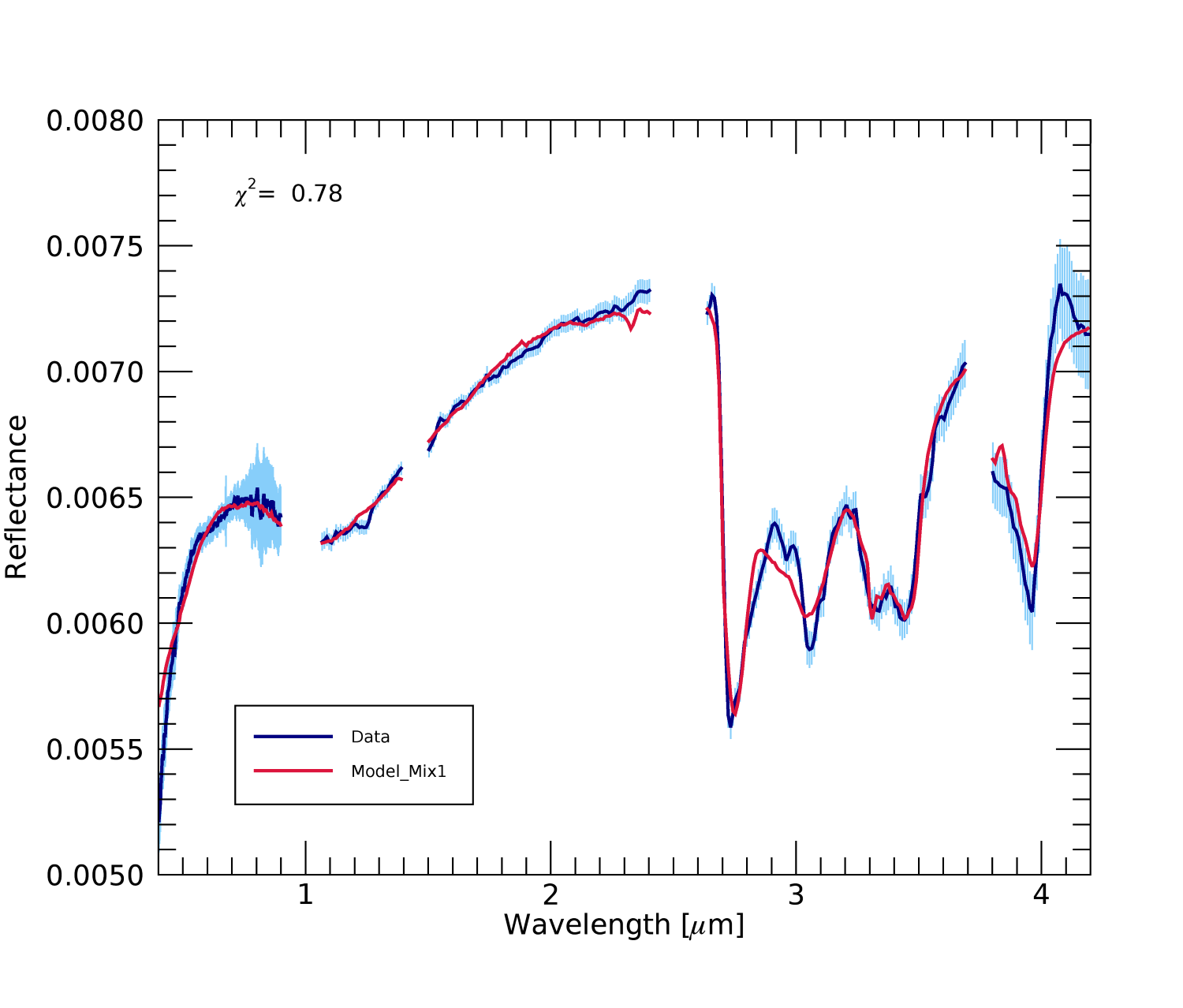
Figure 4. Best fit result for BS1. Data in blue, simulated spectrum in red.
References
[1] Marchi et al. Nature Astonomy 3, 140-145 (2019).
[2] Ammanito et al. Science 353 (2016).
[3] Russell et al. Science 353, 1008-1010 (2016).
[4] De Sanctis et al. Science 355, 719-722 (2017).
[5] Rizos et al. LPI Contributions 2851, 2056 (2023).
[6] De Sanctis et al. Space Science Reviews 163, 329–369 (2011).
[7] Raponi et al. Monthly Notices of the Royal Astronomical Society (2016).
[8] Rousseau et al. Astronomy & Astrophysics 642 (2020).
[9] Raponi et al. Icarus 320, 83-96 (2019).
[10] Hapke B. Cambridge University Press (2012).
[11] Querry Contractor Report (1985).
[12] Moroz et al. Icarus 134, 253–268 (1998).
[13] de Bergh et al. The Solar System Beyond Neptune, 483-506 (2008).
[14] Filacchione G. Institute of Space Astrophysics and Cosmic Physics (2006).
[15] Davidsson et al. Icarus 201, 335-357 (2009).
[16] De Sanctis et al. Nature 528, 241-244 (2015).
Acknowledgements: This work is supported by the INAF Large Grant "Nature and Evolution of the Organic Material on Ceres" (TERRAE).
How to cite: D'Urzo, S., Raponi, A., and De Sanctis, M. C.: Possible Detection of Fe-Carbonates and Complex Organics in Bright Areas of the Yalode Crater on Ceres, EPSC-DPS Joint Meeting 2025, Helsinki, Finland, 7–13 Sep 2025, EPSC-DPS2025-352, https://doi.org/10.5194/epsc-dps2025-352, 2025.


