
 1,
1,- 1California State University, Los Angeles, United States of America (eroyer@calstatela.edu)
- 2Southwest Research Institute (SwRi), Boulder, CO, USA
- 3Science and Technology Corporation, Boulder, CO, USA
- 4Space Science Institute (SSI), Boulder, CO, USA
Airglow emissions in the upper atmosphere of Venus offer valuable tracers for probing atmospheric dynamics between 90 and 120 km. The 1.27 μm O₂ airglow, which contribution function is near 95 km altitude, is particularly useful as it lies in the transition region at the interface of two distinct circulation regimes: the retrograde super-rotating zonal flow (RSZ) below ~100 km and the sub-solar to anti-solar (SSAS) circulation above. Convergence of the SSAS near the anti-solar point results in O2 airglow from the downwelling excited O2. Although often concentrated at equatorial midnight, peak fluxes are often observed morning-ward of midnight, and exhibit excursions to high latitudes. Observations from ESA's Venus Express (2006–2014), particularly from the VIRTIS instrument, highlighted this complexity and revealed a secondary brightness maximum at ~30°N and ~50°N—features not captured by current global circulation models. Recent modeling efforts, however, suggest that periodic atmospheric waves, such as a ~5-day Kelvin wave, may modulate the O₂ nightglow’s intensity and latitudinal structure.
We present a novel approach using ground-based infrared spectroscopy with the NASA IRTF SpeX instrument to detect and analyze Venus’ O₂ nightglow at 1.27 μm. While the SpeX dataset (2001–present) was originally aimed at cloud studies, it includes regular detections of the O₂ airglow, typically two images per night during Venus observations. By scanning the slit across the planet's disk, we retrieve spatially resolved airglow signals on both the disk and limb, as shown in Figure 1.
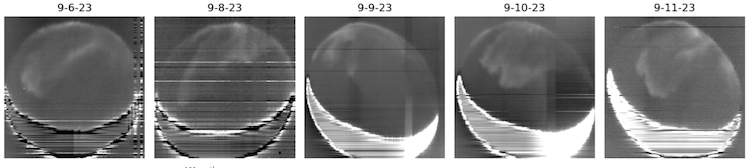
Figure1. IRTF SpeX reconstructed images of the O2 (a1Δg) 1.27 mm airglow showing a hint of a 5-day pattern over a series of images taken between 09-06-2023 and 09-11-2023. On all images, the North is located to the left of the image, the South is to the right. The saturated crescent area represents the dayside of Venus, while the airglow is visible as white patches along the limb and on the disk on the nightside.
Our analysis focuses on extracting temporal and spatial variations in the O₂ emission across a range of observation periods—before, during, and after the Venus Express mission—offering new constraints on atmospheric variability. The data allow for short-term morphology analysis on nights with multiple images and support long-term trend studies over a 23-year period. These ground-based results complement spacecraft datasets and enable us to evaluate model predictions, including those involving Kelvin wave-driven modulation of the nightglow.
This work demonstrates the value of archived ground-based observations for planetary atmosphere studies and provides an important, underutilized dataset for understanding the structure and variability of Venus' upper atmosphere.
References
Gérard, J.-C., Soret, L., Saglam, A., Piccioni, G., Drossart, P. (2010), The distributions of the OH Meinel and O2 (a1 – X3Σ) nightglow emissions in the Venus mesosphere based on VIRTIS observations. Adv. Space Res. 45, 1268–1275, doi:10.1016/j.asr.2010.01.022
Gérard, J.-C., Soret, L., Piccioni, G., Drossart, P. (2014), Latitudinal structure of the Venus O2 infrared airglow: a signature of small-scale dynamical processes in the upper atmosphere. Icarus 236, 93–103, doi:10.1016/j.icarus.2014.03.028
Navarro, T., Gilli, G., Schubert, G., Lebonnois, S., Lefèvre, F., & Quirino, D. (2021). Venus’ upper atmosphere revealed by a GCM: I. Structure and variability of the circulation. Icarus, 366, 114400.
Evodkimova, D., Fedorova, A., Zharikova, M., Montmessin, F., Korablev, O., Soret, L., Gorivov, D., Belyaev, D. and Bertuax, J-L. (2025), Night O2 (a1Dg) airglow spatial distribution and temporal behavior on Venus based on PSICAv IR/Vex nadir dataset, Icarus, Vol. 429, 116417
How to cite: Royer, E., Avina, S., Young, E., Bullock, M., and Navarro, T.: Long-Term Ground-Based Monitoring of the Venusian O₂ Nightglow, EPSC-DPS Joint Meeting 2025, Helsinki, Finland, 7–12 Sep 2025, EPSC-DPS2025-356, https://doi.org/10.5194/epsc-dps2025-356, 2025.


