
 1,3,4,7,8,8,
- 1Université Versailles Saint-Quentin, IPSL, LATMOS, Guyancourt, France (emmanuel.marcq@latmos.ipsl.fr)
- 2IRAP, OMP, CNRS, CNES, Univ. Toulouse, Toulouse, France
- 3LIRA, Observatoire de Paris PSL, Meudon, France
- 4IAA, Granada, Spain
- 5Hensoldt Space Consulting, Guyancourt, France
- 6CNES, Toulouse, France
- 7IASB, Brussels, Belgium
- 8DLR, Berlin, Germany
- *A full list of authors appears at the end of the abstract
ESA's Cosmic Vision M5 Envision mission to Venus will depart in December 2031 and begin its scientific mission in 2034, with its nominal mission lasting for four years. Its payload includes the VenSpec-U ultraviolet imaging spectrometer, designed and built by a consortium of French laboratories (LATMOS, IRAP, LIRA). Its scientific objectives are dedicated to the mapping of sulfur gases (sulfur dioxide SO2 and sulfur monoxide SO) at the planet's clouds top near an altitude of 70 km, as well as the characterization of upper cloud variability, in particular that of the ultraviolet absorber whose composition still eludes us. Its horizontal resolution will be of the order of 10 km, enabling us to constrain the interplay between photochemistry, and atmospheric dynamics on small scales such as gravity waves, convection cells, or enhanced vertical mixing that might be trigered by buoyant volcanic plumes [1].
Operating in nadir or near-nadir viewing and in pushbroom geometry with a 20° transverse field of view (on the order of 100 km across considering the low polar orbit of EnVision), the instrument will analyze sunlight backscattered by clouds on the day side of the planet using two optical channels sharing a single CMOS detector. One channel will take advantage of its high spectral resolution (0.3 nm) over a reduced range (205-235 nm) to resolve the spectral lines of sulfur monoxide and dioxide to characterize the chemical cycle of sulfur. The other channel, with a comparatively lower spectral resolution (2 to 5 nm) over an extended range (190-380 nm), will enable us to study the evolution of sulfur gases and the ultraviolet absorber with good spatial sampling [2, 3]. In addition to its nominal observation mode, the instrument will perform regular calibrations using solar observations (via blank diffusers or pinholes) at least very 112 days, as well as flat fielding using internal UV calibration LEDs.
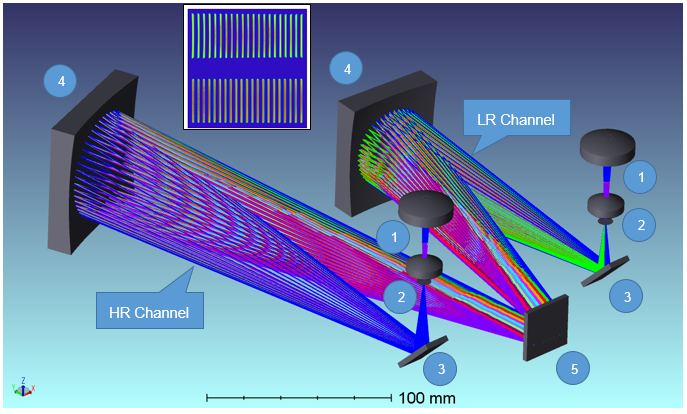
Figure 1. Optical layout of the two channels of VenSpec-U including: (1-2) entrance objectives lenses, (3) visible rejection filters, (4)
Toroidal holographic gratings, (5) shared CMOS detector.
References
[1] Marcq E. et al. (2021) Adv. Space Res., 68(1), 275-291.
[2] Conan L. et al. (2024) SPIE proceedings, Vol. 13144, pp. 197-239.
[3] Lustrement B. et al. (2024) SPIE proceedings, Vol. 13144, pp. 164-196.
https://venspec-u.projet.latmos.ipsl.fr/index.html
Emmanuel Marcq, Lucile Conan, Sandrine Vinatier, Jérémie Lasue, Sandrine Bertran, Benjamin Lustrement, Eliott Simonnet, William Recart, Arthur Stibbe, Napoléon Nguyen Tuong, Nicolas Rouanet, Abraham Diaz Damian, Baptiste Leduc, Rafik Hassen-Khodja, Sébastien Ruocco Christophe Montaron, Burak Duru, Francis Vivat, Abdel Hadi El Ghazi, Romain Mathon, Frédéric Flory, Aurélie Vontrat, Loïc Verdier, Philippe Plasson, Lee-Roy Malac-Allain, Gaëlle Palandri, Nathan Rassié, Jérôme Correa, Franck Montmessin, Lucio Baggio, Gabriel Guignan, Manish Patel
How to cite: Marcq, E., Lasue, J., Vinatier, S., Lara, L., Bertran, S., Lustrement, B., Conan, L., Simonnet, E., Juin, A., Robert, S., Barraud, O., and Alemanno, G. and the The VenSpec-U team: The VenSpec-U instrument on board EnVision, EPSC-DPS Joint Meeting 2025, Helsinki, Finland, 7–12 Sep 2025, EPSC-DPS2025-395, https://doi.org/10.5194/epsc-dps2025-395, 2025.


