
 3,4
3,4- 1Dept. of Mechanical Engineering, University of California, Berkeley, CA, United States of America (pmarcus@me.berkeley.edu)
- 2Space Science Laboratory, University of California, Berkeley, CA, United States of America (mikewong@ssl.berkeley.edu)
- 3Dept. of Astronomy, University of California, Berkeley, CA, United States of America (imke@berkeley.edu)
- 4NASA Goddard Space Flight Center, Green Belt, Md, United States of America (amy.simon@nasa.gov)
In 2024, we published numerical simulations of Jovian anticyclones, including the Great Red Spot (GRS), that are solutions to the governing three-dimensional, compressible equations of motion. Our calculations depended on several unknown parameter values of the atmosphere that cannot be directly observed (e.g., the heights of the top of the convective zone, the heights of the top, middle, and bottom of the GRS, and the temperatures of the atmosphere at heights from the convective zone up to 700mb). A wide range of parameter values produced stable vortices with velocities that matched the HST observations, including its hollowness (i.e., its quiet, and sometimes cyclonic center). However, it took a detailed search of the unknown parameter space to find the (apparently) one set of parameter values that produces an anticyclone that fits the GRS’s HST velocities and the JWST thermal observations of its anomalously cold top near 400mb. While exploring parameter space, we found that minor changes of the temperature profile and other parameters made large and qualitative changes to the vortex (e.g., changing it from hollow to unhollow, altering its vertical thickness, and/or adjusting its height in the atmosphere, vortical intensity and/or horizontal area, or making it unstable). Knowledge of how the vortices changed with respect to their parameter values not only provides us with an understanding of how hollowness occurs in vortices but also gives us guidance on the parameter values that are needed to simulate other Jovian vortices, especially the Red Oval, which we shall soon observe with the JWST and map its winds. The sensitivity of the GRS to subtle changes of the parameter values provides us with a starting point as to understanding how subtle changes in the parameter values of the Jovian atmosphere might have caused the GRS to change since its Voyager observations - particularly, its shrinkage and its increase in its vertical vorticity.
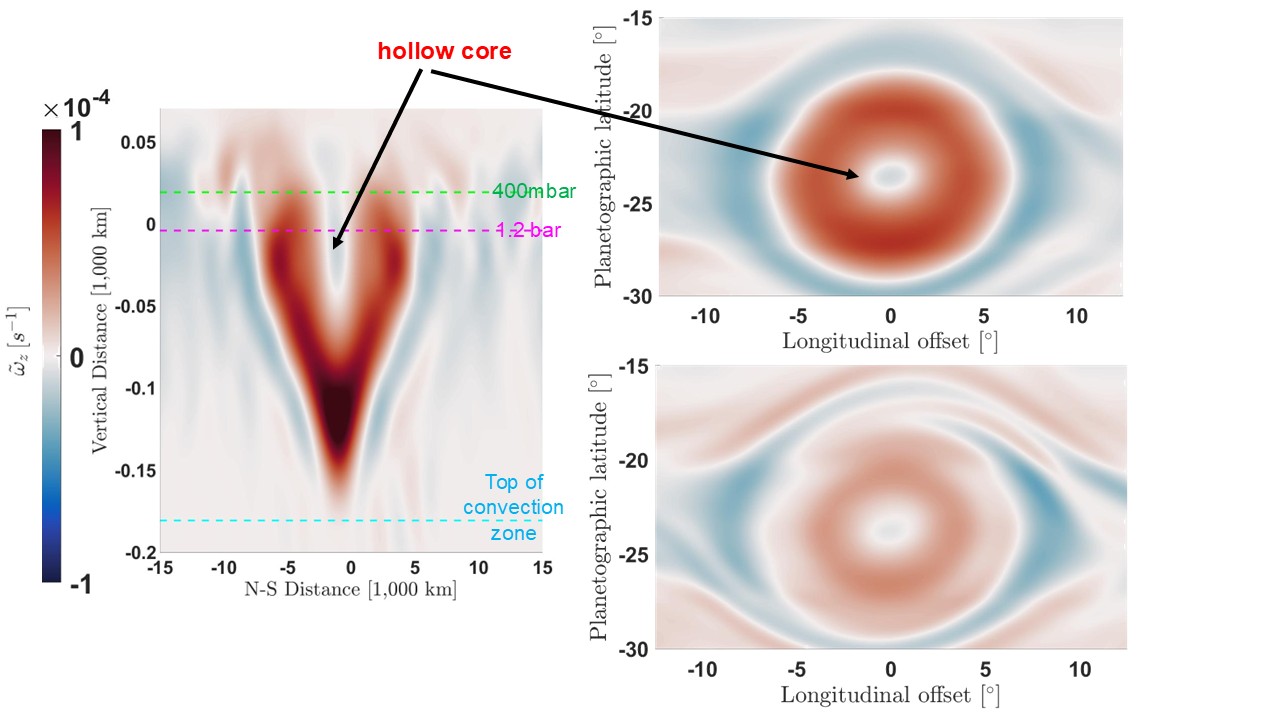
Caption. The anomalous vertical vorticity of the GRS from our published simulation in the Journal of Fluid Mechanics 984 (2024): A61. https://doi.org/10.1017/jfm.2024.132. The anticlonic vorticity is in red, and the cyclonic vorticity is blue. Left Panel shows the GRS in the vertical-north/south plane. The origin of the vertical coordinate is aribtrary. The three dashed lines are the heights of the HST clouds (purple), JWST clouds (green) , and the top of the convective zone (blue). The hollowness is only in the upper part of the GRS. The largest vorticities are below the visible clouds and have Rossy numbers of unity or greater, making the GRS ageostrophic. We find, in general, that the bottoms of our simulated vortices are unable to penetrate into the convective zone, and the GRS has no penetration. Note that the panel is stretched in the vertical direction and that the GRS is just greater than two hundred kilometers thick, while it is more than ten thousands kilometers wide. Right Panels: Top Panel shows the GRS in the east/west-north/south plane at 1.2 bar, approximately the height of the HST clouds, and the Bottom Panel shows the GRS in the same plane at 400mbar, approximately the height of the JWST clouds .
How to cite: Marcus, P., Kim, S., Wong, M., de Pater, I., and Simon, A.: 3D Solutions to the Equations of Motion of Jovian Vortices constrained by JWST Temperatures and Velocities Along with HST Velocities , EPSC-DPS Joint Meeting 2025, Helsinki, Finland, 7–12 Sep 2025, EPSC-DPS2025-416, https://doi.org/10.5194/epsc-dps2025-416, 2025.


