
 1,1,1,1,2,3,4,
- 1ISAE-SUPAERO, University of Toulouse, France (naomi.murdoch@isae.fr)
- 2The University of Maryland, College Park, USA
- 3IPGP, University Paris Diderot, Paris, France
- 4Université Côte d’Azur, Observatoire de la Côte d’Azur, CNRS, Laboratoire Lagrange, Nice, France
- 5CNES, Toulouse, France
The close encounter between asteroid Apophis and Earth in 2029 presents an unparalleled opportunity for the first in-situ seismic study of an asteroid. The Seismic Instrument for Asteroids (SIA) will be deployed to the surface of (99942) Apophis by the ESA RAMSES mission and used to measure the seismicity of the asteroid due to tidal forces [1,2], in addition to monitoring other natural sources such as micro-meteoroid impacts or thermal cracks; [3-5]. SIA is under development at ISAE-SUPAERO with the support of the French Space Agency (CNES). The instrument is the culmination of over a decade of research and development, incorporating advancements from projects such as BASiX, CNES Apophis 2029 studies, ESA COPINS, and the NEO-MAPP European Commission Horizon 2020 project.
The main science and technological goal of SIA is to perform the first ever in-situ seismic study on the surface of an asteroid. SIA will constrain the mechanical properties of the surface during landing, measure the seismic background noise on the surface of Apophis, quantify the seismicity of Apophis in response to tidal forces, and probe the subsurface and internal structure of Apophis. Such information about the asteroid’s physical properties is essential for planetary defense (for assessing potential impact damage and developing mitigation strategies), as well as for our understanding of the evolutionary history of asteroids.
The SIA instrument (Fig. 1) is a compact seismometer that incorporates three commercially available geophone sensors (built to endure extreme environments) and custom-built electronics that are carefully designed to ensure a high sensitivity and low intrinsic noise. The SIA sensor is expected to have a noise level lower than 1.0E-9 m/s/√Hz in the 5-200 Hz bandwidth. The instrument performance is evaluated at ISAE-SUPAERO, relying heavily on the experience and expertise gained from the SEIS (InSight) instrument testing [6,7]. Initial thermal vacuum (TVAC) and vibration testing demonstrated that the sensors survived the launch and the operational environments, and that the noise level and the transfer function remain unchanged.
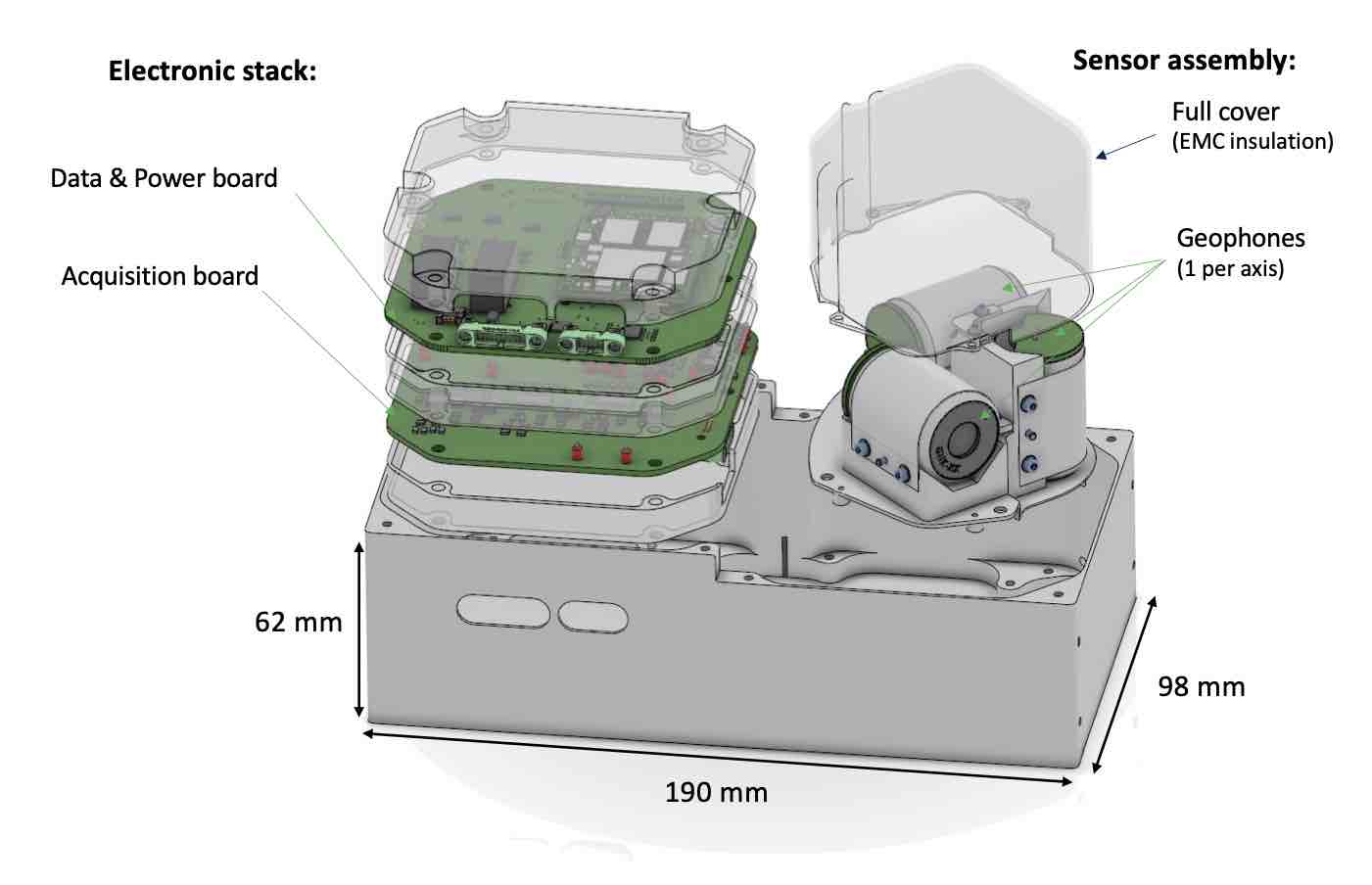
Figure 1: Expanded CAD view of SIA. The instrument contains three geophones, in addition to the data and power board and the acquisition electronics. The current best estimate of the dimensions is 190 x 98 x 62 mm.
Based on Discrete Element Method (DEM) simulations it has been predicted that the peak seismic activity (largest occurrence of quakes) occurs as tides are dissipating in the hours after closest approach [1] (Fig. 2). This is likely due to changing centripetal forces (due to rotation rate changes during encounters [1,2]), and the relaxation following the tidal deformation. However, the largest amplitude quake(s) make occur prior to the perigee [2]. As such, SIA should be deployed on the surface of Apophis prior to the closest approach to Earth (ideally 10s of hours prior). In the lead-up to perigee, periodic measurements will be conducted for instrument commissioning and background noise assessment. Then, during the critical window from three hours before to six hours after perigee—when seismic activity induced by tidal forces is expected [1,2]—continuous monitoring will be essential. Following the close encounter, additional periodic measurements should be taken to track the evolution of background noise and seismic activity, including diurnal variations. Ideally, these post-encounter observations would continue for several tens of hours. The measurements before and/or after the close encounter are important to help identify which seismic signals originate due to the tidal forces, and which are due to the asteroid surface environment.
After deployment, SIA can function in any orientation without requiring leveling, but the instrument must be in direct contact with the asteroid's surface to make the seismic measurements. Instead of anchoring the instrument to the surface, our approach relies on simple surface contact. Attempting to secure the instrument would likely result in attachment only to the loose regolith, which may not be well connected to the underlying material. As long as the lander remains in contact with the surface, ground motion will be transmitted to the seismometer. If seismic amplitudes happen to exceed the asteroid’s local surface gravity, brief lofting may occur, with the subsequent landing offering an additional opportunity to study the asteroid’s mechanical properties.
This presentation will discuss the science objectives and operational scenario for SIA in addition to providing an update on the SIA instrument design and development.

Figure 2: The Apophis encounter trajectory indicating the period of peak seismicity (the period of largest occurrence of quakes) as predicted by DEM simulations [1].
References:
1] DeMartini, J. et al. (2024) Apophis T-5.
[2] Ballouz et al., (2025) Apophis T-4.
[3] Murdoch, N. et al., (2017) Planetary and Space Science, 144, 89-105.,
[4] Murdoch, N. et al., (2015) Asteroids IV, University of Arizona Press Space Science Series. `
[5] Compaire, N., et al. (2022). Geophysical Journal International, 229(2), 776-799.
[6] Lognonné, P. et al., (2019) Space Science Reviews, 215.
[7] Mimoun, D. et al. (2017) Space Science Reviews, 211.
Acknowledgements:
The authors acknowledge funding support from the European Commission's Horizon 2020 research and innovation programme under grant agreement No 870377 (NEO-MAPP project), and from the French Space Agency (CNES).
How to cite: Murdoch, N., Cadu, A., Garcia, R. F., Sournac, A., Wilhelm, A., Carpi, P., André, T., DeMartini, J., Mimoun, D., Logonné, P., Kawamura, T., Michel, P., Piou, V., and Bousquet, P.: Seismic Instrument for Asteroids (SIA): the RAMSES seismometer, EPSC-DPS Joint Meeting 2025, Helsinki, Finland, 7–12 Sep 2025, EPSC-DPS2025-417, https://doi.org/10.5194/epsc-dps2025-417, 2025.


