
 1
1- 1Southwest Research Institute, Boulder, CO, United States of America (bottke@boulder.swri.edu)
- 2Charles University, V Holešovičkách 2, CZ-18000, Prague 8, Czech Republic
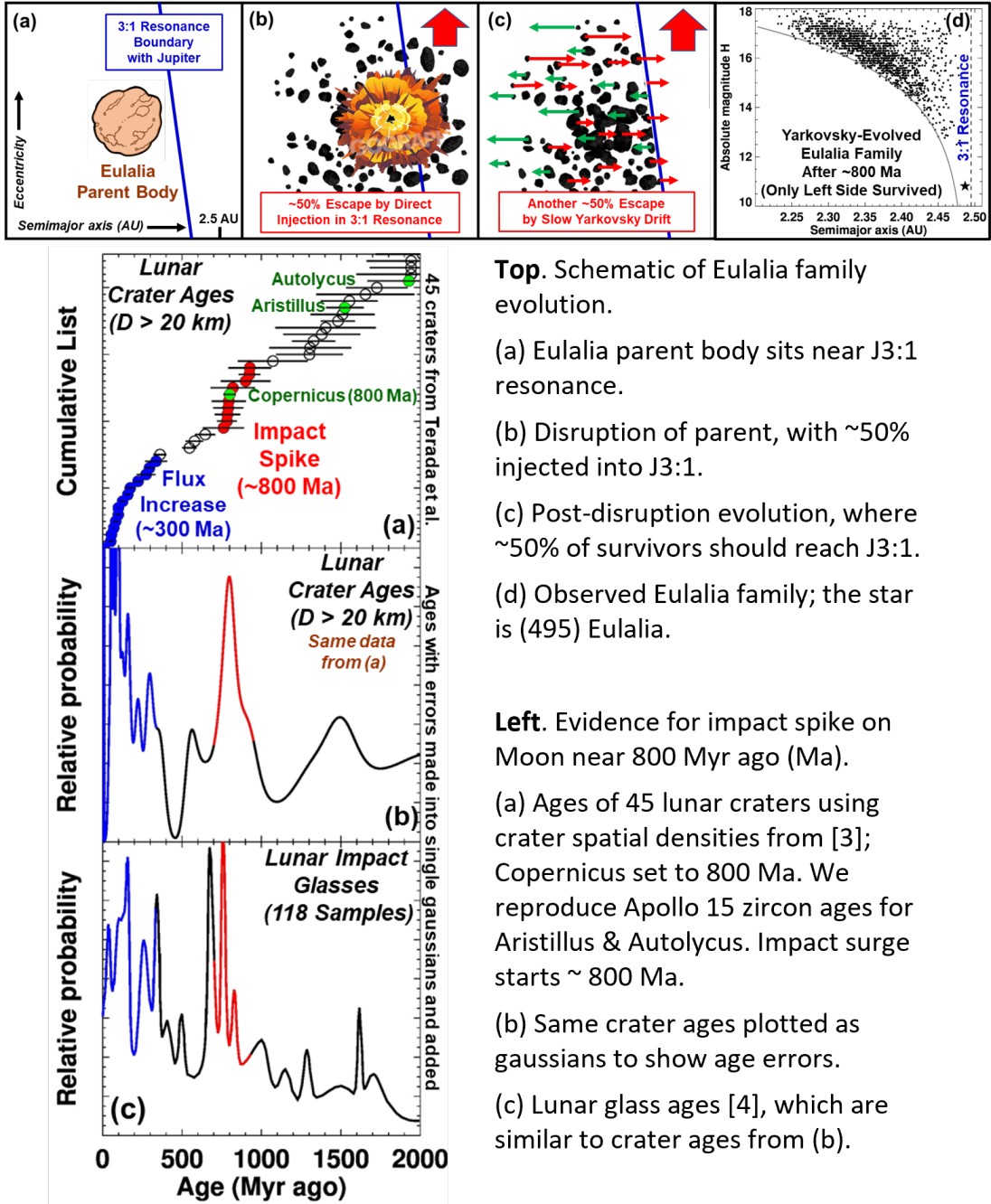
Many assume that inner solar system impact rates have been constant for the last ~3 Gyr (e.g., [1]). The evidence for a constant flux, however, is based on the spatial densities of small craters (Dcrater < 1-2 km diameter) superposed on dated lunar terrains [2]. While these data constrain the flux of small asteroids (D < 0.1 km), they are less predictive of the large impactor flux, which may be driven by surges. For example, [3] measured the spatial densities of Dcrater < 0.1-0.2 km craters on the ejecta blankets of 59 fresh lunar craters with Dcrater > 20 km; 45 are shown in the Left Fig. By setting Copernicus crater (Dcrater = 93 km) to be 800 Myr old (Ma), based on Apollo 12 data [2], crater spatial densities can be turned into ages (Left Fig). Their results suggest a prominent lunar shower occurred ~800 Ma. Similar trends are found in the 40Ar/39Ar age profiles of 118 lunar impact glasses [4] (Left Fig). The match between crater and impact glass ages provides support for the work of [5], the first to argue for a lunar impact spike ~800 Ma. They also indicate lunar impact glass ages are less biased than previously thought (e.g., [6]).
Using collisional/dynamical models [e.g., 7], we can now reproduce this impactor surge from the formation of the Eulalia asteroid family, whose D > 100 km parent body disrupted on the brink of the 3:1 mean motion resonance with Jupiter (J3:1) ~ 800 Ma (Top Fig). This rare occurrence allowed roughly half the family to be injected into the J3:1, with additional members migrating in later by Yarkovsky drift. Ultimately, approximately three-fourths of this family reached the J3:1 over a roughly ~100 Myr interval, enough to explain the size and number of large lunar craters with ages near 800 Ma.
Note that for every impact on the Moon, ~twenty same-sized or larger impacts strike Earth. We find this bombardment intriguing because several sudden transitions in our biosphere occur near 800 Ma. Some examples include: (i) the return of anoxic conditions to the deep ocean for the first time since ~1.8 Ga [8], (ii) an abrupt decrease in carbon isotopes (δ13C) in Australia’s Bitter Springs formation (e.g., [9]), and (iii) major changes in the abundance, diversity, and environmental distribution of marine eukaryotes [10]. We speculate that major terrestrial impacts near this time from Eulalia projectiles might have stimulated such activity. If true, it can be argued that the Eulalia family forming event strongly influenced the evolution of life on Earth. We also point out that Martian caldera ages, dated using superposed craters, show hints of clustering near 800 Ma. If so, Eulalia impacts may also be responsible for a short-term increase in Martian volcanism near that time.
[1] Neukum, G. et al. 2001. Space Sci. Rev. 96, 55. [2] Stöffler, D., Ryder, G. 2001. Space Sci. Rev. 96, 9. [3] Terada, K. et al. 2020. Nature Comm. 11, 3453. [4] Ghent, R. R., & N. E. B. Zellner. 2020. White Paper for the Planetary Decadal Survey. [5] Zellner, N. E. B., et al. 2009. GCA 73, 4590. [6] Huang, Y.-H. et al. 2018, GRL 45, 6805; [7] Bottke, W. F. 2015. Icarus 247, 191-271. [8] Canfield, D. E. et al. 2008. Science 321, 949. [9] Wörndle et al. 2019. Chem. Geo 524, 119. [10] Knoll A. H. 2014. Cold Spring Harb Perspect Biol 6, a016121.
How to cite: Bottke, W., Vokrouhlický, D., and Dykhuis, M.: An Impact Shower on the Earth, Moon, and Mars from 800 Million Years Ago, EPSC-DPS Joint Meeting 2025, Helsinki, Finland, 7–12 Sep 2025, EPSC-DPS2025-428, https://doi.org/10.5194/epsc-dps2025-428, 2025.


