
- Astronomical Institute Slovak Academy of Sciences, Interplanetary matter, Slovakia (dusan.tomko@gmail.com)
We investigated the dynamical evolution of the meteoroid stream originating in the nucleus of comet 21P/Giacobini-Zinner. We created 20 partial models, in each assuming 10,000 test particles, and fixed values for the evolutionary time and the strength of the Poynting–Robertson effect. These models provided a ‘‘mosaic’’ with which to map the entire stream.
We tried to identify the predicted showers, corresponding to the individual filaments, in the IAU MDC photographic database, version 2021 (Porubčan et al., 2011; Neslušan et al., 2014), the IAU MDC ‘‘Cameras for Allsky Meteor Surveillance’’ (CAMS) video database, version V3 (Gural, 2011; Jenniskens et al., 2011, 2016a,b,c; Jenniskens and Nénon, 2016), the 2007–2021 ‘‘SonotaCo’’ video database (Sono-taCo, 2009, 2016, 2017; SonotaCo et al., 2021); and the ‘‘European viDeo MeteOr Network Database’’ (EDMOND) (Kornoš et al., 2014a,b). Hereafter, we refer to these databases with the capital letters F, C, S, and E, respectively. The versions of the databases used contained thegeocentric data and orbits of 4873, 471 582, 394 408, and 145 830 meteors, respectively.
We confirmed the relationship between the comet 21P/Giacobini-Zinner and the meteor shower October Draconids, #9. Our modeling also confirmed the erratic (rapidly evolving) orbits of the comet and the meteoroids in its stream. In accordance with the modeling, the October Draconids can survive in a compact orbital configuration, enabling their recognition as a meteor shower, only during ∼1 kyr after they are ejected from the surface of the parent body.
We predicted six meteor showers associated with 21P in total. The particles in these showers occur at the collisional course with the Earth after ∼1 to ∼2 kyr after their ejection.
We also found the probable relationship between comet 21P and several other showers. The 𝜄-Cygnids, #525, corresponded to the predicted filament F3 of the 21P’ stream. The 𝜒-Cygnids, #757, and the August 𝛽-Aquariids, #474, corresponded to filament F4, although the August 𝛽-Aquariids were meanwhile moved to the list of removed showers. It is, therefore, questionable whether this is a real shower. Our modeling supports its real existence. It seems it could be a duplicate shower (another solution) of the 𝜄-Cygnids. Furthermore, filament F5 was identified with the June 𝜉1-Sagittariids, #861, 𝜉2-Capricornids, #623, Northern 𝜎- Sagittariids, #167, and also with the 𝛼-Capricornids, #1. These four showers are probably solutions of the same shower. We note that the 𝜈- Draconids, #220, were identified, in addition to the October Draconids, with filament F1. This identification was, however, very uncertain. Filament F2 was predicted, but not identified with any real shower.
All the aforementioned showers have their radiant areas on the northern ecliptical hemisphere. We also predicted a filament, F6, with the radiant area on the southern sky. This filament was identified with two of four southern-sky solutions of the Daytime Capricornids- Sagittariids, #115.
Of all the showers found to originate in comet 21P, only the October Draconids, #9, and 𝛼-Capricornids, #1, are the established showers.
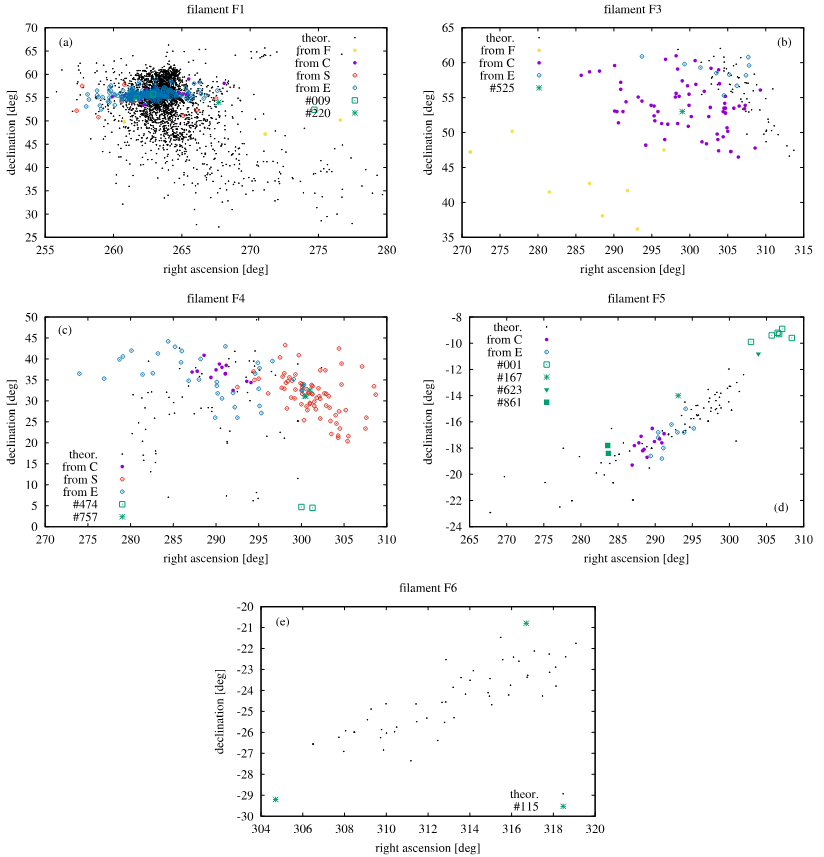
Fig. 1. The positions of the radiants of theoretical particles in filaments F1, F3–F6 (black triangles) and the positions of the real meteors in the shower corresponding to a given filament (yellow, violet, red, and blue full or empty circles indicating the identification of shower in F, C, S, and E databases, respectively). The mean radiants of the showers in the IAU MDC list of showers corresponding to given filament are shown with a large green symbol.
How to cite: Neslušan, L. and Tomko, D.: Long-period dynamical evolution of the meteoroid stream originating in comet 21P/Giacobini-Zinner, EPSC-DPS Joint Meeting 2025, Helsinki, Finland, 7–12 Sep 2025, EPSC-DPS2025-457, https://doi.org/10.5194/epsc-dps2025-457, 2025.


