
 1,
1,- 1University of Arizona, Lunar and Planetary Laboratory, Planetary Sciences, Tucson, AZ, United States of America (ellenshowell@gmail.com)
- 2Johns Hopkins University/Applied Physics Laboratory, Laurel, MD, USA
- 3University of Central Florida, Orlando, FL, USA
- 4University of Maine at Farmington, Farmington, ME, USA
We use multiple observations of NEAs to constrain thermophysical models, probe the thermal inertia, and determine sizes from albedos. We examine a variety of NEAs observed at the NASA Infrared Telescope Facility (IRTF) using SpeX [1] in the 0.8-5 micron range to better understand their structure and surface properties. When radar observations contribute to shape models, the thermophysical modeling can be more sophisticated and better utilized. However, even basic shape information such as obliquity constraints and rotation rate (i.e.fast or very slow) can improve the modeling results. We choose targets that are planned to be observed with radar, or that already have radar observations to serve as an independent measure of the size. The radar range depth is a direct measure of the asteroid’s extent in the line-of-sight at the time of observation. If NEOWISE observations are available, these can also be very helpful for individual objects, provided the images are carefully checked [2].
Shape models of NEAs show a remarkable variety of shapes. At diameters of 100m and larger, rubble-pile structures with spheroidal shapes are common (about 25%). However, simple thermal models like NEATM [3] that assume a spherical shape can give albedo best-fit values that do not match the asteroid’s diameter. There are many reasons that a simple model may miss important realistic characteristics, and the shape is not always the most important factor. Large solar phase angles, non-zero obliquity, and rough and irregular surface texture can also be important. At the same time, thermal observations of very slowly rotating asteroids, including those in non-principal axis (NPA) rotation states, often fit remarkably well using a spherical model even with very elongated or irregular shapes. Interpretation of the model results in cases where the size and shape are known independently from radar observations can be instructive. Figure 1 (top) shows thermal observations from the NASA IRTF in 2018 of (163899) 2003 SD220. This NEA was observed at both Arecibo Observatory and Goldstone [4]. A radar image is shown in Figure 1 (bottom). This object is in an NPA rotation state with apparent rotation of about 285 days. The solar phase angle was 80-84 degrees at the time of observation. The changing beaming parameter indicates that other effects such as self-shadowing or surface roughness are important to match the observations. We will present additional examples of NEA thermal modeling and explore the reasons for the model fit to be either better or worse than one might expect.

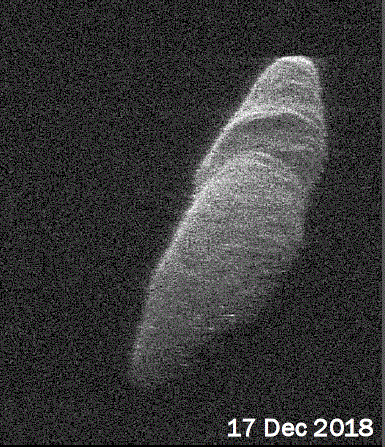
Figure 1. (top) Spectra and model fits for 2003 SD220 taken in 2018 on four different dates. Thermal inertia is assumed to be zero due to the very slow rotation period. A simple model fits well despite the very irregular shape. The radar image on the bpttpm was taken on 17 Dec 2018 in bistatic mode [4] transmitting from Goldstone and receiving at the Green Bank Telescope. This asteroid has an apparent size of at least 2.5km and shows ridges and surface concavities.
[1] Rayner, J. T., Toomey, D. W. Onaka, P. M. Denault, A. J. ; Stahlberger, W. E. ; Vacca, W. D. ; Cushing, M. C. ; Wang, S.(2003) PASP 115, Issue 805, pp. 362-382.
[2] Myers, S. A., Howell, E. S. Fernández, Yanga R. Marshall, Sean E. Magri, Christopher Vervack, Ronald J. Hinkle, Mary L., (2025) NEOWISE Data Processing and Color Corrections for Near-Earth Asteroid Observations, PSJ 6, Issue 4 id 80 12pp.
[3] Harris, A. W. (1998), A thermal model for near-Earth asteroids, Icarus 131, 291-30
[4] Rivera-Valentin, E. G., Taylor, P. A., Reddy, V.; Jao, J. S.; Benner, L. A. M.; Brozovic, M.; Naidu, S. P.; Virkki, A. K.; Marshall, S. E.; Sanchez, J. A.; Bonsall, A.; Seymour, A.; Ghigo, F. D.; Busch, M. W., (2019) “Radar and Near-Infrared Characterization of Near-Earth Asteroid (163899) 2003 SD220”, 50th LPSC LPI contrib. 2132 id3016.
How to cite: Howell, E., Vervack, R., Fernandez, Y., Myers, S., Hinkle, M., Magri, C., Marshall, S., and Rivera-Valentin, E.: Combining thermal and radar observations of near-Earth asteroids, EPSC-DPS Joint Meeting 2025, Helsinki, Finland, 7–12 Sep 2025, EPSC-DPS2025-462, https://doi.org/10.5194/epsc-dps2025-462, 2025.


