
- 1McGill University, Earth and planetary science, Canada (mahesh.herath@mail.mcgill.ca)
- 2University of York
- 3Trottier Space Institute
- 4University of Alberta
- 5University of San Diego
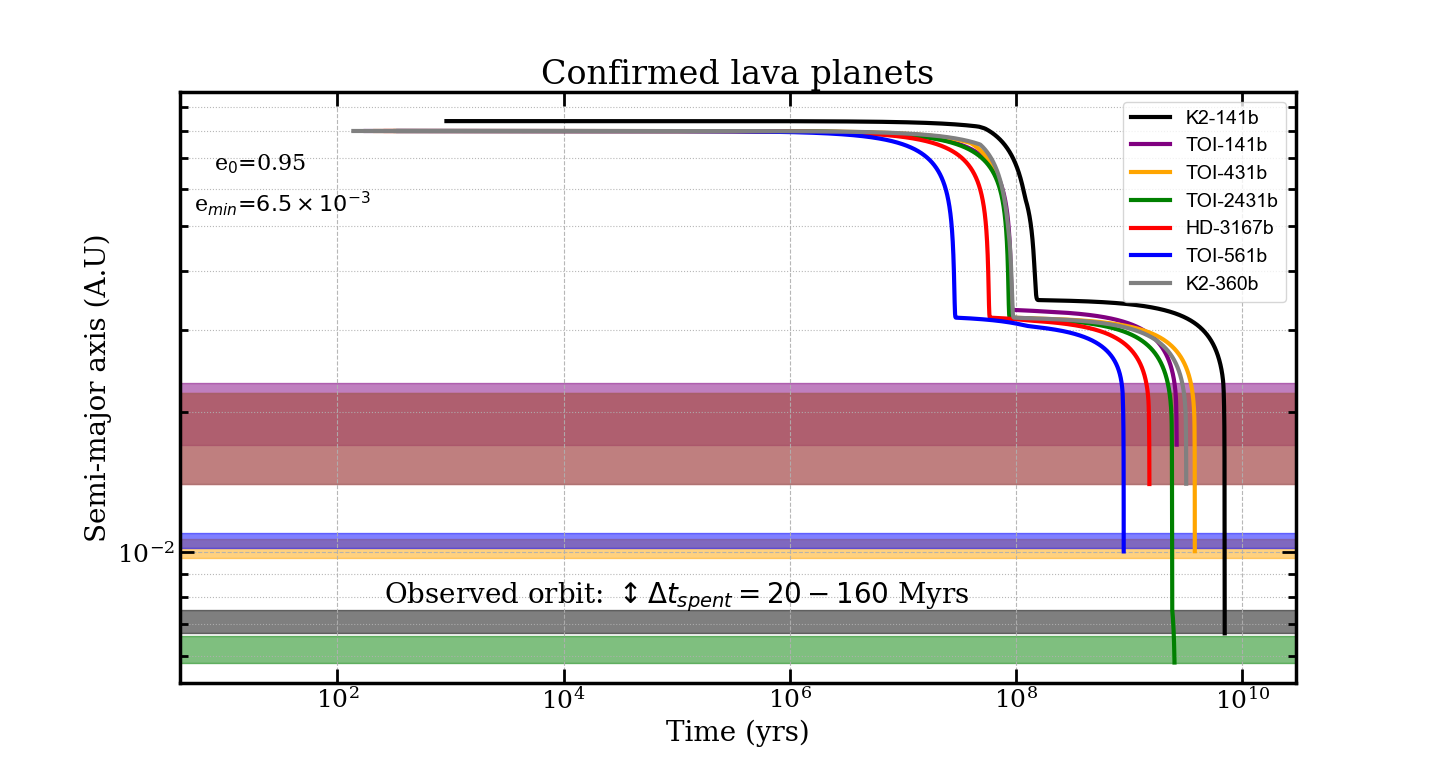
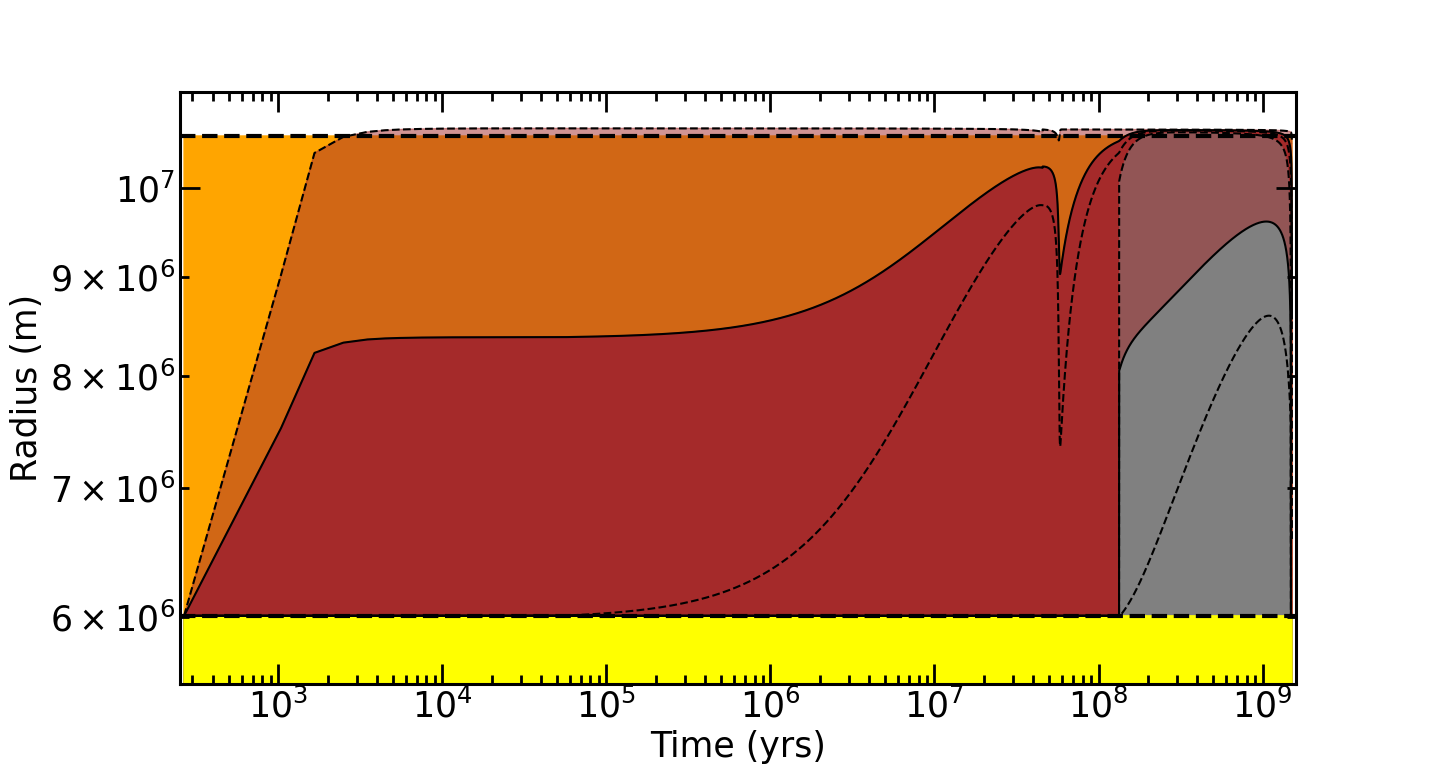
One of the mostfascinating types of exoplanets we have discovered are lava planets. Lava planets are rocky planets that have orbital periods of one day or less. Due to their proximity to the host star and the resulting high stellar flux, they can maintain a permanent dayside magma ocean, with a likely solid nightside. It is however very unlikely they formed in their observed positions. They may have migrated into their current locations via tidal decay. The present state of the magma oceans in the two hemispheres of these planets can be affected by their migratory history. We investigate if a lava planet can have a molten nightside (hence a global magma ocean) resulting from tidal heating during planetary migration. We also aim to determine the process by which lava planets can migrate to their current locations. We created a coupled interior thermal model and orbit dynamics model that leads to a feedback loop between changes in the interior and the orbit. We investigate if tidal dissipation is sufficient to decay an orbit far enough for a rocky planet to become a lava planet. To this end, we included a dynamic tidal dissipation factor Q for the planet interior. The dissipation factor was affected by the changes in the structure of the lava planet interior, which in turn contributes to the changes in the orbit of the planet.
We simulated planets between 1.0 and 1.8 Earth-radii and had their internal structures evolve as they migrate from 0.1 AU to 0.006 AU (14 day to 14 hour orbital periods). This range of values are consistent with known lava planets. We conducted a grid search between eccentricities of 0.01 to 0.9 and semi-major axes from 0.01 to 0.1. The goal of the search was to find the optimal conditions that can create a lava planet. We find that a fully molten nightside would at most last about 100 million years through tidal heating at high eccentricities (e > 0.5). Such high eccentricities would only be feasible if the planet began its tide induced migration at distances between 0.03 and 0.06 AU. A partially molten (mushy) nightside can be sustained for billions of years if a small, measurable eccentricity ( 0.0001 < e < 0.001) is maintained in the orbit. In fact, this base eccentricity was vital to allow our model planets to migrate into semi-major axes consistent with sub-one-day orbital periods. Without the base eccentricity, the orbits circularized too rapidly until they stabilized at locations far from their known orbits. To maintain a base eccentricity, the presence of another planet is necessary to give an energy boost to the orbit of the model planet. It was notable that the planets in our simulations exhibited 3 stages in their migration process. There was high eccentricity migration initially where the semi-major axis changed dramatically, followed by orbital stability for billions of years, and finally falling towards the star due to the sustained base eccentricity.
The results show that a global magma ocean is unlikely through migration induced tidal heating, but a molten dayside and a mushy nightside is feasible. We also find that tidal decay alone may be unable to cause planetary migration into ultra short period orbits and would require the planet to be in a resonant orbit with an additional outer planet. The thermal-orbital model suggests lava planets in general are falling into their star. If they pass through their current observed orbits at a slow enough pace, they can be observed without showing high variation in orbital period.
How to cite: Herath, M., Boukaré, C.-É., Cowan, N., Dumberry, M., and Lee, E.: The coupled thermal and orbital evolution of lava planets, EPSC-DPS Joint Meeting 2025, Helsinki, Finland, 7–12 Sep 2025, EPSC-DPS2025-465, https://doi.org/10.5194/epsc-dps2025-465, 2025.


