
 2,3,1,1,4,5,1
- 1Faculty of Aerospace Engineering, Delft University of Technology, Delft, Netherlands
- 2Division of Geological and Planetary Sciences, California Institute of Technology, Pasadena, CA, USA
- 3Jet Propulsion Laboratory, California Institute of Technology, Pasadena, CA, USA
- 4European Space Research and Technology Centre, ESA, Noordwijk, the Netherlands
- 5Lunar and Planetary Laboratory, University of Arizona, Tucson, AZ , USA
- 6Department of Earth and Planetary Sciences, University of California, Santa Cruz, California, USA
Introduction Tidal observations have provided crucial insight into the interior of various Solar System bodies; including Mercury (1), Venus (2), the Moon (3, 4), Mars (5, 6), Jupiter (7), Io (8) and Titan (9, 10). Previous efforts to characterize planetary interior structures using tides have focused on inferring one-dimensional (i.e., radial) structure. However, lateral variations in properties can induce patterns of tidal deformation that are distinct from those produced by radial structure, thus allowing for a 3D characterization of the interior through future detailed observations of time-varying gravity or shape.
In a spherically symmetric body, the tidal response mirrors the wavelength of the tidal forcing. However, lateral heterogeneities cause mode coupling (i.e., interaction between forcing and response at mutually distinct harmonics). This wavelength-dependent variation in tidal deformation forms the basis of tidal tomography — a technique that seeks to constrain internal 3D structure by measuring the body's tidal response across different wavelengths (11–14).
Here, we present the first application of tidal tomography beyond Earth, explore its potential use in ongoing missions, and advocate for its broader consideration in future planetary exploration efforts.
First Uses of Tidal Tomography Beyond Earth Due to the high precision required to detect signals associated with 3D structure, tidal tomography had been applied only to the Earth (15). But, recently, a reanalysis of GRAIL Lunar gravity data has revealed a nearside/farside dichotomy in the Moon’s mantle from its unexpectedly large-amplitude degree three response, suggesting a ~100K thermal anomaly (16). While this constitutes the first application of this technique to an extraterrestrial body, more examples might soon follow. Juice’s 3GM instrument will be precise enough to unveil variations of Ganymede’s outer ice shell of a few percent its mean shell thickness (17). The effects of 3D tides might also be recorded on the surface of planetary bodies. The distribution of Io’s volcanoes might be indicative of tidal dissipation in a body with an asthenosphere with a laterally varying melt distribution (18).
Future Applications of Tidal Tomography The first use of tidal tomography beyond Earth demonstrates the potential to map the three-dimensional interior structure of planetary bodies remotely. We argue that future missions should consider using tidal tomography to characterize 3D structures in planetary interiors. Enceladus is perhaps the clearest example. Static gravity and shape data hints at thickness variations in Enceladus’ crust (19, 20), which are expected to drive an exceptionally large-amplitude mode coupled tidal response for the body (12, 21, 22). Lateral variations in interior properties are the fingerprint of processes relevant to habitability (e.g., ocean circulation, the distribution of tidal heating). With the tiny Saturnian moon being one of the top priority planetary science targets for both ESA and NASA, tidal tomography should be considered in future Enceladan missions.
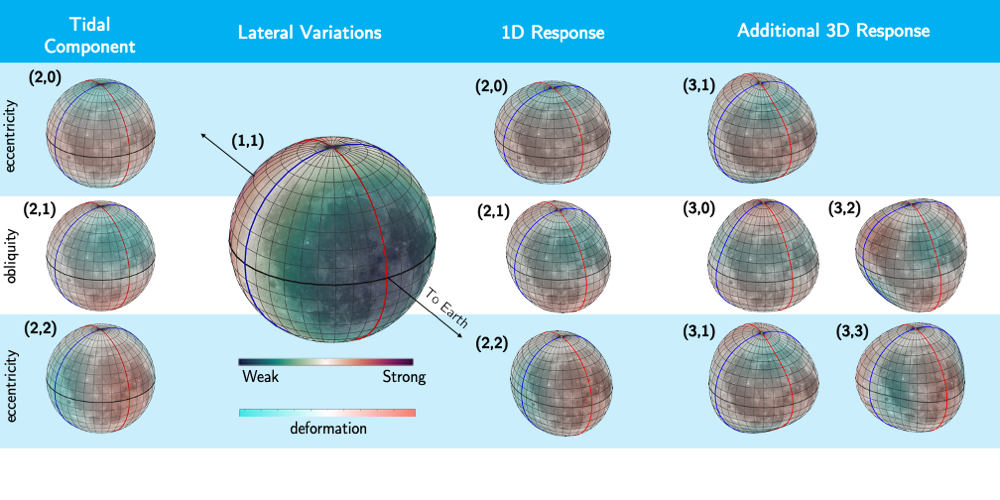
Figure 1: Schematic representation of the tidal response of the Moon to various tidal components for a 1D and a 3D Moon
References
1. S. Padovan, J. L. Margot, S. A. Hauck, W. B. Moore, S. C. Solomon, J Geophys Res Planets. 119, 850–866 (2014).
2. A. S. Konopliv, C. F. Yoder, Geophys Res Lett. 23, 1857–1860 (1996).
3. I. Matsuyama et al., Geophys Res Lett. 43, 8365–8375 (2016).
4. J. G. Williams et al., J Geophys Res Planets. 119, 1546–1578 (2014).
5. C. F. Yoder, A. S. Konopliv, D. N. Yuan, E. M. Standish, W. M. Folkner, Science (1979). 300, 299–303 (2003).
6. L. Pou et al., J Geophys Res Planets, in press, doi:https://doi.org/10.1029/2022JE007291.
7. D. Durante et al., Geophys Res Lett, in press, doi:https://doi.org/10.1029/2019GL086572.
8. R. S. Park et al., Nature. 638, 69–73 (2025).
9. D. Durante, D. J. Hemingway, P. Racioppa, L. Iess, D. J. Stevenson, Icarus. 326, 123–132 (2019).
10. S. Goossens, B. van Noort, A. Mateo, E. Mazarico, W. van der Wal, Nat Astron. 8, 846–855 (2024).
11. C. Qin, S. Zhong, J. Wahr, Geophys J Int. 207, 89–110 (2016).
12. M. Rovira-Navarro, I. Matsuyama, A. Berne, Planet Sci J. 5, 129 (2024).
1.3 S. Zhong, C. Qin, G. A, J. Wahr, Geophys Res Lett. 39 (2012).
14. L. Métivier, M. Greff-Lefftz, M. Diament, Geophys J Int. 167, 1060–1076 (2006).
15. H. C. P. Lau et al., Nature. 551, 321–326 (2017).
16. R. S. Park and A. Berne and A. S. Konopliv and J. T. Keane and I. Matsuyama and F. Nimmo and M. Rovira-Navarro and M. P. Panning and M. Simons and D. J. Stevenson and R. C. Weber, Nature (accepted)(2025).
17. M. Rovira-Navarro et al., Geophys Res Lett (2025).
18. A. Veenstra, M. Rovira-Navarro, W. van der Wal, T. Steinke, A. Davies, Res Sq (2025), doi:10.21203/rs.3.rs-5522583/v1.
19. D. J. Hemingway, T. Mittal, Icarus. 332, 111–131 (2019).
20. M. Beuthe, A. Rivoldini, A. Trinh, Geophys Res Lett. 43, 10, 10–88, 96 (2016).
21. A. Berne, M. Simons, J. T. Keane, R. S. Park, Geophys Res Lett. 50 (2023), doi:10.1029/2023GL106656.
22. M. Beuthe, Icarus. 302, 145–174 (2018).
How to cite: Rovira-Navarro, M., Berne, A., Park, R. S., Veenstra, A., Calliess, D., Dirkx, D., Fayolle, S., Matsutayama, I., Nimmo, F., Simons, M., and van der Wal, W.: Using Tidal Tomography to Unveil the 3D Structure of Moons, EPSC-DPS Joint Meeting 2025, Helsinki, Finland, 7–12 Sep 2025, EPSC-DPS2025-49, https://doi.org/10.5194/epsc-dps2025-49, 2025.


