TP13 | Planetary Dynamics: Shape, Gravity, Orbit, Tides, and Rotation from Observations and Models

TP13

Planetary Dynamics: Shape, Gravity, Orbit, Tides, and Rotation from Observations and Models
Convener: Haifeng Xiao | Co-conveners: Attilio Rivoldini, Alexander Berne, Alexander Stark, Vishnu Viswanathan, William Desprats
Orals TUE-OB2
| Tue, 09 Sep, 09:30–10:30 (EEST)
 
Room Uranus (Helsinki Hall)
Posters TUE-POS
| Attendance Tue, 09 Sep, 18:00–19:30 (EEST) | Display Tue, 09 Sep, 08:30–19:30
 
Finlandia Hall foyer, F53–64
Tue, 09:30
Tue, 18:00
Shape, gravity field, orbit, tidal deformation, and rotation state are fundamental geodetic parameters of any planetary object. Measurements of these parameters are prerequisites for spacecraft navigation and mapping from orbit as well as modelling of planetary internal structure and evolution. This session welcomes contributions from all aspects of planetary geodesy, including relevant theories, observations, planned measurement concepts as well as modeling efforts in application to planets, satellites, asteroids, and comets.

Session assets

Orals: Tue, 9 Sep, 09:30–10:30 | Room Uranus (Helsinki Hall)

Chairpersons: Haifeng Xiao, William Desprats
09:30–09:42
|
EPSC-DPS2025-49
|
ECP
|
On-site presentation
Marc Rovira-Navarro, Alex Berne, Ryan S Park, Allard Veenstra, Daniel Calliess, Dominic Dirkx, Sam Fayolle, Isamu Matsutayama, Francis Nimmo, Mark Simons, and Wouter van der Wal

Introduction Tidal observations have provided crucial insight into the interior of various Solar System bodies; including Mercury (1), Venus (2), the Moon (3, 4), Mars (5, 6), Jupiter (7), Io (8) and Titan (9, 10). Previous efforts to characterize planetary interior structures using tides have focused on inferring one-dimensional (i.e., radial) structure. However, lateral variations in properties can induce patterns of tidal deformation that are distinct from those produced by radial structure, thus allowing for a 3D characterization of the interior through future detailed observations of time-varying gravity or shape.

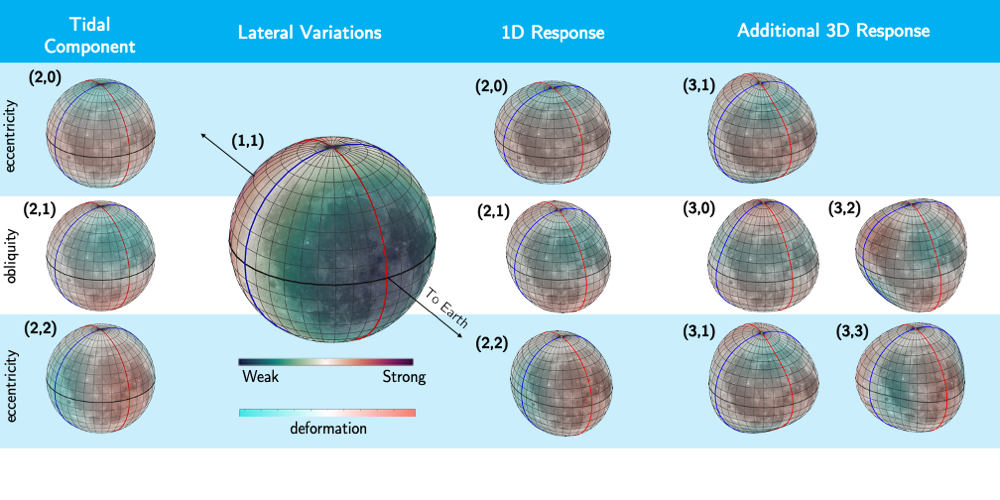
In a spherically symmetric body, the tidal response mirrors the wavelength of the tidal forcing. However, lateral heterogeneities cause mode coupling (i.e., interaction between forcing and response at mutually distinct harmonics). This wavelength-dependent variation in tidal deformation forms the basis of tidal tomography — a technique that seeks to constrain internal 3D structure by measuring the body's tidal response across different wavelengths (1114).

Here, we present the first application of tidal tomography beyond Earth, explore its potential use in ongoing missions, and advocate for its broader consideration in future planetary exploration efforts.

First Uses of Tidal Tomography Beyond Earth Due to the high precision required to detect signals associated with 3D structure, tidal tomography had been applied only to the Earth (15). But, recently, a reanalysis of GRAIL Lunar gravity data has revealed a nearside/farside dichotomy in the Moon’s mantle from its unexpectedly large-amplitude degree three response, suggesting a ~100K thermal anomaly (16). While this constitutes the first application of this technique to an extraterrestrial body, more examples might soon follow. Juice’s 3GM instrument will be precise enough to unveil variations of Ganymede’s outer ice shell of a few percent its mean shell thickness (17). The effects of 3D tides might also be recorded on the surface of planetary bodies. The distribution of Io’s volcanoes might be indicative of tidal dissipation in a body with an asthenosphere with a laterally varying melt distribution (18).  

Future Applications of Tidal Tomography The first use of tidal tomography beyond Earth demonstrates the potential to map the three-dimensional interior structure of planetary bodies remotely. We argue that future missions should consider using tidal tomography to characterize 3D structures in planetary interiors. Enceladus is perhaps the clearest example. Static gravity and shape data hints at thickness variations in Enceladus’ crust (19, 20), which are expected to drive an exceptionally large-amplitude mode coupled tidal response for the body (12, 21, 22).  Lateral variations in interior properties are the fingerprint of processes relevant to habitability (e.g., ocean circulation, the distribution of tidal heating). With the tiny Saturnian moon being one of the top priority planetary science targets for both ESA and NASA, tidal tomography should be considered in future Enceladan missions.

Figure 1: Schematic representation of the tidal response of the Moon to various tidal components for a 1D and a 3D Moon

References

1. S. Padovan, J. L. Margot, S. A. Hauck, W. B. Moore, S. C. Solomon, J Geophys Res Planets. 119, 850–866 (2014).

2. A. S. Konopliv, C. F. Yoder, Geophys Res Lett. 23, 1857–1860 (1996).

3. I. Matsuyama et al., Geophys Res Lett. 43, 8365–8375 (2016).

4. J. G. Williams et al., J Geophys Res Planets. 119, 1546–1578 (2014).

5. C. F. Yoder, A. S. Konopliv, D. N. Yuan, E. M. Standish, W. M. Folkner, Science (1979). 300, 299–303 (2003).

6. L. Pou et al., J Geophys Res Planets, in press, doi:https://doi.org/10.1029/2022JE007291.

7. D. Durante et al., Geophys Res Lett, in press, doi:https://doi.org/10.1029/2019GL086572.

8. R. S. Park et al., Nature. 638, 69–73 (2025).

9. D. Durante, D. J. Hemingway, P. Racioppa, L. Iess, D. J. Stevenson, Icarus. 326, 123–132 (2019).

10. S. Goossens, B. van Noort, A. Mateo, E. Mazarico, W. van der Wal, Nat Astron. 8, 846–855 (2024).

11. C. Qin, S. Zhong, J. Wahr, Geophys J Int. 207, 89–110 (2016).

12. M. Rovira-Navarro, I. Matsuyama, A. Berne, Planet Sci J. 5, 129 (2024).

1.3 S. Zhong, C. Qin, G. A, J. Wahr, Geophys Res Lett. 39 (2012).

14. L. Métivier, M. Greff-Lefftz, M. Diament, Geophys J Int. 167, 1060–1076 (2006).

15. H. C. P. Lau et al., Nature. 551, 321–326 (2017).

16. R. S. Park and A. Berne and A. S. Konopliv and J. T. Keane and  I. Matsuyama and F. Nimmo and M. Rovira-Navarro and M. P. Panning and M. Simons and D. J. Stevenson and R. C. Weber, Nature (accepted)(2025).

17. M. Rovira-Navarro et al., Geophys Res Lett (2025).

18. A. Veenstra, M. Rovira-Navarro, W. van der Wal, T. Steinke, A. Davies, Res Sq (2025), doi:10.21203/rs.3.rs-5522583/v1.

19. D. J. Hemingway, T. Mittal, Icarus. 332, 111–131 (2019).

20. M. Beuthe, A. Rivoldini, A. Trinh, Geophys Res Lett. 43, 10, 10–88, 96 (2016).

21. A. Berne, M. Simons, J. T. Keane, R. S. Park, Geophys Res Lett. 50 (2023), doi:10.1029/2023GL106656.

22. M. Beuthe, Icarus. 302, 145–174 (2018).

How to cite: Rovira-Navarro, M., Berne, A., Park, R. S., Veenstra, A., Calliess, D., Dirkx, D., Fayolle, S., Matsutayama, I., Nimmo, F., Simons, M., and van der Wal, W.: Using Tidal Tomography to Unveil the 3D Structure of Moons, EPSC-DPS Joint Meeting 2025, Helsinki, Finland, 7–13 Sep 2025, EPSC-DPS2025-49, https://doi.org/10.5194/epsc-dps2025-49, 2025.

09:42–09:54
|
EPSC-DPS2025-1447
|
ECP
|
On-site presentation
Edoardo Santero Mormile and Giuseppe Mitri

Determining the internal structure of planetary bodies from gravitational observations is a key challenge in planetary geophysics. Gravity inversion techniques make it possible to estimate mass distribution by combining information on a body's shape, gravitational field, and rotational dynamics. However, gravity data alone present a well-known ambiguity between mass magnitude and depth, making the interpretation of internal layering a complex inverse problem.


We present SynthGen, a code developed to simulate the gravitational response of planetary bodies based on parametric interior models. It exploits the spherical harmonics framework described in Wieczorek [1], through the computation of gravitational harmonic coefficients [Cnm, Snm] which characterise the global gravitational field, thanks to the SHTools [6] routines. SynthGen takes as input a simplified multi-layer interior model, assuming them homogenous. Model parameters consist of the number of internal layers, their mean thickness and density, and eventually, the topography of internal interfaces. On the latter, several ways are implemented: sphere, polar/equatorial flattened ellipsoid, randomly generated topography, downwarded Bouguer anomaly (see Wieczorek & Phillips [2], avoiding isostacy assumptions) and finally an input user grid. Given these inputs, SynthGen computes the corresponding gravitational potential, Free-Air anomalies, and Bouguer anomaly fields for the modelled body, generating full-resolution global maps.

SynthGen outputs can be used in two ways: if it is used to simulate a known body, so a gravity model is already available, the synthetic results can be compared to the real measurements, assessing the validity of the evaluated interior model and measuring its performance through different metrics. In this case, SynthGen performed an automated parameter-space exploration (controlled by the user). By randomly sampling model parameters within physically plausible bounds that it is user-configurable (constrained by the satisfaction of the conservation of total mass and moment of inertia, together with external shape constraints), it iteratively evaluates a wide range of configurations. The optimal internal structure is determined by identifying the parameter set that minimises discrepancies between simulated and observed gravitational data. This is performed through a suite of statistical metrics (e.g. RMSE, MAE, R2, SSIM, NCC, PSNR, etc.), finally combined into one. We tested this procedure on Mercury, using a publicly available MESSENGER-derived gravitational model (namely HgM009, from Genova et al, 2015 [3]), exploring a simple 3-layers structure and one with an internal core differentiation (4-layers). SynthGen retrieves a best-fit crust-mantle boundary at approximately 34.5 +/- 10.7 [km] depth and the core parameters at ~7267.2 +/- 47.5 [kg/m³] and core bulk radius at 1984.1 +/- 14.4 [km], in agreement with recent geophysical studies [4,5,6]. These results validate the method’s robustness and reliability.

In addition to this procedure, SynthGen can be used predictively in case of an “unmeasured” body. It enables forward modelling of gravitational signals expected from future targets such as Ganymede [5], which will be studied in detail by ESA’s upcoming JUICE mission. It can thus serve as a valuable tool for testing theoretical interior structures and simulating their measurable gravitational signatures.

By combining analytical modelling, numerical efficiency, and flexibility across planetary scenarios, SynthGen offers a useful platform for planetary interior investigations from the gravitational point of view. It can handle various planetary shapes, datasets, and scientific objectives, and it is user configurable, together with already implemented configuration files for Mercury, Venus, Earth and Moon, together with a model of Ganymede.


Acknowledgements:
E.S.M. and G.M. acknowledge support from the Italian Space Agency (project 2023-6-HH.0). This research has been conducted within the framework of the Italian national inter-university PhD programme in Space Science and Technology.


References:
[1] M. A. Wieczorek, "Gravity and Topography of the Terrestrial Planets", in Treatise on Geophysics, Elsevier, 2015, pp. 153–193. doi:10.1016/B978-0-444-53802-4.00169-X
[2] M. A. Wieczorek and R. J. Phillips, “Potential anomalies on a sphere: Applications to the thickness of the lunar crust”, JGR: Planets, vol. 103, no. E1, pp. 1715–1724, 1998. doi:10.1029/97JE03136
[3] A. Genova et al., “Regional variations of Mercury’s crustal density and porosity from MESSENGER gravity data”, Icarus, vol. 391, p. 115332, 2023.
[4] S. Buoninfante et al., “Gravity evidence for a heterogeneous crust of Mercury”, Scientific Reports, vol. 13, 19854, 2023. https://doi.org/10.1038/s41598-023-46081-4

[5] A. Rivoldini, T. Van Hoolst, “The interior structure of Mercury constrained by the low-degree gravity field and the rotation of Mercury”, Earth and Planetary Science Letters, 2013, https://doi.org/10.1016/j.epsl.2013.07.021.

[6] Margot, Jean-Luc, et al. "Mercury's internal structure." arXiv preprint arXiv:1806.02024 (2018).

[7] D. M. Fabrizio et al., ‘Observability of Ganymede’s gravity anomalies related to surface features by the 3GM experiment onboard ESA’s JUpiter ICy moons Explorer (JUICE) mission’, Icarus, 2021.

[8] Mark A. Wieczorek and Matthias Meschede (2018). “SHTools — Tools for working with spherical harmonics”, Geochemistry, Geophysics, Geosystems, 19, 2574-2592, doi:10.1029/2018GC007529.

How to cite: Santero Mormile, E. and Mitri, G.: SynthGen: A Gravitational Simulator For Planetary Interior Modelling  , EPSC-DPS Joint Meeting 2025, Helsinki, Finland, 7–13 Sep 2025, EPSC-DPS2025-1447, https://doi.org/10.5194/epsc-dps2025-1447, 2025.

09:54–10:06
|
EPSC-DPS2025-1617
|
ECP
|
On-site presentation
Pierre-Louis Phan and Nicolas Rambaux

Five Venus missions are under development to study the planet in the next decade, with ESA's EnVision and NASA's VERITAS both including a geophysical investigation among their objectives[1]. Their radar and gravity experiments will observe Venus's orientation, enabling spin dynamics analyses to infer geophysical and atmospheric properties.

To support these future observations, we developed a polar motion model for Venus. Polar motion describes the motion of a planet's spin axis relative to its surface. It is distinct from precession-nutation, which describes the motion of the spin axis relative to the fixed celestial sphere. Both motions provide complementary constraints for interior models.

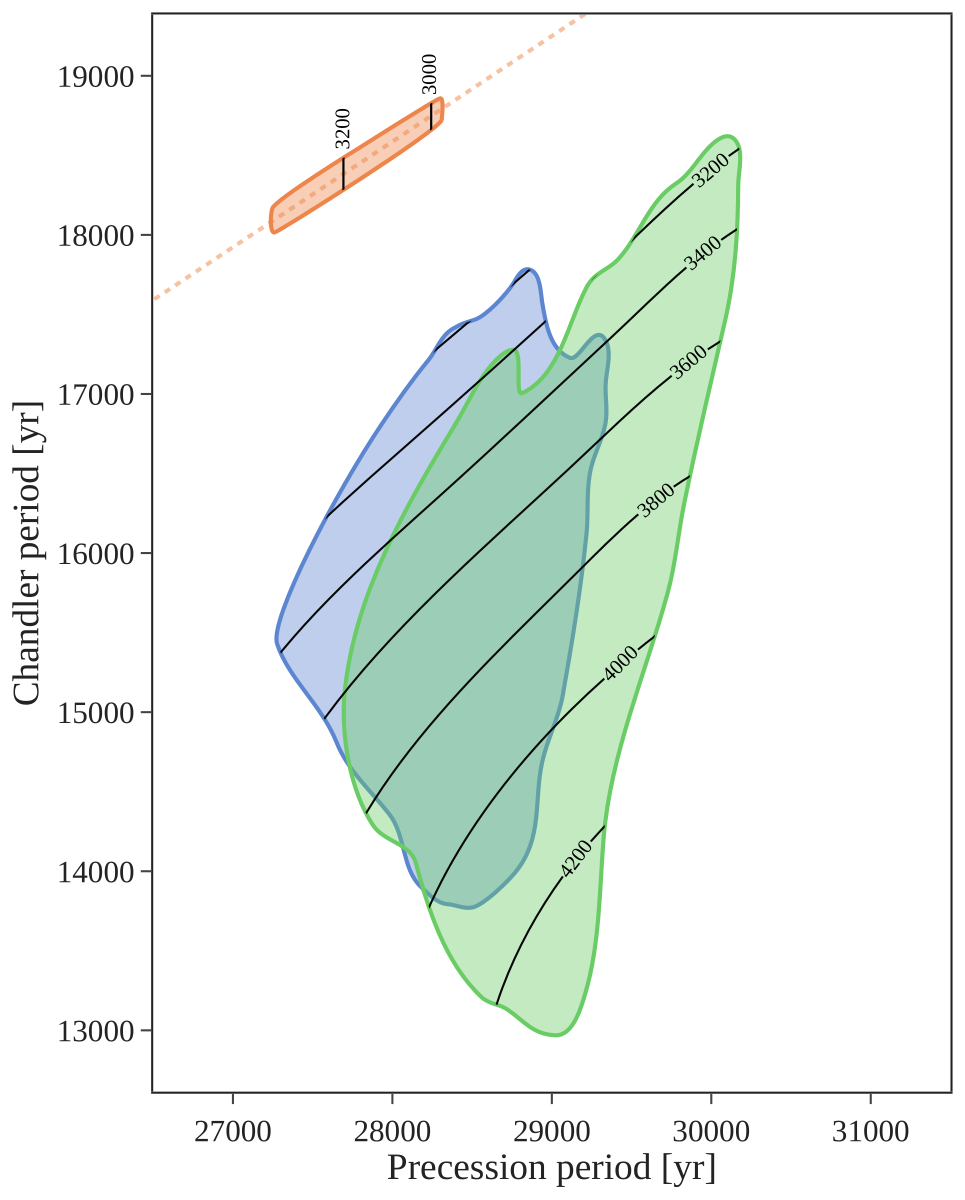
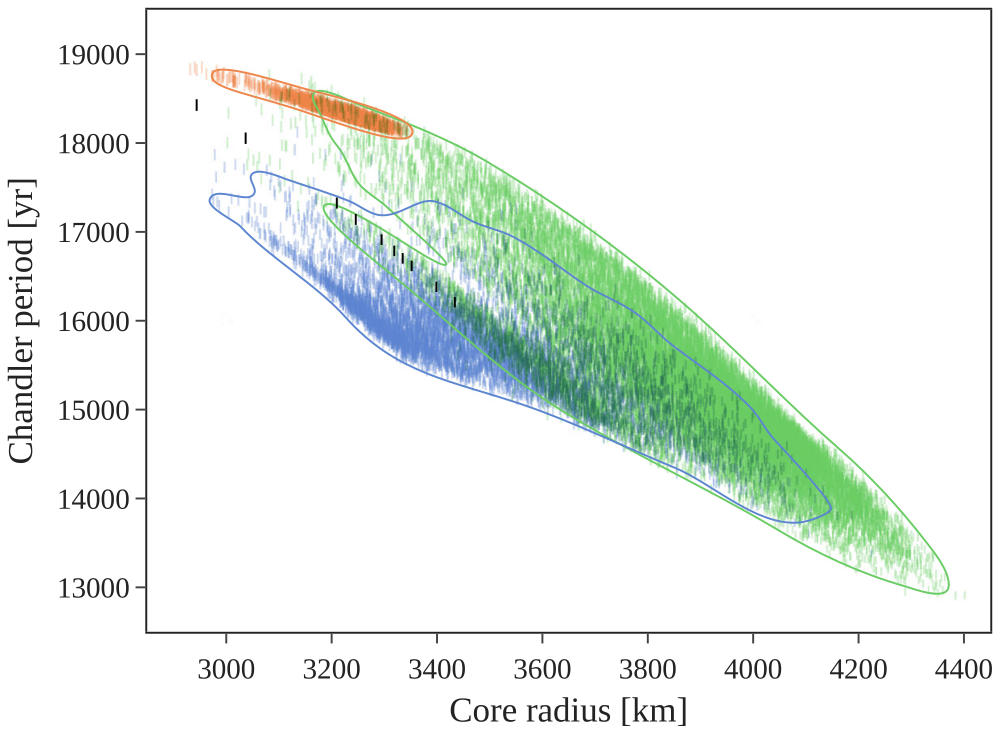
Our polar motion model accounts for solar torque, deformations of a viscoelastic mantle, and atmospheric dynamics. We revisited the expression for the free motion period: solar torque is the dominant phenomenon affecting Venus's Chandler period, accelerating the wobble by a factor of 2.75. Using available interior models[2], we predict a Chandler period in the range [12900 ; 18900] years (Fig.1 below)[3]. During EnVision's four-year primary mission, this manifests as a linear drift of about 90 meters (±20 m) of the spin pole on Venus's surface, comparable to the expected precession of 240 meters.

Therefore, when anticipating the upcoming orbiter missions, polar motion should be incorporated into Venus rotation models, alongside the precession and spin rate variations whose recovery has already been simulated[4,5]. A combined recovery of both the precession and Chandler periods could reveal the state and estimate the size of Venus’s core (Fig.2 below)[3].

Figure 1 - Chandler period of Venus computed for different interior models. Colored bars correspond to the density profiles from Shah et al. [2], featuring either a fully liquid core (green), a solid inner core with a liquid outer core (blue), or a fully solid core (orange). For each core state, the 99% contour of a kernel density estimate is shown. Black bars correspond to the density profiles from Dumoulin et al. [6], all featuring fully liquid cores.

Figure 2 - Chandler and precession periods of Venus computed for the density profiles of Shah et al. [2], featuring either a fully liquid core (green), a solid inner core with a liquid outer core (blue), or a fully solid core (orange). For each core state, the 99% contour of a kernel density estimate is shown. Black level lines indicate the core size of the models in kilometers, to within 50 km.

[1] Widemann et al. (2023), Space Science Reviews, doi:10.1007/s11214-023-00992-w
[2] Shah et al. (2022), The Astrophysical Journal, doi:10.3847/1538-4357/ac410d
[3] Phan and Rambaux (2025, under review)
[4] Rosenblatt et al. (2021), Remote Sensing, doi:10.3390/rs13091624
[5] Cascioli et al. (2021), Planetary Science Journal, doi:10.3847/psj/ac26c0
[6] Dumoulin et al. (2017), JGR Planets, doi:10.1002/2016je005249

How to cite: Phan, P.-L. and Rambaux, N.: Towards a comprehensive rotation model for Venus, EPSC-DPS Joint Meeting 2025, Helsinki, Finland, 7–13 Sep 2025, EPSC-DPS2025-1617, https://doi.org/10.5194/epsc-dps2025-1617, 2025.

10:06–10:18
|
EPSC-DPS2025-325
|
ECP
|
On-site presentation
Haifeng Xiao, Alexander Stark, Attilio Rivoldini, Marie Yseboodt, Stefano Bertone, Rose-Marie Baland, Oliver Stenzel, Arthur Briaud, Hauke Hussmann, Luisa Lara, and Pedro Gutiérrez

Mercury is locked in a 3:2 spin-orbit resonance. Moreover, the combination of its non-spherical shape and eccentric orbit lead to reversing torques that produce small periodic changes in its spin rate, a motion referred to as forced (physical) libration. The annual (88-day) libration of Mercury has been determined independently based on observations from Earth-based radar (Margot et al., 2012), camera and/or laser altimeter (Stark et al., 2015; Bertone et al., 2021), and radio tracking (Mazarico et al., 2014; Genova et al., 2019; Konopliv et al., 2020). Unfortunately, the precision of such annual libration measurements does not allow the detection of a large solid inner core (Van Hoolst et al., 2012). Additional long-period forced librations due to the non-Keplerian characteristics of Mercury’s orbits could be amplified by resonances if their periods are close to that of a libration eigenperiod (Yseboodt et al., 2013). Constraints on the amplifications of these additional librations would inform us about the free libration periods, which can be related to the interior structure of Mercury. Currently, these long-period librations remain largely unknown.

We devise an alternative approach based on the self-registration of laser altimetric profiles (Xiao et al., 2022; Xiao et al., 2025a) to maximize their self-consistency, while precisely tracking temporal variations of the rotation angle of the prime meridian. This allows us to simultaneously measure the annual libration and the long-period librations. We also take advantage of the fact that mismodelings in the rotation angle and external error sources would shift the laser profiles in different ways. The orbit, pointing, and timing errors are typically slow-varying and thus lead to near-constant shifts. In contrast, offsets in the rotation angles would rotate the profiles around Mercury’s spin axis. We apply our approach to MESSENGER’s Mercury Laser Altimeter (MLA) data to constrain Mercury’s librations (Xiao et al., 2025b). 

Figure 1. Rotation angle variation, with respect to Mercury’s resonant rotation, using IAU2015 model values as priors. Each dot represents the measurement from an individual MLA profile. Results using other a priori values feature similar trends.

Simulations using realistic synthetic profiles verify that there is negligible bias associated with the proposed approach. In terms of the actual profiles, we have experimented with various a priori rotation and orientation values, i.e., Stark2015, IAU2015 (Archinal et al., 2018), Genova2019, and Bertone2021. An example of the obtained temporal variation of the rotation angle is shown in Figure 1. In addition, Figure 2 shows the amplitudes of  our measured mean rotation rate and annual libration. The obtained annual libration converges to 37.53±0.56 as, which is significantly smaller than the existing estimates and indicative for a slightly smaller outer core and a larger inner core. The amplified long-period libration is clearly visible in Figure 1 with its amplitude constrained to be 18.50±1.12 as. The captured long-period libration features a period of around 6 years, and is either induced by Venus (5.66 y), Jupiter (5.93 y), or the Earth (6.57 y).  

For interpretation, we have performed libration modelling taking into account the gravitational coupling between layers (Dumberry et al., 2013) and different core compositions to investigate the insights these measurements provide into Mercury's interior (Rivoldini et al., this meeting; Yseboodt et al., this meeting). Preliminary models favor an inner core size larger than 1,000 km.  These findings will critically enhance our understanding of Mercury’s thermal evolution and magnetic dynamo. Further improvements can be expected from data by the upcoming BepiColombo Laser Altimeter (BELA) onboard ESA/JAXA’s BepiColombo mission to Mercury (Thomas et al., 2021).

Figure 2. Rotation rates and annual libration amplitudes estimated from various a priori values, in comparison with existing estimates. The 3-σ errors for our weighted mean rotation rate and annual libration are 0.53×10⁻⁶ °/day and 0.56 as, respectively.

References

Archinal et al., 2018. Celest. Mech. Dyn. Astron., 130. https://doi.org/10.1007/s10569-017-9805-5.
Bertone et al., 2021. JGR: Planets, 126(4). https://doi.org/10.1029/2020JE006683.
Dumberry et al., 2013. Icarus, 225(1), 62-74.  https://doi.org/10.1016/j.icarus.2013.03.001.
Genova et al., 2019. GRL, 46(7). https://doi.org/10.1029/2018GL081135.
Konopliv et al., 2020. Icarus, 335, 113386. https://doi.org/10.1016/j.icarus.2019.07.020.
Margot et al., 2012. JGR: Planets, 117(E12). https://doi.org/10.1029/2012JE00416.
Mazarico et al., 2014. JGR: Planets, 119(12). https://doi.org/10.1002/2014JE004675.
Stark et al., 2015. GRL, 42(19). https://doi.org/10.1002/2015GL065152.
Thomas et al., 2021. SSR, 217, 1-62. https://doi.org/10.1007/s11214-021-00794-y.
Van Hoolst et al., 2012. EPSL, 333. https://doi.org/10.1016/j.epsl.2012.04.014.
Xiao et al., 2022. PSS, 214, 105446. https://doi.org/10.1016/j.pss.2022.105446.
Xiao et al., 2025a. GRL, 52(7), e2024GL112266. https://doi.org/10.1029/2024GL112266.
Xiao et al., 2025b. Lunar and Planetary Science Conference. https://www.hou.usra.edu/meetings/lpsc2025/pdf/1980.pdf. E-poster available at https://lpsc2025.ipostersessions.com/Default.aspx?s=6F-4E-28-F7-3A-45-58-51-CB-5C-5D-57-69-39-F5-9B.
Yseboodt et al., 2013. Icarus, 226(1). https://doi.org/10.1016/j.icarus.2013.05.011. 

How to cite: Xiao, H., Stark, A., Rivoldini, A., Yseboodt, M., Bertone, S., Baland, R.-M., Stenzel, O., Briaud, A., Hussmann, H., Lara, L., and Gutiérrez, P.: Mercury’s librations from self-registration of MESSENGER laser profiles, EPSC-DPS Joint Meeting 2025, Helsinki, Finland, 7–13 Sep 2025, EPSC-DPS2025-325, https://doi.org/10.5194/epsc-dps2025-325, 2025.

10:18–10:30
|
EPSC-DPS2025-1543
|
On-site presentation
Attilio Rivoldini, Tim Van Hoolst, Haifeng XIao, Antony Trinh, Nicola Tosi, Marie Yseboodt, Rose-Marie Baland, Jérémy Rekier, Santiago Andres Triana, and Arthur Briaud

Mercury experiences long-period forced librations as a result of periodic gravitational perturbations on its orbit from other planetary bodies. These librations can be resonantly amplified when the planetary forcing periods are close to one of the two free libration normal modes. The periods of the free libration modes strongly dependent on the interior structure of the planet and on couplings between the solid shell, outer core, and inner core. Among the internal couplings, the gravitational-pressure coupling between the planet shell and inner core has the largest effect on the forced libration amplitude and free libration periods. Although dissipative couplings — of electromagnetic or viscous origin as well as the viscous relaxation of the inner core —  have a small effect on the free libration periods, they can substantially affect the amplitude of the forced libration.    

In this study, we investigate the effect of Mercury’s interior structure, composition, thermal state, and dynamical shape on the long-period librations, incorporating the effects of internal couplings. We compare our model predictions with the recently derived long-period libration time series obtained from co-registration of MESSENGER laser altimeter observations  (Xiao et al. 2025, this meeting).

How to cite: Rivoldini, A., Van Hoolst, T., XIao, H., Trinh, A., Tosi, N., Yseboodt, M., Baland, R.-M., Rekier, J., Triana, S. A., and Briaud, A.: Effect of Mercury's interior structure on its long-period libration, EPSC-DPS Joint Meeting 2025, Helsinki, Finland, 7–13 Sep 2025, EPSC-DPS2025-1543, https://doi.org/10.5194/epsc-dps2025-1543, 2025.

Posters: Tue, 9 Sep, 18:00–19:30 | Finlandia Hall foyer

Display time: Tue, 9 Sep, 08:30–19:30
Chairpersons: Haifeng Xiao, Attilio Rivoldini
F53
|
EPSC-DPS2025-1458
|
ECP
|
On-site presentation
Arthur Briaud, Alexander Stark, Hauke Hussmann, Haifeng Xiao, Jürgen Oberst, and Attilio Rivoldini

Mercury's unique orbital and rotational dynamics, shaped by its proximity to the Sun and its elliptical orbit, result in periodic variations in tidal forces. These forces induce changes in the planet's shape and gravitational field, described by Tidal Love Numbers (TLNs). TLNs are essential for constraining Mercury’s internal structure, including core size, mantle composition, and crustal properties [1–5]. Accurate estimates of these deformations require precise observations, such as laser and radar altimetry for surface displacement and radio science to detect gravity variations, e.g., [6]. Additional instruments, including the Advanced Pointing Imaging Camera (APIC) and Earth-based repeat-pass Synthetic Aperture Radar (SAR) interferometry, also provide valuable measurements of radial tidal deformation [7–9]. Moreover, the differential flattening of Mercury’s internal layers can influence its tidal response; for example, librations of the inner core may significantly shape these deformations [10]. Mercury's TLNs are particularly sensitive to heterogeneities arising from spatial variations in temperature, composition, and physical properties. These internal variations add complexity to Mercury’s tidal behaviour by affecting the elastic and viscous response of its layers. To investigate these effects, we will employ advanced numerical models that incorporate geophysical and thermodynamic constraints. Our simulations will include variations in mantle composition, temperature distribution, and the rheological properties of the crust, mantle, and core. Similar to icy moons, where localised temperature or mineralogical differences alter mechanical responses [11,12], similar spatial heterogeneities on Mercury may result in non-uniform tidal deformation. Our approach explores a broad parameter space encompassing plausible scenarios for Mercury’s thermal evolution, core–mantle interactions, and lithospheric structure. The modelled TLNs will be compared with observational constraints such as tidal deformations, mass, and moment of inertia to refine our understanding of Mercury’s geodynamic and compositional evolution.

A key outcome of this work will be the generation of predictions to support and interpret upcoming observations from the ESA–JAXA BepiColombo mission [13]. BepiColombo, currently en route to Mercury, will deliver high-precision measurements of the planet’s shape, gravity field, and rotational dynamics. These observations will provide critical tests for our models and enable direct comparison between predicted and observed TLNs, thereby enhancing our understanding of Mercury's internal structure, including core composition, mantle heterogeneities, and lithospheric dynamics. This study underscores the importance of integrating numerical modelling with observational data to probe Mercury’s interior. In addition to leveraging insights from BepiColombo, we will incorporate independent constraints— including libration and tidal Love number h2 measurements derived from the work of H. Xiao and collaborators (EPSC abstract: Mercury’s librations from self-registration of MESSENGER laser profiles) to develop a more comprehensive view of Mercury’s interior. However, it is important to note that the expected precision improvements in obliquity, annual libration amplitude, and tidal h2 from BepiColombo’s BELA instrument, compared to MESSENGER's MLA, may not substantially refine constraints on Mercury’s deep interior. Therefore, a key focus for BELA and related investigations should be the detection of long-period librations (which can constrain inner and outer core sizes), the measurement of tidal phase lag (sensitive to mantle viscosity), and deviations from the Cassini state (related to the dissipation and mantle viscosity). These parameters offer more promising pathways for significantly improving our understanding of Mercury’s internal structure.

References:

[1] Goossens, et al., (2022), The Planetary Science Journal3(6), 145.

[2] Mazarico et al.,  (2014), JGR: Planets119(12), 2417-2436.

[3] Mosegaard and Tarantla, (1995), JGR: Solid Earth100(B7), 12431-12447.

[4] Steinbrügge et al.,  (2018), JGR: Planets123(10), 2760-2772.

[5] Rivoldini et al., (2009), Icarus201(1), 12-30.

[6] Xiao, et al., (2025). Geophysical Research Letters52(7).

[7] Park et al., (2020) , PSS194, 105095.

[8] Williams et al., (2012), Classical and Quantum Gravity29(18), 184004.

[9] Rosen et al., (2000), Proceedings of the IEEE88(3), 333-382.

[10] Rivoldini and Van Hoolst, (2013), EPSL377, 62-72.

[11] Tobie et al., (2005), Icarus, 177(2), 534-549.

[12] Rovira-Navarro,  et al., (2024), The Planetary Science Journal5(5), 129.

[13] Hussmann, and Stark, (2020), The European Physical Journal Special Topics229, 1379-1389

How to cite: Briaud, A., Stark, A., Hussmann, H., Xiao, H., Oberst, J., and Rivoldini, A.: New Insights from MESSENGER Data on Mercury’s Tidal Response and Internal Structure, EPSC-DPS Joint Meeting 2025, Helsinki, Finland, 7–13 Sep 2025, EPSC-DPS2025-1458, https://doi.org/10.5194/epsc-dps2025-1458, 2025.

F54
|
EPSC-DPS2025-641
|
ECP
|
On-site presentation
Haifeng Xiao, Alexander Stark, Rose-Marie Baland, Mathieu Dumberry, Attilio Rivoldini, Tim Van Hoolst, Marie Yseboodt, Arthur Briaud, Luisa Lara, and Pedro Gutiérrez

Like our Moon, Mercury is assumed to be driven by dissipative torques into an equilibrium Cassini state 1, where its spin axis, its orbit normal, and the Laplace pole remain coplanar during the precessional cycle. The orientation of Mercury’s spin axis has been determined independently based on observations from Earth-based radar (Margot et al., 2007, 2012), camera and/or laser altimeter (Stark et al., 2015; Bertone et al., 2021), and radio tracking (Mazarico et al., 2014; Verma and Margot, 2016; Genova et al., 2019; Konopliv et al., 2020). The obliquity, the separation angle between the spin axis and the orbital normal, is constrained to be approximately 2 arcmin and deviation of the spin axis from coplanarity is limited to a phase lag of around 10 arcsec.

If Mercury is indeed forced into an equilibrium Cassini state and the whole planet precesses as a rigid body (Dumberry, 2021), its obliquity can be used to infer its normalized polar moment of inertia which depends on Mercury’s radial mass distribution (e.g., Peale, 1981; Baland et al., 2017). In addition, a precise estimate of the angular offset of Mercury’s spin axis to the Cassini state can place a constraint on its tidal quality factor Q and thus on the bulk viscosity of its mantle (Baland et al., 2017; MacPherson and Dumberry, 2022).

In this study, we look into Mercury’s Cassini state by applying the co-registration techniques to the MESSENGER Mercury Laser Altimeter (MLA) profiles. First, we reprocess the profiles (Xiao et al., 2021) and self-register them to maximize their self-consistency by shifting the profiles in both lateral and radial directions (Xiao et al., 2022; Xiao et al., 2025). After that, we build a reference terrain model out of these self-registered profiles. Finally, we merge all original profiles and co-register them as a whole to the reference terrain model by solving for corrections to the mismodeling in the orientation angles. We have carried out some preliminary experiments at various zonal bands and with different a priori orientation angles (Figure 1). In these cases, the prime meridian angle is fixed and set to match our measured annual and long-period libratons (Xiao et al., this meeting). We can see that our estimates converge well and place Mercury within 2 arcsec (0.0006 degree) of the Cassini state although some yet-to-be-explained dependence on latitude can be observed.

We will further refine the proposed approach and carry out simulations using realistic synthetic profiles to validate our approach and quantify the uncertainty. Once the assessment of Mercury’s Cassini state is finalized, we will combine it with our estimated annual and long-term librations of Mercury (Xiao et al., this meeting), and its tidal Love number h2 (Xiao et al., 2025) to shed comprehensive insights into the planet’s interior structure and compositions (e.g., Dumberry and Rivoldini, 2015; Briaud et al., this meeting; Rivoldini et al., this meeting; Yseboodt et al., this meeting). This information can critically constrain the thermal evolution of Mercury and its magnetic dynamo.

Figure 1. Right ascension (RA) and declination (DEC) angles of Mercury’s spin axis at J2000.0 in the International Celestial Reference Frame (ICRF). Circles are the existing surface-based measurements, and squares correspond to the gravity-based solutions. The thick black reference line represents the classical Cassini state reconstructed from ephemerides data (Baland et al., 2017). Diamonds, triangles, and stars represent our measurements at [81°N, 84°N], [75°N, 84°N], and [60°N, 84°N], respectively. Colors denote the a priori orientation angles used that correspond to the existing estimates. 

References

Baland et al., 2017. Icarus, 291, 136-159. https://doi.org/10.1016/j.icarus.2017.03.020.

Bertone et al., 2021. JGR: Planets, 126(4). https://doi.org/10.1029/2020JE006683.

Dumberry, 2021. JGR: Planets, 126(2), e2020JE006621.  https://doi.org/10.1029/2020JE006621.

Genova et al., 2019. GRL, 46(7). https://doi.org/10.1029/2018GL081135.

Konopliv et al., 2020. Icarus, 335, 113386. https://doi.org/10.1016/j.icarus.2019.07.020.

MacPherson and Dumberry, 2022. JGR: Planets, 127(4), e2022JE007184. https://doi.org/10.1029/2022JE007184.

Margot et al., 2007. Science, 316(5825), 710-714. https://doi.org/10.1126/science.1140514.

Margot et al., 2012. JGR: Planets, 117(E12). https://doi.org/10.1029/2012JE00416.

Mazarico et al., 2014. JGR: Planets, 119(12). https://doi.org/10.1002/2014JE004675.

Peale, 1981. Icarus, 48(1), 143-145. https://doi.org/10.1016/0019-1035(81)90160-3.

Dumberry and Rivoldini, 2015. Icarus, 248, 254-268. https://doi.org/10.1016/j.icarus.2014.10.038.

Stark et al., 2015. GRL, 42(19). https://doi.org/10.1002/2015GL065152.

Verma and Margot, 2016. JGR: Planets, 121(9), 1627-1640. https://doi.org/10.1002/2016JE005037.

Xiao et al., 2021. JoG, 95(2), 22. https://doi.org/10.1007/s00190-020-01467-4.

Xiao et al., 2022. PSS, 214, 105446. https://doi.org/10.1016/j.pss.2022.105446.

Xiao et al., 2025. GRL, 52(7), e2024GL112266. https://doi.org/10.1029/2024GL112266.

How to cite: Xiao, H., Stark, A., Baland, R.-M., Dumberry, M., Rivoldini, A., Van Hoolst, T., Yseboodt, M., Briaud, A., Lara, L., and Gutiérrez, P.: Mercury’s Cassini state from co-registration of MESSENGER laser profiles, EPSC-DPS Joint Meeting 2025, Helsinki, Finland, 7–13 Sep 2025, EPSC-DPS2025-641, https://doi.org/10.5194/epsc-dps2025-641, 2025.

F55
|
EPSC-DPS2025-1702
|
ECP
|
On-site presentation
William Desprats, Stefano Bertone, Sander Goossens, Daniel Arnold, Gaku Nishiyama, Alexander Stark, and Adrian Jäggi

The Mercury Laser Altimeter (MLA) on board of the Mercury Surface, Space Environment, Geochemistry and Ranging (MESSENGER) mission provided the first high-resolution topographic models and geodetic insights about Mercury’s internal structure, though its data was mainly limited to the northern hemisphere. The BepiColombo Laser Altimeter (BELA) will offer complementary global altimetry coverage due to its near-circular orbit. As a result, combining observations from MLA and BELA could significantly improve our knowledge of the geodetic parameters of Mercury, and help solve current open questions on its internal structure and composition.

We present expected improvements on Mercury’s geodetic parameters, such as obliquity, librations, rotation rate, and radial displacement Love number h2, by comparing crossovers-based solutions for these parameters within consistent closed-loop simulations of MLA and BELA altimetry data.  Our simulations incorporate realistic altimetric ranges to available DEMs (enhanced with synthetic sub-resolution features), orbital dynamics, and perturbations. 

We also discuss the benefits of cross-dataset crossovers (i.e., consisting of a BELA track crossing with an MLA track), in particular to densify the sparse set of crossovers resulting from each mission at low latitudes

While this approach is mainly applicable to the northern hemisphere, it results in reduced uncertainties that are then mapped through Markov Chain Monte Carlo analysis to improve constraints on plausible internal structure models for Mercury.

How to cite: Desprats, W., Bertone, S., Goossens, S., Arnold, D., Nishiyama, G., Stark, A., and Jäggi, A.: Combined MLA and BELA altimetry crossover analyses for Mercury geodesy and interior studies, EPSC-DPS Joint Meeting 2025, Helsinki, Finland, 7–13 Sep 2025, EPSC-DPS2025-1702, https://doi.org/10.5194/epsc-dps2025-1702, 2025.

F56
|
EPSC-DPS2025-995
|
On-site presentation
Marie Yseboodt, Rose-Marie Baland, Attilio Rivoldini, Tim Van Hoolst, and Alexander Stark

Librations describe the oscillatory motion of a body’s orientation, particularly relevant for tidally locked objects such as Mercury, which is in a 3:2 spin-orbit resonance. However the definition of libration is not unique. We compare several libration definitions for Mercury, highlighting their implications for observed longitudinal libration amplitudes.
In Yseboodt et al. (2010, 2013), the rotation angle ϕ(t) is defined from a fixed reference point (the intersection of two inertial planes). Writing the equation of motion in an inertial frame is crucial to avoid spurious terms that arise in rotating frames. The libration angle is defined as a small deviation from the orbital forcing term 3/2 M(t)+Ω(t)+ω(t).
Alternatively, another libration angle can be defined as a small increment from a uniform rotation. These two approaches yield different dynamical equations and expressions for libration amplitudes. We compute the transformations between the two formulations and analyze their behavior in regimes where the forcing frequency is much smaller or larger than the natural (free) frequencies, showing how the sensitivity of the amplitude is affected by interior structure parameters.
We also provide a frequency decomposition of the orbital perturbations acting on each part of the equations of motion, along with examples of libration models.
A third rotation angle, W(t), is defined from the intersection of Mercury’s equator and the ICRF equator (as in the IAU reports, e.g., Archinal et al. 2018). We link it with the previously defined libration angles and with the orbit orientation in the ICRF and the expressions in Stark et al. (2015)..
The trends of ϕ(t) and W(t), corresponding to mean rotation rates, differ slightly due to the precession of Mercury’s orbit. We quantify these differences numerically.
This study is important for an accurate interpretation of spacecraft and radar observations of Mercury’s rotation (Xiao et al., this meeting, and Rivoldini et al, this meeting).

How to cite: Yseboodt, M., Baland, R.-M., Rivoldini, A., Van Hoolst, T., and Stark, A.: Rotation and libration angles of Mercury: definitions and models, EPSC-DPS Joint Meeting 2025, Helsinki, Finland, 7–13 Sep 2025, EPSC-DPS2025-995, https://doi.org/10.5194/epsc-dps2025-995, 2025.

F57
|
EPSC-DPS2025-1486
|
Virtual presentation
Alexis Coyette, Rose-Marie Baland, and Tim Van Hoolst

We here develop an angular momentum approach to study the Cassini states (CS) of large satellites such as the Galilean satellites and Titan. Contrary to classical approaches where obliquity is the solution of a trigonometric equation and is constant-over-time, our dynamical approach allows us to identify not only the mean obliquity of satellites, but also their nutation in space as well as their polar motion (PM) with respect to the solid surface.

Large icy satellites are assumed to be in a CSI configuration with an obliquity close to zero. We investigate this equilibrium state by solving the dynamical equations for a fully rigid satellite and without averaging the external torque over the mean anomaly. We obtain mean obliquities close to those obtained from the classical studies. In addition to that mean value, our second-order dynamical method allows us to identify CSI nutations at quasi semi-diurnal and diurnal periods (and with amplitudes ranging from tens to thousands of mas) as well as one diurnal and one long-period PM. For Io, Europa and Ganymede, the diurnal and long-period PMs are of the same order of magnitude, while the long-period PM dominates the solution for Callisto and Titan.

We next extend our dynamical model to include the presence of a subsurface ocean and predict the orientation of the spin axes of the outer shell, internal ocean and solid interior. We find five eigenmodes, including a Free Ocean Nutation (FON) and an Inner Chandler Wobble (ICW). Far from resonance with one of these eigenmode, the obliquity asymptotically tends towards values close to or slightly higher than that of a fully solid satellite. Depending on the shell and ocean thickness, PM is dominated by its diurnal or long-period term, with amplitudes that can reach tens or even hundreds of meters. Large amplitudes of nutation and PM can result from a resonance between the node precession and the FON or between the pericenter precession and the ICW.

How to cite: Coyette, A., Baland, R.-M., and Van Hoolst, T.: A second-order angular momentum theory for the Cassini states of large satellites with presence of a subsurface ocean, EPSC-DPS Joint Meeting 2025, Helsinki, Finland, 7–13 Sep 2025, EPSC-DPS2025-1486, https://doi.org/10.5194/epsc-dps2025-1486, 2025.

F58
|
EPSC-DPS2025-1659
|
On-site presentation
Sebastien Le Maistre, Valerio Filice, Alfonso Caldiero, Marta Goli, Julien Laurent-Varin, Rose-Marie Baland, Marie Yseboodt, Antony Trinh, Alexis Coyette, Jean-Charles Marty, Tim Van Hoolst, and Veronique Dehant

Callisto, the outermost Galilean moon of Jupiter, remains one of the most enigmatic large bodies in the Solar System. Although spacecraft flybys have revealed a geologically ancient and relatively inert surface, its internal structure is still poorly constrained (e.g., [1]). Determining whether Callisto harbors a subsurface ocean or has experienced differentiation is crucial to understanding its formation and thermal and geological evolution. We present a radio science experiment concept for a lander mission to Callisto, designed to measure its rotation, tidal response, and ephemeris with high precision in order to infer its internal structure and dynamical state.

The proposed experiment uses two-way Doppler tracking between the lander and Earth-based antennas, employing a Ka- or X-band coherent transponder (e.g., LaRa [2]). By collecting coherent Doppler data over multiple orbital periods of Callisto, we aim to detect tidal deformations (characterized by the Love number h2​), forced longitudinal librations, and the orientation of Callisto’s spin axis. We perform an end-to-end simulation to quantify the experiment’s sensitivity to these key geodetic observables, which are directly linked to the presence and thickness of a subsurface liquid layer and to the degree of differentiation of the interior. The estimated precision in rotation and tidal parameters is then propagated to interior structure parameters (such as the thickness and density of internal layers) and compared against theoretical models, including undifferentiated, partially differentiated, and ocean-bearing structures.

In addition, we evaluate the potential of lander-based radiometric data to refine Callisto’s ephemeris, providing improved constraints on tidal dissipation processes within the Jovian system and enabling long-term tests of gravitational theories. Accurate knowledge of the migration rate of Callisto could also shed light on the origin of Jupiter’s obliquity of 3.12 degree [3].

This study demonstrates that a single lander, equipped with a well-designed radio science experiment, can deliver essential constraints on Callisto’s deep interior, offering a valuable geophysical complement to orbital and flyby investigations.

[1] T. Van Hoolst et al., Geophysical characterization of the interiors of Ganymede, Callisto and Europa by ESA’s JUpiter ICy moons Explorer. Space Science Reviews, 220(5):54S, 2024.

[2] Le Maistre et al., LaRa, an X-band coherent transponder ready to fly. In European Planetary Science Congress, pages EPSC2022–1169, 2022.

[3] Dbouk and Wisdom. The origin of jupiter’s obliquity. The Planetary Science Journal, 4(10):188, 2023.

How to cite: Le Maistre, S., Filice, V., Caldiero, A., Goli, M., Laurent-Varin, J., Baland, R.-M., Yseboodt, M., Trinh, A., Coyette, A., Marty, J.-C., Van Hoolst, T., and Dehant, V.: Probing Callisto's Interior: A Radio Science Investigation from a Landed Platform, EPSC-DPS Joint Meeting 2025, Helsinki, Finland, 7–13 Sep 2025, EPSC-DPS2025-1659, https://doi.org/10.5194/epsc-dps2025-1659, 2025.

F59
|
EPSC-DPS2025-673
|
On-site presentation
Dominic Dirkx, Sam Fayolle, Miguel Avillez, Tristan Dijkstra, Valerio Filice, Luigi Gisolfi, Jonas Hener, Lars Hinüber, Alfonso Sanchez Rodriguez, Riva Alkahal, Kevin Cowan, Steve Gehly, Xuanyu Hu, Marceau Jeanjean, Marco Langbroek, Antonio Lopez Rivera, Andrea Minervino Amodio, Michael Plumaris, Markus Reichel, and Simon Van Hulle

The TU Delft Astrodynamics Toolbox (Tudat) [1] is a free open-source software (FOSS) suite geared towards research and education in computational astrodynamics (https://docs.tudat.space/). The primary focus of its functionality is numerical propagation and estimation of the dynamics of objects in space, with applications to a broad range of past, current, and future planetary missions and data sets.  

The uniqueness of Tudat and its powerful estimation module stems from its versatility and modularity, combined with its fully open-source nature. It handles diverse data sets (e.g. radio range and Doppler, optical astrometry, VLBI, radar), while offering high-fidelity models for both spacecraft and Solar System bodies dynamics alike, covering a wide range of different dynamical regimes. These features make the Tudat software suite equally suitable for estimating the dynamics (and related physical parameters) of spacecraft, small bodies (asteroids, minor moons), natural satellites, and planets.

Building upon a strong legacy in simulation (see https://docs.tudat.space/en/latest/_src_about/research_output.html for a list of publications), Tudat’s capabilities have recently been expanded to real data analyses, with a development team comprised of both professional research software engineers and planetary scientists/astrodynamicists. Here we showcase these capabilities, demonstrating the readiness level of our observation and dynamical models for state-of-the-art analyses, and providing an outlook on our future plans.

Tudat makes it possible for the user to both perform and disseminate their analyses with full transparency regarding their underlying assumptions, settings, and models. Ongoing studies by the research team using these new features of Tudat will be published along with the full analysis code and results, allowing anyone in the community to entirely and easily reproduce all results. This not only allows for cross-examination of the results and underlying models by the full community, but will also facilitate building upon this analysis, allowing new ideas and methods to be tested and applied with a minimum of effort by any interested party, and not only the original authors. Such an approach is expected to improve the scientific return of current and future dynamical studies of various Solar System bodies.  

At present, Tudat provides capabilities to process several categories of Earth- and space-based observational data: (i) deep-space range and (closed-loop) Doppler tracking data of planetary missions (e.g. [2]) collected by the Deep Space Network (DSN) and ESA’s ESTRACK, supporting multiple standard data formats such as IFMS, ATDF, ODF and TNF; (ii) deep-space (open-loop) Doppler and VLBI tracking data of planetary missions collected by the Planetary and Radio Interferometry and Doppler Experiment (PRIDE) with radio(astronomy) telescopes [3]; (iii) optical astrometry and radar tracking archived by the Minor Planet Center (MPC)[4] and the Natural Satellite Data Center (NSDC)[5]. 

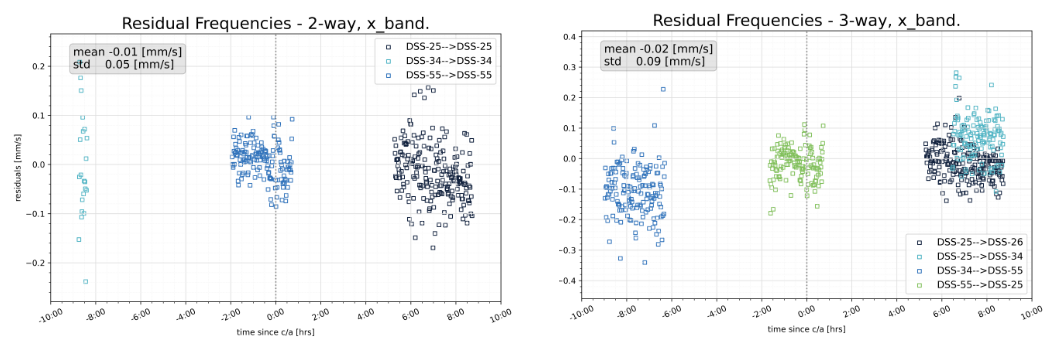
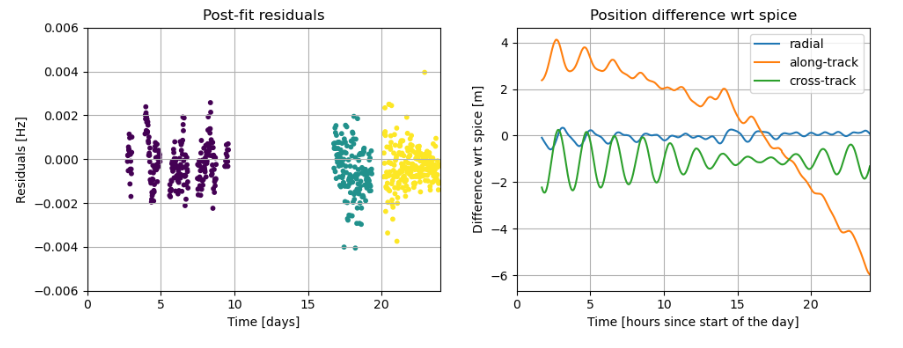
Tudat’s deep-space radiometric processing capabilities have been successfully tested for several missions including GRAIL (Fig. 1) and Cassini (Fig. 2). By comparing post-fit residuals and estimated orbits against those obtained from reference solutions, we validate that our dynamical and observation models reproduce the measured data within the expected noise characteristic of the data.

Fig. 1: Post-fit residuals and orbit differences for GRAIL from S-band Doppler data.

Fig. 2: Pre-fit residuals for Cassini from X-band Doppler data at Titan flyby T033.[8]

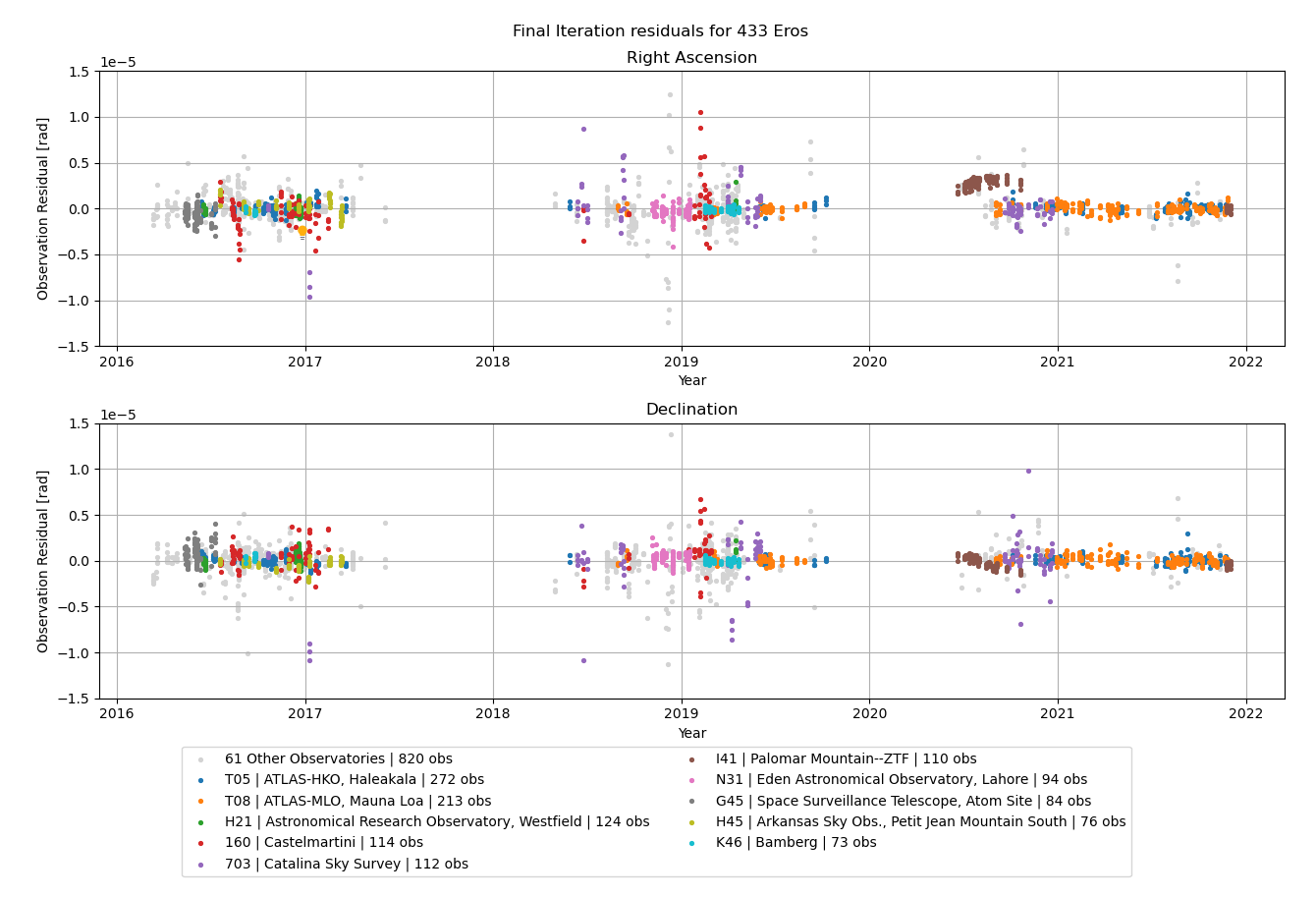
In another demonstration involving different system dynamics and data types/quality, our software has been successfully applied to orbit estimation of small bodies from astrometric observations. Fig. 3 shows the post-fit residuals for the MPC observations of Eros. The difference between our estimated orbit and the JPL Horizons orbit (used as a reference) is consistent with the expected level of uncertainty.

Fig 3: Orbit differences w.r.t. JPL Horizons (top) and post-fit residuals (bottom) for Eros from a six-year arc of MPC optical astrometry

Finally, the scope and accuracy of our dynamical models have been demonstrated to reproduce the motion of both spacecraft and natural bodies with the fidelity level required for high precision orbit estimations (see Fig. 4 for an example of Galilean satellites). This ensures that our software has the capability to fully exploit the quality of the available data sets and provide physically realistic orbital solutions and physical parameter estimates. 

Fig 4: Orbit differences of Galilean moons over 1 year between Tudat and NOE ephemerides (as generated during validation of analyses in [7])

Tudat’s real data processing capabilities are now at the core of several research projects, primarily focusing on the orbits, interiors, and/or dynamical evolution of Solar System bodies.  

Current analyses include the investigation of long-term time variations of Mars’ gravity field as a means to probe the physics of its deep interior, by combining tracking data from various Martian orbiters [7]. A re-analysis of Cassini tracking data acquired during Titan flybys is also ongoing (to be ultimately combined with long-term astrometry observations), with a particular focus on solving existing discrepancies in the estimation of tidal parameters [8]. Data analysis of Rosetta Doppler tracking coupled with high-fidelity coma density modelling will commence soon with the goal of improving understanding of the interior and dynamics of comet 67P [9]. Tudat will also be used to process the open-loop Doppler and VLBI data of the PRIDE experiment on the JUICE mission.


[1] Dirkx, D., et al. (2022). The open-source astrodynamics Tudatpy software–overview for planetary mission design and science analysis. EPSC2022, (EPSC2022-253).

[2] Gurvits, L. I., et al. (2023). Space Science Reviews, 219(8), 79.

[3] Asmar, S. W. (2022). Radio science techniques for deep space exploration. John Wiley & Sons.

[4] Minor Planet Center. (n.d.). Minor Planet Circulars (MPCs). Cambridge, MA: Smithsonian Astrophysical Observatory. https://www.minorplanetcenter.net/

[5] Arlot, J. E., & Emelyanov, N. V. (2009). Astronomy & Astrophysics, 503(2), 631-638.

[6] Fayolle, M.,et al. (2023). Astronomy & Astrophysics, 677, A42.\

[7] Alkahal, R. and Root, B.C. (2024) Satellite gravity-rate observations to uncover Martian plume-lithosphere dynamics. EPSC2024, (EPSC2024-952).

[8] Hener, J. et al. (2025), Re-visiting determination of Saturn-Titan tidal interaction parameters using the open-source Tudat software.these proceedings

[9] Reichel, M. et al. (2025), Assessing the impact of perturbations on the motion of Rosetta spacecraft near Comet 67P/Churyumov-Gerasimenko, these proceedings

How to cite: Dirkx, D., Fayolle, S., Avillez, M., Dijkstra, T., Filice, V., Gisolfi, L., Hener, J., Hinüber, L., Sanchez Rodriguez, A., Alkahal, R., Cowan, K., Gehly, S., Hu, X., Jeanjean, M., Langbroek, M., Lopez Rivera, A., Minervino Amodio, A., Plumaris, M., Reichel, M., and Van Hulle, S.: Tudat: an open-source, high-fidelity orbit and parameter estimation software – Overview of planetary mission data analysis capabilities, EPSC-DPS Joint Meeting 2025, Helsinki, Finland, 7–13 Sep 2025, EPSC-DPS2025-673, https://doi.org/10.5194/epsc-dps2025-673, 2025.

F60
|
EPSC-DPS2025-1567
|
ECP
|
On-site presentation
Jonas Hener, Dominic Dirkx, Sam Fayolle, Luigi Gisolfi, Valerio Filice, Valery Lainey, and Pieter Visser

[Introduction] 
Between 2006 and 2016, Cassini collected high-precision Doppler measurements during ten of its Titan fly-bys. These data allowed the determination of Titan’s gravity field up to degree and order 5 [1, 2] and its tidal Love number k2 [2,3]. In this work we revisit the determination of this parameter, seeing as two existing determinations of k2 [2, 3] are statistically inconsistent, implying different characteristics of Titan’s interior structure, specifically the ocean density [3]. The conflicting results may stem from modelling differences, estimation settings or under-estimation of the error bars associated with the determined values. Using the open-source orbit and parameter estimation software Tudat [4] and a rigorous open-science approach, we aim to provide an independent, fully transparent re-analysis of the Titan flybys’ radio-science data, and thus help resolve the conflict from prior k2 estimates and its implications for the interior models. Here we present the results of the observational and dynamical models test, which demonstrate the suitability of the Tudat software to carry out this analysis.


[Modelling Results]
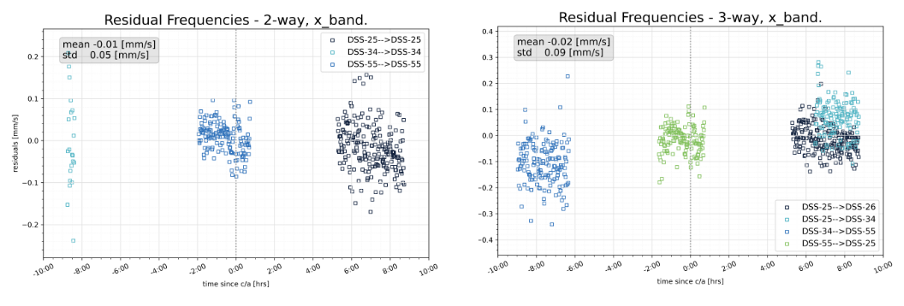
To isolate potential mis-modelling in the computation of the radiometric observables, we adopt a reference trajectory of the Cassini spacecraft from a spice-disseminated navigation solution, simulate the expected X- and Ka-band Doppler observables and compare them against the real observables. The inherent noise level of the 2-way Doppler observables is between 0.02 and 0.07 mm/s [3]. In the example of tracking pass T033, we demonstrate the computation of the observables to their noise level. When embedding the observables computation in an estimation, the small biases in the residual statistics are expected to be absorbed by ground station bias and clock synchronisation parameters. We conclude that the observables model is at the expected level.

Figure 1: Residuals from computed Doppler observables during Titan flyby T033, based on the Cassini reference trajectory.

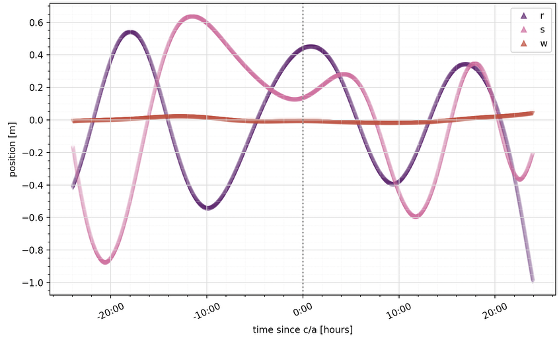
The detection of the acceleration exerted on the spacecraft due to the tidal response of Titan's gravity field demands a dynamical model of Titan that is sufficiently accurate over the timescale of the inversion. In the case of multi-arc estimation of the Titan ephemeris, as employed in prior analyses [2, 3], this timescale is in the order of two days. We aim to retrieve k2 alongside a single arc solution for the Titan ephemeris, which is beneficial for the accuracy and consistency of the determined value [2]. This requires the Titan dynamical model to be sufficiently accurate over multiple years [5], including subtle effects such as Saturn’s tidal dissipation at Titan’s forcing frequency and Saturn’s rotation pole motion. Eventually, a consistent single-arc ephemeris solution will also be critical to extract the tidal dissipation signature from Titan’s dynamics. Figure 2 demonstrates the accuracy of our model, which we derive from comparison with the numerical solution of Titan’s orbit from the Paris Observatory [6]. Titan position residuals over ± 24 hours (Fig. 2a) are contained within ± 1 m. The dynamical model is likely even more accurate, as the dominating in-plane signature is believed to originate from interpolation functions of the ephemeris kernel. Residuals over ± 5 years are contained within ± 100 m in-plane and grow up to 1500 m out-of-plane. 

(a) Residuals over ± 24 h. Initial Titan state fitted to the reference ephemeris.

(b) Residuals over ± 5 years. Initial Titan state and Saturn's tidal quality factor fitted to the reference.

Figure 2: Titan position residuals in the orbit-defined RSW frame over the timescale of a single flyby pass (a) and all passes (b).

In addition to accurate dynamical models of the Titan dynamics, the trajectory of the Cassini spacecraft needs adequate modelling. This includes non-conservative forces like solar radiation pressure, thermal emissions from RTGs, and Titan’s atmosphere during low-altitude passes [2, 3]. Another challenge is reconstructing the motion of the low gain antenna phase center used during the high-latitude T110 flyby. These modelling efforts are still ongoing.


[Preliminary Conclusions and Outlook]
The models for Doppler observables were shown to be sufficiently mature to reproduce the Cassini observables to the accuracy of their inherent noise level. In several instances residual signatures were found. Their origin is still under investigation, but suspected to stem from the Cassini reference trajectory instead of the observable computation itself. We demonstrated a Titan dynamical model accuracy of < 1 m (Fig. 2a) on the timescale of individual passes, which is considered satisfactory for a multi-arc estimation. The current state of residuals over the 10 year interval (Fig. 2b) is promising with regards to enabling a global inversion with a single, consistent Titan ephemeris. Further work will investigate and mitigate the out-of-plane residual signature. The implementation of selected dynamical models for the Cassini spacecraft is ongoing.
Further tests of the Titan dynamical model over a timespan of 180 years show in-plane residuals within ± 2500 m and 50000 m out-of-plane. After mitigation of remaining out-of-plane deviations, we aim for an inversion of Titan’s dynamical model over periods much greater than the Cassini mission. Such an inversion could be constrained with additional astrometric observables from e.g. Voyager 1&2 and ground-based campaigns. We aim to recover parameters relating to the long-term evolution of Titan’s orbit (specifically the tidal quality factor of Saturn at Titan’s forcing frequency), with implications for the long-term history of the entire Saturnian system [6].


[1] Iess, L., et al. (2012). The tides of Titan. Science, 337(6093)
[2] Durante, D., et al. (2019). Titan's gravity field and interior structure after Cassini. Icarus, 326
[3] Goosens, S., et al. (2024). A low-density ocean inside Titan inferred from Cassini data. Nature Astronomy, 8(7)
[4] Dirkx, D., et al. (2022). The open-source astrodynamics Tudatpy software–overview for planetary mission design and science analysis. EPSC2022
[5] Fayolle, M., et al. (2022). Decoupled and coupled moons’ ephemerides estimation strategies application to the JUICE mission. Planetary and Space Science, 219
[6] Lainey, V., et al. (2020). Resonance locking in giant planets indicated by the rapid orbital expansion of Titan. Nature Astronomy, 4(11)


How to cite: Hener, J., Dirkx, D., Fayolle, S., Gisolfi, L., Filice, V., Lainey, V., and Visser, P.: Re-visiting determination of Saturn-Titan tidal interaction parameters using the open-source Tudat software., EPSC-DPS Joint Meeting 2025, Helsinki, Finland, 7–13 Sep 2025, EPSC-DPS2025-1567, https://doi.org/10.5194/epsc-dps2025-1567, 2025.

F61
|
EPSC-DPS2025-949
|
ECP
|
On-site presentation
Sam Fayolle, Dominic Dirkx, Marc Rovira Navarro, Jelle Mol, and Soufyan Roubiou

Tides are key drivers of planetary system long-term evolution. Both planet and satellite tides indeed yield a secular change in the satellites’ semi-major axis and eccentricity. They also induce tidal heating in the satellites’ interiors, thus controlling their thermal evolution.  

Consistently accounting for the effect of tides on the gravitational potential of natural satellites is essential to study their dynamics and that of spacecraft flybying and/or orbiting them. Various strategies exist to include tides in dynamical models. But, for natural satellites in 1:1 spin-orbit resonances, the effects of satellite tides (i.e., tides raised on the satellite by the host planet) on the satellite’s own orbit and rotation are particularly challenging to model. This becomes apparent when looking at Kaula’s potential expansion (all quantities with  refer to the perturbing body):

All eccentricity functions Glmp(e*)  are O(e*)  terms, except for G220(e*). The latter therefore represents the dominating component of the tidal potential, and occurs at the forcing frequency:

with n the satellite’s mean motion and θ the rotation angle of the body undergoing tides. This mode typically dominates the tidal response, and for instance accounts for the leading term in the secular evolution of the satellite’s orbit due to planet tides (tides raised on the satellite on the planet).

However, for satellite tides, the commensurability between the satellite’s orbital and rotational periods causes this forcing mode to vanish. The tidal response becomes then dominated by the next leading terms, whose forcings occur at the following frequencies:

The dominant forcing modes thus exactly coincide with the main once-per-orbit frequency driving the satellite’s translational and rotational dynamics.  This requires highly consistent modelling of the interplay between the satellite’s orbit, rotation, and tidal deformation. Any inconsistency would indeed lead to unphysical dynamics, either breaking the spin-orbit resonance and/or predicting wrong secular rates for the da/dt or de/dt. For instance, neglecting the role of a small misalignment between the moon’s long-axis and the planet-satellite line at periapsis implies either one of the following  [1]:

  • The resonance is maintained, but the energy dissipated through tides is overestimated, leading to the following semi-major axis changing rate [2]

             instead of [3]

      with k2 and Q the satellite’s tidal Love number and quality factor, respectively.

  • The energy dissipation is accurately modelled, but the satellite is expected to be in a pseudo-synchronous state, which we know to be unphysical [4].

Both inconsistencies above stem from the use of decoupled models which cannot reproduce the delicate balance between i) how the satellite’s orbit and rotation define its instantaneous response to tidal forcing; and ii) how this response in turn affects the satellite’s translational and rotational dynamics.  

When focusing on the effect of satellite tides on the satellite’s own orbit, as in e.g., natural satellite ephemerides studies, a common approach is to account for the averaged contribution (over one orbit) of tidal dissipation to the system’s dynamics [5]. This is done by introducing an additional perturbing force on the satellite (see Fayolle, 2025 for derivation from Eq. 1):

This approach, however, only reproduces the average – rather than instantaneous - orbital effects of satellite tides. Moreover, as it does not explicitly model the satellite’s gravitational deformation. While sufficient to extract the signature of tidal dissipation from the satellite’s own dynamics (given quality of existing data), this is ill-suited to model tidal effects in the dynamics of a nearby spacecraft. For future missions (JUICE, Europa Clipper), the signature of satellite tides on both their own dynamics and that of the spacecraft will be visible in the data. Concurrently modelling both effects will thus be crucial to obtain a consistent quantification of tidal parameters, which current models do not allow.

To resolve this, we therefore propose a coupled propagation of the satellite’s orbital motion, rotational dynamics, and tidal deformation, based on [6,7]. In this approach, the tidal deformation is formulated as an ordinary differential equation of the satellite’s gravity coefficients. Numerically integrating these alongside the satellite’s translational and rotational states yields time-dependent variations of the gravity coefficients, which are by definition consistent with the orbit, rotation, and assumed rheology of the satellite. The concurrent propagation of this extended dynamical model automatically accounts for all couplings at play. Such an approach not only provides a unified way to model the orbit-rotation-tide interactions, but is also equally applicable to include satellite tides in the dynamics of the satellite itself, or in those of a nearby spacecraft.

We show that our model  - implemented in the open-source Tudat software [8] - correctly reproduces the full coupled orbital-rotational-tidal dynamics, using both the Earth-Moon and Mars-Phobos systems as test cases, and assuming a simple Maxwell rheology. We obtain the expected secular rates for the satellite’s semi-major axis and eccentricity, while conserving rotational energy and maintaining the spin-orbit resonance. In the case of Phobos, the non-negligible enhancement of tidal dissipation effects due to librations also matches theoretical expectations [9]. We numerically verified that the resulting time history of our gravity coefficients matches that predicted by using Eq. 1 up to at least 3rd order in eccentricity (after expanding Eq. 1 to account for librations, following [10]).

In the context of upcoming missions such as JUICE and Europa Clipper, such a unified model will be invaluable to obtain consistent estimates of tidal parameters from their combined effects on natural satellites’ and spacecraft’s dynamics. Future work will include adopting more complex and realistic rheology models, and investigating the possibility to directly estimate interior properties (e.g., modulus and rigidity instead of Love numbers, etc.).


References

[1] Fayolle (2025) PhD dissertation

[2] Boué & Efroimsky (2019) CMDA 131

[3] Goldreich & Soter (1966) Icarus 5.1-6

[4] Makarov & Efroimsky (2013) The Astrophysical Journal 764.1

[5] Lainey et al. (2009) Nature 459.7249

[6] Correia et al. (2014) A&A 57:A50

[7] Boue et al. (2016) CMDA 12631-60

[8] Dirkx et al. (2022) EPSC2022-253

[9] Efroimsky (2018) Icarus 306

[10] Frouard & Efroimsky (2017) CMDA 129.1-2

How to cite: Fayolle, S., Dirkx, D., Rovira Navarro, M., Mol, J., and Roubiou, S.: A consistent numerical integration of orbit, tides, and rotation for synchronous satellites, EPSC-DPS Joint Meeting 2025, Helsinki, Finland, 7–13 Sep 2025, EPSC-DPS2025-949, https://doi.org/10.5194/epsc-dps2025-949, 2025.

F62
|
EPSC-DPS2025-1215
|
ECP
|
On-site presentation
Markus Reichel, Xuanyu Hu, Dominic Dirkx, Raphael Marschall, Thomas Andert, Luigi Gisolfi, Jessica Agarwal, Martin Päzold, and Jürgen Oberst

Next year marks the tenth anniversary of the conclusion of the Rosetta mission at the Jupiter-family comet 67P/Churyumov-Gerasimenko. The spacecraft-lander duo was the first to perform an extended, close rendezvous with, as well as landed exploration on, a comet during its perihelion passage [1]. The suite of instruments onboard has acquired a unique dataset of remote-sensing and in situ observations of the active nucleus and the ambient comae.


    The motion of the spacecraft platform is influenced by various dynamical effects, especially in the immediate vicinity of the nucleus [2]. The gravitational influence of the low-density, kilometre-sized body is weak, however, its bilobed shape (and therefore the mass distribution) gives rise to a significant non-central gravitational component [3,4,5]. The complex rotation state of the nucleus adds to the variability of such perturbation on the spacecraft [6,7]. In this dynamical environment, the role of non-conservative forces will be particularly prominent, and their accurate modelling especially important. Unlike gravitation, which attenuates away from the nucleus, the intensity of solar radiation changes only perceptibly with heliocentric distance. Meanwhile, coma densities are typically larger near the nucleus, and the activity of the comet generally increases as it approaches perihelion. Moreover, the irregular shape of the nucleus and its unevenly distributed surface activity may induce significant spatial and temporal variabilities of the coma structures [8,9]. Both solar radiation pressure and coma drag depend on the configuration, attitude and surface properties of the spacecraft, however. For the coma drag, typical models of flow density and relative velocity may have high uncertainties, leading to potentially substantial mismodeling.


   In our work, we investigate the perturbations on Rosetta and their impact on spacecraft motion around 67P in detail.  We utilise (and where necessary extend) the open-source TU Delft Astrodynamics Toolbox (Tudat), taking advantage of its versatility and modularity in dynamical- and observation-model settings, as the generic interface [10]. A focus here is on the incorporation of state-of-the-art physical models that had been developed and validated by Rosetta measurements to capture the intricate behaviour of the rarefied comae [11].  We evaluate model implementation strategies aimed at efficiently quantifying spacecraft perturbations.  The outcome from this (line of) investigation is expected to provide more insight into the optimisation of dynamic models for spacecraft orbit determination. In the subsequent steps of our work, we will reanalyse the spacecraft tracking data to use our improved dynamical model to generate a more robust determination of the comet’s gravity field.


  • Glassmeier K.-H., et al. (2007), Space Sci. Rev.
  • Scheeres, D. J. (2012), Orbital Motion in Strongly Perturbed Environments
  • Pätzold, M. et al. (2016), Nature
  • Pätzold, M. et al. (2019), MNRAS
  • Laurent-Varin J. et al. (2024), Icarus
  • Preusker F. et al. (2015), Astr. & Astrophy.
  • Jorda L. et al. (2016), Icarus
  • Marschall et al. (2024), in Comets III
  • Agarwal et al. (2024), in Comets III
  • Dirkx et al. (2022), EPSC Abstract
  • Marschall et al. (2020), Frontiers of Physics

How to cite: Reichel, M., Hu, X., Dirkx, D., Marschall, R., Andert, T., Gisolfi, L., Agarwal, J., Päzold, M., and Oberst, J.: Assessing the impact of perturbations on the motion of Rosetta spacecraft near Comet 67P/Churyumov-Gerasimenko , EPSC-DPS Joint Meeting 2025, Helsinki, Finland, 7–13 Sep 2025, EPSC-DPS2025-1215, https://doi.org/10.5194/epsc-dps2025-1215, 2025.

F63
|
EPSC-DPS2025-1773
|
On-site presentation
Marta Goli and Sebastien Le Maistre

Decades of Doppler tracking data from Mars orbiters and landers have enabled the development of increasingly precise models of Mars’s ephemeris, gravity field, and rotational parameters. These data are typically processed independently for each spacecraft, or combined without fully exploiting the potential for common-mode noise cancellation enabled by simultaneous observations when two spacecraft are within the same tracking antenna’s primary beam.


Factors such as link coherence, downlink frequency separation, and the available frequency bands all affect the ability to suppress shared noise sources in shared-beam differential observables [1, 2]. Much of the simultaneous-tracking Mars datasets consist of observables recorded during periods of simultaneous tracking of multiple spacecraft from the same antenna under suboptimal conditions. In most cases, this tracking was enabled by the DSN’s Multiple Spacecraft Per Antenna (MSPA) capability, which supports reception of multiple downlinks using closed-loop receivers, while only one uplink is active at a time [3]. Consequently, most overlaps involve low-quality one-way links, with some two-way/three-way or three-way/three-way data.


We investigate the extent to which the shared-beam tracking can be exploited for common-mode noise suppression in such suboptimal cases, and how this capability depends on link configuration, frequency separation, and other factors. Our objective is to identify configurations in which shared-beam observable differentiation and related techniques provide a degree of improvement in spacecraft orbit determination and in the estimation of planetary ephemerides, gravity field and rotation parameters. We also aim to assess opportunities for reprocessing historical data and provide recommendations for future missions, including design and scheduling strategies for multi-spacecraft missions that could benefit from shared-beam tracking without requiring a dedicated radio science payload.


[1] M. Gregnanin, ‘The Rotation and Solid Tides of Mars from Same Beam Interferometry of a Lander Network’, PhD Thesis, Sapienza University of Rome, 2014.

[2] H. Hanada et al., ‘Overview of Differential VLBI Observations of Lunar Orbiters in SELENE (Kaguya) for Precise Orbit Determination and Lunar Gravity Field Study’, Space Sci Rev, vol. 154, 2010

[3] Jet Propulsion Laboratory, 810-005 DSN Telecommunications Link Design Handbook, 2024.

How to cite: Goli, M. and Le Maistre, S.: Can we exploit shared-beam tracking in historical Mars radio science datasets?, EPSC-DPS Joint Meeting 2025, Helsinki, Finland, 7–13 Sep 2025, EPSC-DPS2025-1773, https://doi.org/10.5194/epsc-dps2025-1773, 2025.

F64
|
EPSC-DPS2025-1502
|
ECP
|
On-site presentation
Hao Chen, Philipp Gläser, Wladimir Neumann, and Jürgen Oberst

The Hayabusa-2 mission, conducted by JAXA, orbited and returned samples from asteroid (162173) Ryugu in 2018 (Watanabe et al., 2017). The Optical Navigation Camera Telescope (ONC-T) was designed to capture high-resolution images for modeling the shape of Ryugu (Watanabe et al., 2017). Currently, the publicly available shape models of Ryugu have been generated from two approaches: structure-from-motion combined with multi-view stereo (SfM-MVS; Watanabe et al., 2019), and a neural implicit method (NIM) based on neural radiance fields (NeRF; Chen et al., 2024). While these methods effectively reconstruct the asteroid’s overall geometry, they fail to accurately resolve fine surface details, highlighting the need for enhanced modeling techniques. Fortunately, the NIM shows significant promise in achieving high-fidelity 3D scene representation, even with limited image input.

In this study, we used an improved NIM to perform detailed shape modeling of Ryugu and accurately reconstruct its surface morphology (Chen et al., 2025). To capture fine-scale surface features, including boulders of varying sizes and shapes, our approach introduces a multi-scale deformable grid representation that flexibly incorporates neighborhood information with different receptive fields. In addition, the 3D points generated by the SfM-MVS method are used to provide explicit geometric supervision during training, enhancing the accuracy of surface reconstruction.

To evaluate the reconstruction performance, we used 61 ONC-T images acquired during the 'Box-C' operations, with a spatial resolution of approximately 0.6 to 0.7 meters. We demonstrate that our proposed NIM is capable of reliably reconstructing Ryugu’s shape from a limited number of images, yielding volume and surface area estimates that are more consistent with the SfM-MVS reference than those produced by the NIM model of Chen et al. (2024). Compared to the SfM-MVS model and the NIM model proposed by Chen et al. (2024), our method more effectively reconstructs both small-scale and large, irregularly shaped boulders, as evidenced by comparisons between real and synthetic images from 3D models. In addition, it successfully recovers terrain features in the polar regions, despite the limited coverage of the ONC-T imagery. Owing to its reduced dependency on dense image inputs, our approach also presents the potential to simplify mission planning for global shape modeling by relaxing image acquisition requirements.

References:

Chen et al., 2024. Neural implicit shape modeling for small planetary bodies from multi-view images using a mask-based classification sampling strategy. ISPRS Journal of Photogrammetry and Remote Sensing, 212, pp.122-145.

Chen et al., 2025. Modeling the global shape and surface morphology of the Ryugu asteroid using an improved neural implicit method. Astronomy & Astrophysics, 696, p.A212.

Watanabe et al., 2017. Hayabusa2 mission overview. Space Science Reviews, 208, pp.3-16.

Watanabe et al., 2019. Hayabusa2 arrives at the carbonaceous asteroid 162173 Ryugu—A spinning top–shaped rubble pile. Science, 364(6437), pp.268-272.

How to cite: Chen, H., Gläser, P., Neumann, W., and Oberst, J.: High-resolution Shape Modeling of Ryugu from an Improved Neural Implicit Method, EPSC-DPS Joint Meeting 2025, Helsinki, Finland, 7–13 Sep 2025, EPSC-DPS2025-1502, https://doi.org/10.5194/epsc-dps2025-1502, 2025.