
 2,3,4,1
- 1Charles University in Prague, Institute of Astronomy, Faculty of Mathematics and Physics, Prague, Czechia
- 2Department of Physics, The Catholic University of America, Washington, DC 20064, USA
- 3SETI Institute, Carl Sagan Center, 339 Bernado Avenue, Suite 200, Mountain View CA 94043, USA
- 4Unistellar, 5 allée Marcel Leclerc, bâtiment B, Marseille, 13008, France
Over the past few years, the Unistellar network has grown into the world’s largest citizen science telescope network, with more than 15,000 smart, digital and robotic telescopes (eVscopes) operated by amateur astronomers across the globe. The network has evolved into a powerful scientific tool, enabling coordinated observations that contribute directly to professional research. One of the most active and impactful areas has been the physical characterization of asteroids via optical photometry and stellar occultations—two complementary techniques that together provide critical constraints on asteroid spin states, shapes, sizes, and binarity.
Unistellar observers regularly participate in global campaigns coordinated through a dedicated Citizen Science website, Slack workspace, and Science mode in the Unistellar mobile app, which include tailored event predictions, observation guidelines, and data upload tools. Once uploaded, the data are processed through automated pipelines, where photometric time series are calibrated, modeled, and reported back to the community. The resulting lightcurves are not only used to determine rotation periods but also feed into lightcurve inversion algorithms to derive 3D shape models and spin axes. In parallel, high-time-resolution occultation observations allow for direct size measurements and detection of features such as satellites or ring systems.
We present results from recent Unistellar campaigns that demonstrate the scientific return of this distributed observational network. A highlight is the multi-chord occultation of asteroid (16583) Oersted, which yielded 10 positive detections and one grazing chord, enabling the first robust size and shape model of this main-belt asteroid. The occultation profile was combined with sparse photometry and lightcurve data to constrain the spin state via the ADAM algorithm, demonstrating the synergy between the two observational techniques.
Another successful campaign targeted the TNO 2013 LU28, a particularly challenging object due to the rarity of bright star occultation events. A dedicated global coordination effort led to three positive Unistellar chords—an exceptional achievement for a distant, slow-moving object—providing constraints on its size and shape, and highlighting the potential of amateur contributions even in the outer Solar System.
In the realm of lightcurve photometry, the Unistellar network has recently contributed to the rotation state characterization of several near-Earth asteroids (NEAs), where timely observations are critical due to their short visibility windows and fast apparent motion. The successful period determination of asteroid (7335) 1989 JA, for example, provided essential input for planetary defense modeling and was later published with citizen scientists as co-authors. In a related effort, targeted Unistellar campaigns led to dense lightcurve coverage of slowly rotating main-belt asteroid (319) Leona, contributing to derivation of its shape and pole orientation. Additionally, shape models of (775) Ampella and (211) Isolda were obtained by combining Unistellar photometry with archival data, demonstrating the network’s capacity to contribute to physical modeling of large object.
Ongoing campaigns are now focusing on main-belt asteroids from ancient collisional families, which offer a window into early Solar System evolution, as well as a new set of targets from young asteroid families that are suspected to be parent bodies of meteorites. These families, only a few million years old, offer an opportunity to study pristine spin and shape distributions, unaltered by long-term thermal torques or collisions. Photometric data from Unistellar telescopes are being used to derive rotational periods and, where data are sufficient, to construct shape models that will be compared with dynamical evolution simulations and meteorite spectral matches.
All these efforts are tightly linked to professional research projects such as the Czech Science Foundation (GAČR) project "Gaia–XSHOOTER: Survey of 'promising' asteroid families" (ID 25-16789S), where student-led analyses of lightcurve and occultation data from Unistellar observers play a direct role in advancing the science. Importantly, these projects create a bridge between professional institutions and motivated amateur astronomers, offering clear observational goals, robust data processing pipelines, and opportunities for co-authorship in peer-reviewed publications.
The Unistellar platform demonstrates the power of organized, large-scale amateur contributions to asteroid science. Its structure—combining smart telescope technology, global coordination, and automated pipelines—lowers the barrier to entry while ensuring data quality. Campaigns such as those targeting Oersted, Nezarka, LU28, and multiple NEAs illustrate the network’s capability to contribute meaningfully to current research questions in planetary science, including asteroid evolution, meteorite parent body identification, and planetary defense.
In this presentation, we advocate for further integration of citizen science networks into professional observing strategies, particularly in areas where fast response and geographical diversity are crucial. We will outline best practices for campaign planning, data validation, and community engagement, and reflect on the lessons learned from building an international team of amateur observers who are not just participants—but active contributors—to peer-reviewed planetary science.
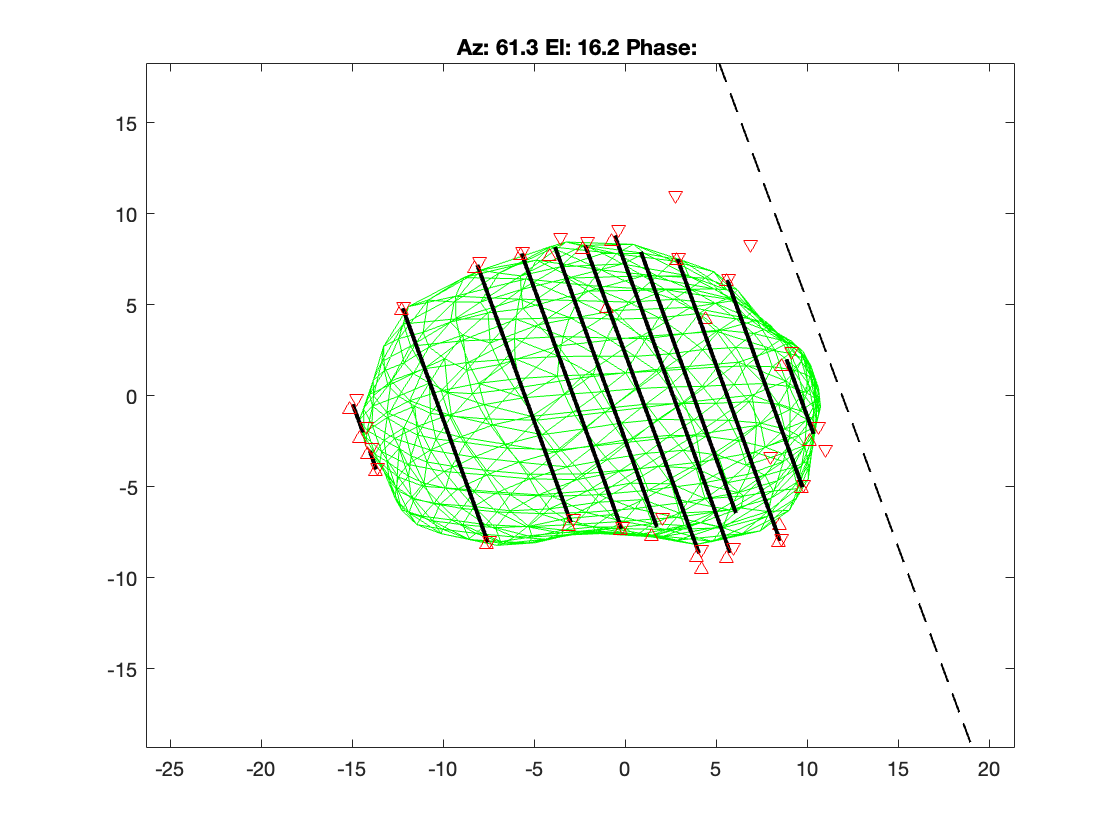
Figure 1: Shape model projection of asteroid (16583) Oersted (gray silhouette) overlaid on the occultation chord profile from the April 2024 multi-chord stellar occultation event. The model, derived using the ADAM algorithm, combines lightcurve data and occultation chords to constrain the asteroid’s size, shape, and spin state. The chords represent individual observer detections (solid lines = positive chords; dashed = negative/grazing), and the agreement demonstrates the consistency of the derived physical model.
How to cite: Hanuš, J., Pokorný, P., Marchis, F., Lambert, R., Esposito, T. M., and Ďurech, J.: Unistellar Network Contributions to the Physical Characterization of Asteroids through Lightcurves and Stellar Occultations, EPSC-DPS Joint Meeting 2025, Helsinki, Finland, 7–12 Sep 2025, EPSC-DPS2025-490, https://doi.org/10.5194/epsc-dps2025-490, 2025.


