
 ,,,,
,,,,- National Institute for Astrophysics (INAF/IAPS), Institute for Space Astrophysics and Planetology, Rome, Italy (enrico.bruschini@inaf.it)
The information about the geological history of Mars is contained and codified into the minerals forming the Martian rocks and derived meteorites. Therefore, to understand the physical and chemical processes which occurred on Mars it is necessary to study the mineralogy of its rocks. In this work, we present the results of an in-depth μ-Raman imaging of the Martian shergottite NWA13367. The meteorite was recently discovered and so far, only a preliminary and partial characterization is available [Gattacceca et al. 2021]. We worked on an unpolished 1 mm-thick slab with an exposed area of a few square centimeters. On the sample’s surface, we defined several regions of interest (ROIs). We used Raman spectroscopy to identify the mineral phases and map their distribution in the selected ROIs. The identified phases can be subdivided into: 1) primary minerals, 2) shock-induced phases and 3) secondary minerals. Primary minerals are the most abundant phases in the meteorite where we identified olivine, clinopyroxene, and orthopyroxene. Other primary minerals present in much smaller quantities are chromite and merrillite. The only observed shock-induced phase is maskelynite while calcite represents the secondary minerals. The textural relationships and the distribution of the minerals revealed by our spectral imaging allow us to identify the main processes underwent by the meteorite. The carbonate identified in the sample is present as veins and plagues often found at the boundaries between grains and fractures (Fig. 1) which is consistent with a secondary, terrestrial, origin.
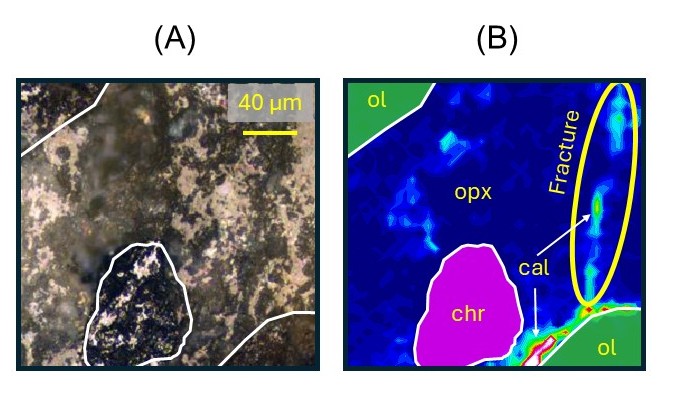
Fig. 1 Main phases and their distribution in Martian shergottite NWA 13367. (A) optical image of one of the selected regions of interest (ROI) of the meteorite. White lines mark the boundaries between different phases. (B) mineral distribution in the same ROI as in panel (A): olivine (ol), orthopyroxene (opx), chromite (chr) and calcite (cal).
The silicate primary phases are characterized by large crystals with a cumulate texture. Maskelynite usually has an irregular distribution while merrillite is rather found as tiny crystals (~ 10μm). Our work will provide new data to support the petrological interpretation of this newly discovered meteorite. In addition, given the current and future presence of Raman spectrometers on Mars (i.e. SHERLOC/Perseverance Rover, RLS/Rosalind Franklin Rover) the sample will be used to test new analytical protocols that could be used to improve the collection of in-situ spectra on the planet.
Fundings: ASI-INAF n. 2023.HH.0 “Attività scientifica di preparazione all’esplorazione marziana”
References:
Gattacceca, J., McCubbin, F. M., Grossman, J., Bouvier, A., Bullock, E., Chennaoui Aoudjehane, H., ... & Schrader, D. L. (2021). The meteoritical bulletin, No. 109. Meteoritics & Planetary Science, 56(8), 1626-1630. https://doi.org/10.1111/maps.13714
How to cite: Bruschini, E., Ferrari, M., Altieri, F., De Angelis, S., Brossier, J., and De Sanctis, C.: Micro-Raman imaging of Martian Shergottite NWA13367, EPSC-DPS Joint Meeting 2025, Helsinki, Finland, 7–13 Sep 2025, EPSC-DPS2025-492, https://doi.org/10.5194/epsc-dps2025-492, 2025.


