
 3,3,3,3,
- 1Real Observatorio de la Armada, Universidad de Granada, San Fernando, Spain (vogao@hotmail.com)
- 2Observatório do Valongo, Universidade Federal do Rio de Janeiro, Brazil
- 3Instituto de Astrofísica de Andalucía (IAA-CSIC), Granada, Spain
- 4Observatório Nacional (MCTI), Rio de Janeiro, Brazil
- 5Laboratório Interinstitucional de e-Astronomia LIneA, Rio de Janeiro, Brazil
On 6 November 2024, the Centaur (54598) Bienor occulted a background star located at coordinates RA 07h41m41.7944s, Dec +38°37′59.699″ (J2000). A total of 28 observation attempts were carried out across Spain and Portugal. Of these, 10 sites reported positive detections, 13 were negative (no disappearance observed), and the remaining suffered from technical or meteorological issues. This constitutes the most densely observed stellar occultation for Bienor—and among Centaurs, second only to Chariklo—for stellar occultations to date.
The occultation campaign was coordinated by the Instituto de Astrofísica de Andalucía (IAA-CSIC), involving a wide network of amateur and professional astronomers. The majority of the successful observations were obtained in Andalusia (Spain), with additional chords from Galicia, Catalonia, Asturias, Castilla-La Mancha, and central Portugal.
Light curves were initially processed with Python photometric routines and refined using the SORA occultation package (Gomes-Junior et al. 2022). Ingress and egress times were extracted via the ChiSquare technique and converted into chords projected in the sky plane. These chords were used to fit an apparent ellipse to the body of Bienor through a five-parameter χ² minimization (center, semi-major axis, oblateness, and position angle). Two negative observations were especially valuable in constraining the body’s edges.
The best-fit solution yields a projected ellipse with dimensions of 275 km × 90 km, with the long axis approximately oriented from south to north. The fit is consistent with previous occultation-based results but shows a slightly larger projected size and a deviation in expected orientation. No secondary events attributable to rings or satellites were detected within the campaign’s photometric sensitivity.
This work presents the most comprehensive multi-chord occultation dataset ever obtained for Bienor, offering significant constraints on its size, elongation, and projected shape. The data are currently being used to refine Bienor’s pole orientation and 3D shape models. A peer-reviewed publication based on this data is being prepared.
Figure 1
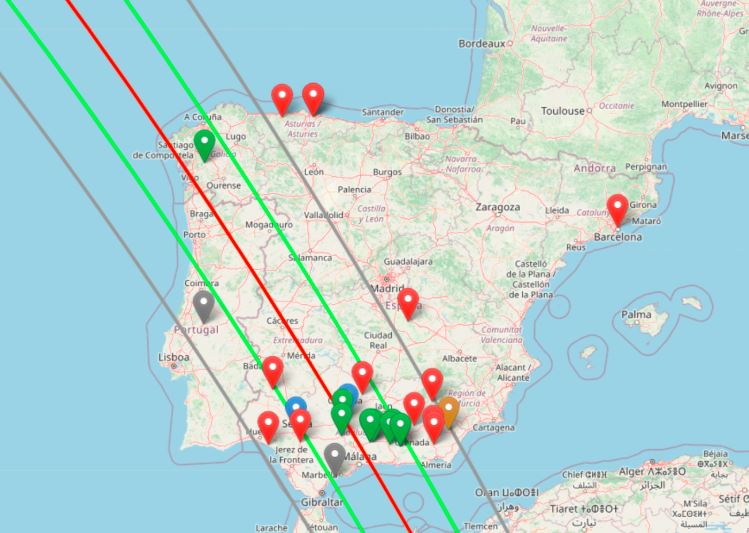
Ground path and observer locations for the 6 November 2024 Bienor occultation
Predicted occultation path and observing sites: central line in red, uncertainty in green and grey. Green pins mark positive detections, red pins indicate negative results, and grey, blue and orange pins are weather-affected or inconclusive
Figure 2

An example of a light curve obtained from the Sierra Nevada Observatory (OSN, Granada, Spain). The drop in stellar brightness corresponds to when Bienor occulted the star. Relative flux (normalised to 1 outside of the occultation) is plotted against time in seconds since 00:00 UTC on 6 November 2024.
Figure 3

Chords and best-fit ellipse of Bienor’s projected silhouette. Observed chords (colored lines) from positive detections (10) and negative observations (2) were used to constrain Bienor's apparent shape. The best-fit ellipse, with ~275 × 90 km dimensions, is shown in black. Observers are identified in the legend.
Acknowledgments
I thank Pablo Santos-Sanz for his continuous support and mentorship as thesis advisor, Luan Catani for his expert guidance using the SORA software at the IAA, Yücel Kılıç for his invaluable help with the telescope setup on the night prior to the occultation; Juan Luis Rizos for collaborating with me during the event and in the following days to perform photometry; José Luis Ortiz for his invaluable help and guidance in the thesis on occultations; and José Luis Gutiérrez Sacristán for teaching telescope operations and providing remote assistance on the night of the occultation.
References
[1] André-Romain Gomes-Junior et al. (2022). SORA: Stellar Occultation Reduction and Analysis. Astronomy and Astrophysics, 658, A29.
[2] Juan Luis Rizos et al. (2024). A study of centaur (54598) Bienor from multiple stellar occultations and rotational light curves. Astronomy and Astrophysics, 689, A82.
[3] Estela Fernández-Valenzuela et al. (2023). The multichord stellar occultation by the centaur Bienor on January 11, 2019. Astronomy and Astrophysics, 669, A112.
[4] Bruno Sicardy et al. (2024). Stellar occultations by Trans-Neptunian Objects. The Astronomy and Astrophysics Review, 32(1), 6.
[5] José Luis Ortiz et al. (2019). Stellar occultations by Trans-Neptunian objects: From predictions to observations and prospects for the future. In M. A. Barucci et al. (Eds.), The Trans-Neptunian Solar System (pp. 413–437). Elsevier.
[6] Bruno Sicardy et al. (2024). Stellar occultations by trans-Neptunian objects. The Astronomy and Astrophysics Review, 32(1), 6.
How to cite: de Ory Guimera, V., Santos-Sanz, P., Catani, L., Rizos, J. L., Ortiz, J. L., Kiliç, Y., Morales, N., Rommel, F. L., and Gutiérrez, J. L.: The 6 November 2024, stellar occultation by the Centaur (54598) Bienor: preliminary results, EPSC-DPS Joint Meeting 2025, Helsinki, Finland, 7–12 Sep 2025, EPSC-DPS2025-518, https://doi.org/10.5194/epsc-dps2025-518, 2025.


