
 ,,
,,- University of Oxford, Physics, United Kingdom of Great Britain – England, Scotland, Wales (emma.belhadfa@physics.ox.ac.uk)
Introduction: The surfaces of airless bodies, such as asteroid (101955) Bennu, are typically composed of a regolith mixture containing both coarse and fine particulates. Observations from NASA’s Origins, Spectral Interpretation, Resource Identification, Security, Regolith Explorer (OSIRIS-REx) mission demonstrated a discontinuity between the remote sensing derived thermophysical properties and thermal spectroscopy results, indicating that a fine layer of dust may be coating the large boulders and coarse regolith surface [1]. To better understand the impact of such a coating on the thermal infrared spectra measured at Bennu, this work developed experimental methods for simulating dust coverings using Space Resource Technology’s CI simulant, based on the bulk composition of the Orgueil meteorite [2].
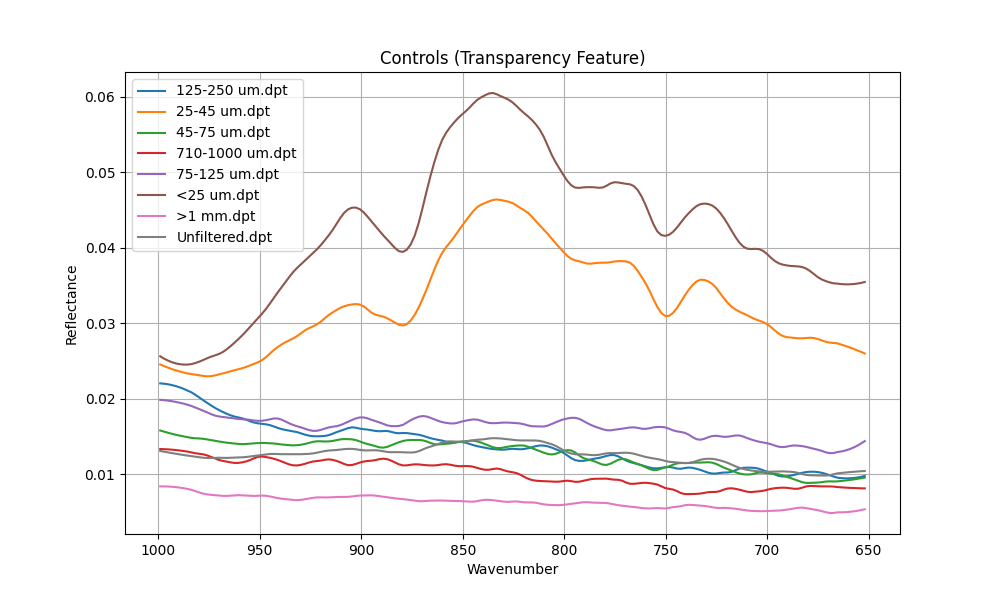
Figure 1: FTIR Reflectance Spectra of Control Samples of CI simulant.
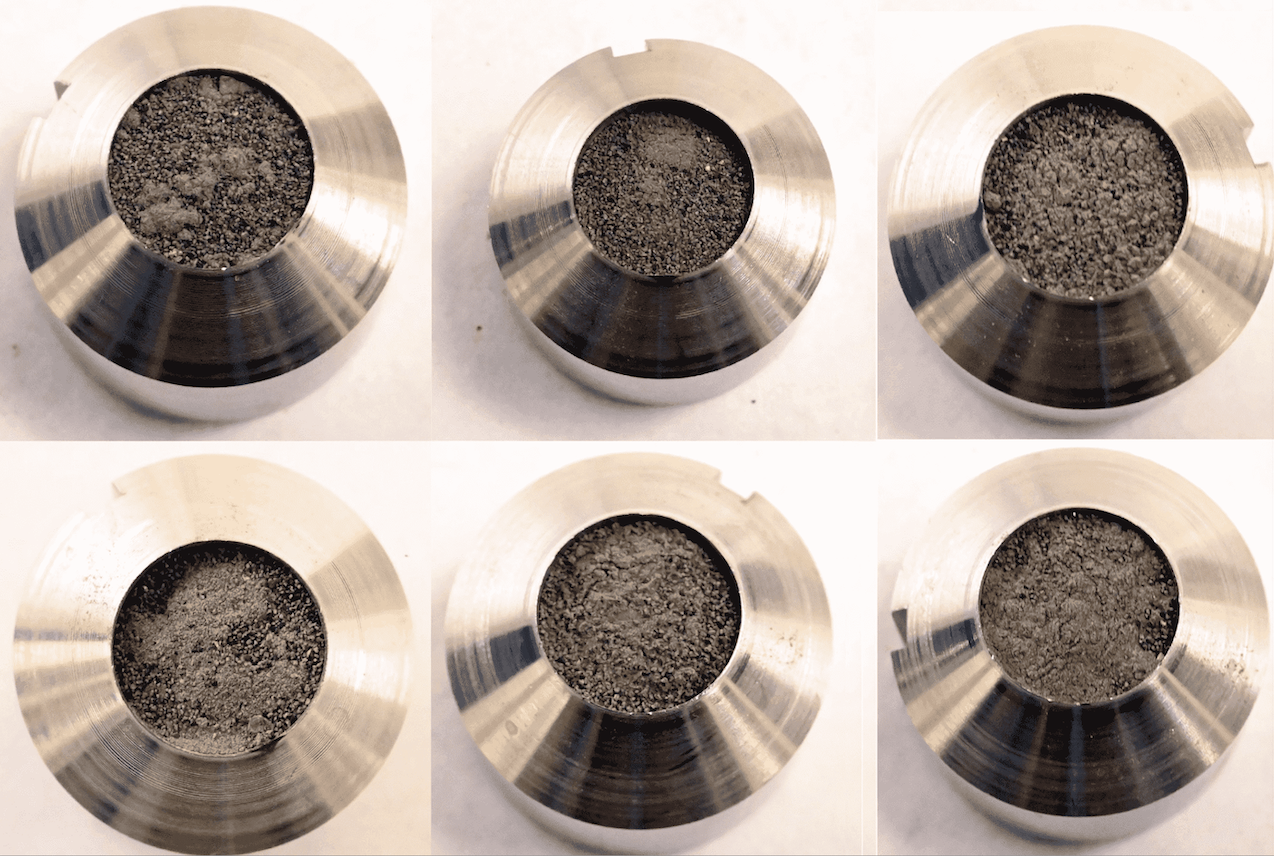
Figure 2: Figure 2: Microscope Camera Images of Sample Surfaces (7%, 10%, 15%, 20%, 25%, 50% Fines wt) of CI simulant
Methods: The CI simulant was first sieved into seven size fractions: <25, 25-45, 45-75, 75-125, 125-250, 710-1000, and >1000 mm. An unsieved sample was used as a control. The spectra of the eight samples were measured using a Bruker Vertex 70v Fourier Transform Infrared Reflectance (FTIR) spectrometer, normalized using a gold standard prior to and after measurements, in the range of 1000-650 cm-1 (Figure 1). The dust coating was simulated by placing increasing mass fractions of fine particulates (<25 mm) onto coarse particulates (125-250 mm) using tweezers. Images were collected using a mirrorless Nikon Z6III microscope to capture surface roughness features (Figure 2). The dust layers were measured at approximately 5%, 7%, 10%, 15%, 20%, 25%, and 50% fines by total mass in the FTIR spectrometer (Figure 3).
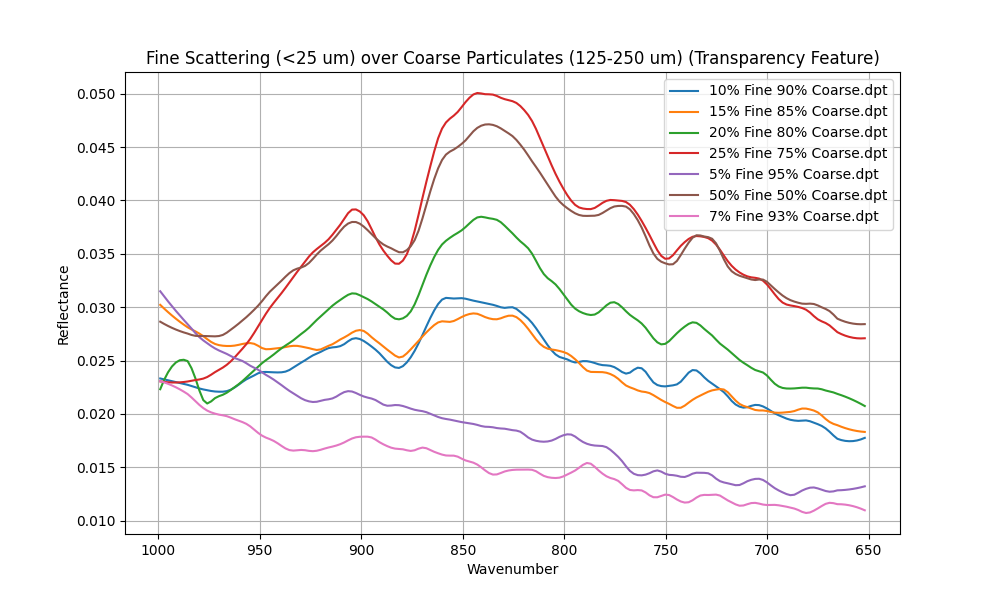
Figure 3: FTIR Reflectance Spectra of Fine-Dusted Samples of CI simulant.
Results: Clumping of Fines: The fine particles of the CI simulant used are particularly susceptible to clumping, likely owing to elevated electrostatics interparticle forces. The result is an uneven covering of dust across the surface of the samples (Figure 2), causing heterogeneity across the top layer of the sample. Future work aims to reduce this clumping effect by using alternative dust deposition mechanisms, including sieves, electrically charged tubes, and air circulation chambers.
Controls: As shown in Figure 1, the spectra fell within two categories: spectra with evidence of a Transparency Feature (TF) ( <45 mm) and those without (>45 mm). This switch is indicated by the appearance of broad transparency features, such as the minimum around 875 and the broad peak around 835 cm-1. Furthermore, the Reststrahlen bands, associated with the vibrational modes of silicates, around 750 cm-1, become more apparent with decreasing particle size.
Fine Coatings ( <45 mm): The simulated dust coatings provided insight into the amount of fines, by mass, required to see fine-dominated spectral features in the overall spectra of the regolith samples. We discovered that very little (>7% wt) fine coverage was required to begin dominating the spectra (Figure 3), indicating that even small amounts of dust coverings could have visible effects on the spectra (e.g. the emergence of TFs and >10% change in the spectral slope).
Implications for OSIRIS-Rex Findings: From the data returned by the OSIRIS-Rex Thermal Emission Spectrometer (OTES) [3], thermal inertia modelling imply that the surface is porous;, however, the spectral findings indicate that the surface is composed of non-porous? rocks with thin dust coatings [4]. Our experiments find that as little as ~7 wt % of <25 µm fines can impose a fine-dominated spectral signature on a 125–250 µm substrate, meaning that spectrally visible coatings on Bennu can be achieved by dust layers only a few microns thick. Therefore, a thin, laterally discontinuous coating could reconcile the difference between Bennu’s rock-controlled thermal inertia and the fine-grained spectral observations measured by OTES. Incorporating wavelength-dependent transmissivity for 10-50 µm coatings could therefore refine surface property constraints for Bennu.
Conclusion: We found that a negligible mass fraction (>7% wt) was sufficient to overwhelm and dominate mid-infrared emissivity spectra. The results indicate that the discontinuity in OTES data could be linked back to dust coating on the larger rocks and boulders.
References: [1] Tinker C. et al. (2023) RAS Techniques and Instruments (Vol. 2, Issue 1). [2] Landsman Z. et al. (2020) EPSC 2020. [3] Christensen P. R. et al. (2018) Space Science Reviews (Vol. 214, Issue 5). [4] Rozitis B. et al. (2022) JGR: Planets (Vol. 127, Issue 6). [5] Rivera-Hernandez F. et al. (2015) Icarus (Vol. 262).
How to cite: Belhadfa, E., Bowles, N., and Shirley, K.: Quantifying Thin Dust Layer Effects on Thermal-IR Spectra of Bennu-Like Regolith: FTIR Experiments with CI Asteroid Simulant , EPSC-DPS Joint Meeting 2025, Helsinki, Finland, 7–12 Sep 2025, EPSC-DPS2025-531, https://doi.org/10.5194/epsc-dps2025-531, 2025.


