
 1,2,1,
- 1Astronomical Observatory Institute, Faculty of Physics and Astronomy, Adam Mickiewicz University, Słoneczna 36, 60-286 Poznań, Poland. (e-mail: am@amu.edu.pl)
- 2Astronomical Institute, Faculty of Mathematics and Physics, Charles University, V Holesovickach 2, 180 00 Prague 8, Czech Republic
- *A full list of authors appears at the end of the abstract
Context
Asteroid sizes, even for large objects are surprisingly poorly determined. As the MP3C database (https://mp3c.oca.eu/) shows, many objects in the range of a few tens of km to 100 km have diameter determinations differing by more than 30% in various studies. This influences density determinations and compositional studies, among others.
On the other hand, there exist techniques capable of determining asteroid diameters with very good precision. Fitting 3D asteroid shape models to multichord stellar occultations is one of them (Durech et al. 2011, Herald et al 2020).
Aims
In order to improve diameter values for a dozen or so large and medium-sized main belt asteroids we conducted two photometric campaigns: one for rotational lightcurves over multiple apparitions and the other for stellar occultations by these objects.
Methods
We performed lightcurve inversion (Kaasalainen, Torppa 2001, Kaasalainen et al. 2001) for the target asteroids obtaining their spins and 3D shapes. Next, we created their on-sky silhouettes for the moments of well-observed stellar occultations and fitted them to the occultation chords (Durech et al. 2011). We tested ten versions of each shape model, with various level of stretch along the spin axis to check the influence of shape model uncertainty on the resulting diameter.
Results
Obtained volume-equivalent diameters have very small uncertainties, at the level of a few percent on average, reaching no more than 10% for targets with the poorest covered occultations. In many cases we managed to resolve the mirror-pole ambiguity (see Fig. 1). Moreover, diameters determined this way have been independently confirmed by applying the Convex Inversion Thermophysical Model (Durech et al. 2017), see the contribution by Choukroun et al. in this meeting. Results from both techniques can be found in the paper by Choukroun et al., accepted to "Astronomy & Astrophysics".
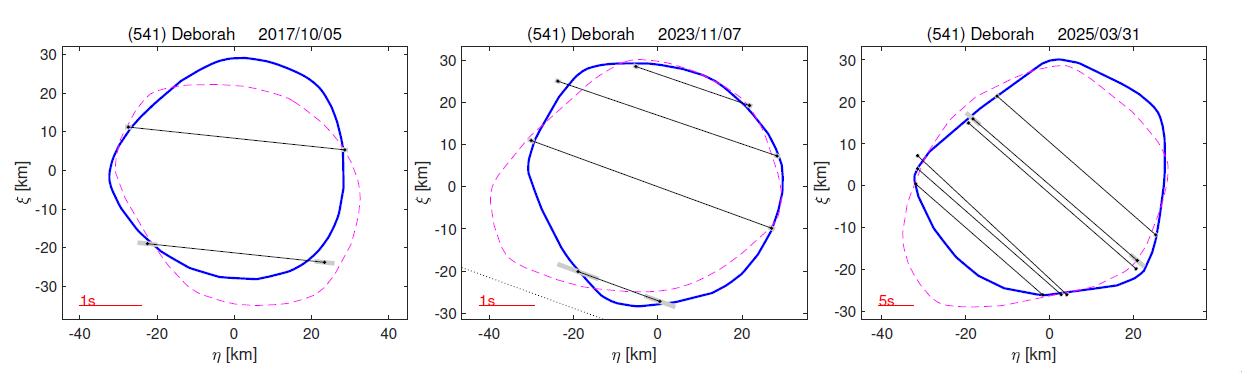
Fig. 1: Sample result: shape model of asteroid (541) Deborah fitted to three stellar occultations (Choukroun et al., accepted to A&A). Preferred spin and shape solution is shown on the fundamental plane with the solid contour, while the rejected one with dashed contour. Straight lines are chords based on occultation timings. Grey segments denote timing uncertainties, while the red segment represents the distance covered by the asteroid shadow in a given time. The diameter of sphere with the equivalent volume for the preferred model is 57 ± 2 km.
Acknowledgement
This work was supported by the National Science Centre, Poland, through grant no. 2020/39/O/ST9/00713.
References
Choukroun, A., Marciniak, A., Durech, J., et al., accepted to A&A
Durech, J., Delbo., M., Carry, B., Hanuš, J., & Alí-Lagoa, V. 2017, A&A, 604, A27
Durech, J., Kaasalainen, M., Herald, D., et al. 2011, Icarus, 214, 652
Herald, D., Gault, D., Anderson, R., et al. 2020, MNRAS, 499, 4570
Kaasalainen, M. & Torppa, J. 2001, Icarus, 153, 24
Kaasalainen, M., Torppa, J., & Muinonen, K. 2001, Icarus, 153, 37
Lightcurve team: M. K. Kamińska, V. Kudak, V. Perig, W. Ogłoza, M. Ferrais, E. Jehin, R. Szakats, M. Żejmo, M. Szkudlarek, N. Takacs Occultation team: V. Nikitin, R. Jones, S. Kidd, T. Haymes, P. Denyer, M. Collins, R. Dequinze, E. Bredner, C. Ellington, M. O'Connell, R. Boninsegna, O. Schreurs
How to cite: Marciniak, A., Durech, J., Choukroun, A., and Perła, J. and the Two teams of observers: Asteroid sizes determined with stellar occultations, EPSC-DPS Joint Meeting 2025, Helsinki, Finland, 7–12 Sep 2025, EPSC-DPS2025-55, https://doi.org/10.5194/epsc-dps2025-55, 2025.


