
 1,23
1,23- 1Centro de Astrobiología CSIC-INTA, Carretera de Ajalvir km4, 28850 Torrejón de Ardoz, Spain (iherreros@cab.inta-csic.es)
- 2Departamento de Ingeniería Térmica y Fluidos, Universidad Carlos III de Madrid, 28911 Leganés, Spain
- 3Université Paris Cité, Institut de Physique du Globe de Paris, CNRS, 1 rue Jussieu, Paris, F-75005, France (charnoz@ipgp.fr)
The Martian Moons eXploration (MMX, JAXA) mission aims to perform the first sample return from Phobos and deploy a rover (IDEFIX, CNES/DLR) to explore the surface. The main objective of MMX is to decipher the origin of Phobos. Consequently, selecting the optimal sampling site in order to maximize the likelihood of retrieving material representative of Phobos’ composition and deploying IDEFIX in a dynamically safe environment are both critical for the success of the mission. In this context, understanding the surface dynamics of Phobos is essential for optimizing site selection, guiding rover operations, and interpreting the geological origin of collected samples.
Our work combines a physics-based analysis of Phobos' orbital dynamics with a surface-constrained trajectory model to assess regolith mobility and terrain stability. The core philosophy of our approach is to treat the moon’s surface as a dynamically evolving environment, shaped not only by impacts and thermal cycling but also by continuous external forces (i.e., centrifugal, tidal, and Coriolis) arising from its orbital motion and near-synchronous rotation around Mars.
We begin from the orbital dynamics analysis, which provides the instantaneous acceleration field across Phobos’ surface throughout its eccentric orbit. These accelerations are derived from a dynamical model that incorporates instantaneous tidal interactions with Mars, Phobos’ spin state, and its complex geometry.
From the resulting dynamic slope field, we extract three key indicators for landing site evaluation, integrating both short-term dynamical mobility and long-term surface behavior:
- Maximum dynamic slope: indicates whether a terrain becomes unstable at any point during the orbit.
- Mean dynamic slope: reflects long-term equilibrium and serves as a proxy for the local repose angle.
- Temporal variability of the dynamic slope: highlights regions subject to cyclic changes in surface stability, potentially enhancing regolith mobility even in otherwise stable areas.
Based on these indicators, we have constructed a normalized map to assess the potential mobility of surface regolith across Phobos (see Figure 1). This map integrates the maximum, mean, and temporal variability of the dynamic slope, offering a synthetic view of terrain stability and its susceptibility to material transport. It provides a valuable basis for evaluating both long-term accumulation zones and areas prone to transient motion, supporting the strategic selection of sampling and landing regions.
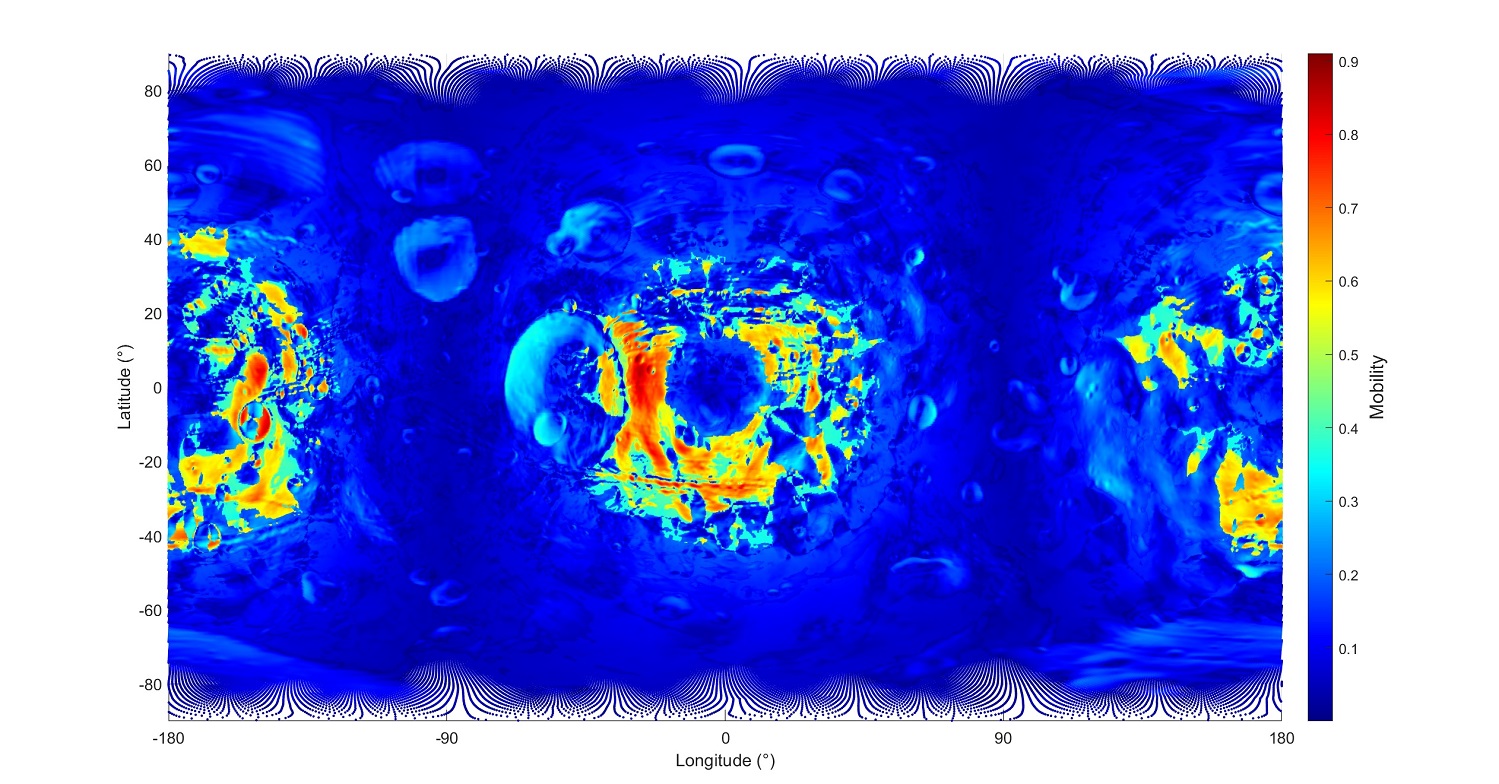
Figure 1. Normalized mobility index across Phobos’ surface, derived from the combination of dynamic slope amplitude, average, and variability along the orbit. The mobility index ranges from 0 (minimum expected material motion) to 1 (maximum susceptibility to regolith displacement).
We then simulate regolith transport across a high-resolution shape model of Phobos (Ernst et al., 2023). These simulations serve two main purposes. First, they allow us to identify low-mobility regions where regolith tends to accumulate, and high-mobility regions where surface material may be periodically transported or lost, and thus less affected by space weathering. This supports the selection of landing zones that are both safe and scientifically valuable. Second, we reverse-integrate trajectories from selected target points (e.g., candidate sampling sites) to identify the potential source areas of deposited material. This source region mapping provides critical context for interpreting in situ analyses by linking samples to their geological and dynamical origin.
Our methodology offers a robust decision-support tool for MMX mission planning, helping to:
- Select landing sites that are both dynamically stable and compositionally representative.
- Guide rover navigation toward accessible, diverse sampling areas.
- Inform post-return analyses by linking samples to their surface origin and transport history.
As of May 2025, the MMX landing site has not yet been finalized. Within the currently proposed candidate zones, some appear better suited to retrieving material representative of the surface regolith, while others may offer access to more pristine, rock-derived samples. For IDEFIX, a subset of these zones combines geological diversity with dynamical safety, offering promising terrain for in situ exploration.
This study demonstrates how physics-based modeling of regolith dynamics can directly support the planning, execution, and interpretation of planetary surface missions. The integration of orbital and surface mechanics offers a predictive framework not only for choosing where to land and sample, but also for uncovering the dynamical history behind the regolith, and identifying those regions most likely to preserve material representative of Phobos’ global composition, crucial for constraining the moon’s origin.
Acknowledgements: SC is supported by the French ANR project Roche, number ANR-23-CE49-0012, and French Space Agency (CNES). IH is supported by grant No. PID2020-116846GB-C22 by the Spanish Ministry of Science and Innovation/State Agency of Research MICIU/AEI/10.13039/501100011033 and by ‘‘ERDF A way of making Europe’’.
How to cite: Herreros, I. and Charnoz, S.: Surface Mobility and Regolith Transport Analysis to Support MMX Landing Site Selection and Sampling Strategies on Phobos, EPSC-DPS Joint Meeting 2025, Helsinki, Finland, 7–12 Sep 2025, EPSC-DPS2025-561, https://doi.org/10.5194/epsc-dps2025-561, 2025.


