
 2,3,
2,3,- 1Asteroid Engineering Laboratory, Lulea University of Technology, Kiruna, Sweden
- 2Department of Physics and Astronomy, Seoul National University, Seoul, Republic of Korea
- 3SNU Astronomy Research Center, Seoul National University, Seoul, Republic of Korea
- 4Korea Astronomy and Space Science Institute, Daejeon, Republic of Korea
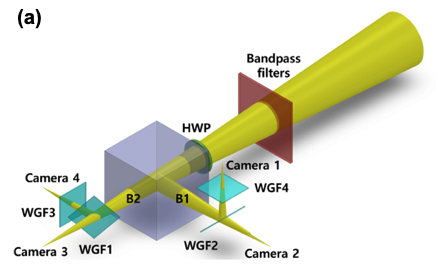
We introduce a newly developed polarimeter, the Seoul National University QUadruple Imaging Device for POLarimetry (SQUIDPOL). Polarimetry is a powerful technique in astronomy for investigating the physical properties of celestial bodies such as small Solar System objects. In the visible wavelength range, Wollaston prisms have often been used to achieve high-precision polarization measurements. However, despite their high accuracy, Wollaston prism-based polarimeters have limitations, including a narrow field of view and the need for collimating optics. SQUIDPOL employs a non-polarizing beamsplitter, four wire-grid polarizers, and four CMOS imagers (Fig. a). By using wire-grid polarizers instead of the commonly adopted Wollaston prisms, SQUIDPOL achieves a moderate field of view (15.6 × 10.7 arcmin²) with a single exposure, which is wider than that of typical Wollaston-based systems (Fig. b).
In this presentation, we share the design, development process, and performance evaluation of SQUIDPOL, currently mounted on the 60-cm telescope at the Pyeongchang Observatory of Seoul National University in South Korea. SQUIDPOL is well suited for observing small Solar System objects due to its low-altitude observation capability (down to ~10° altitude), lower competition for telescope time, and single-exposure polarimetry that minimizes the rotational effects of these bodies. SQUIDPOL aims to achieve a polarization accuracy of ΔP ~ 0.1%. This presentation includes results from laboratory experiments conducted on an optical table to validate the design, as well as performance assessments based on actual observations. We also introduce our recent scientific applications of SQUIDPOL, such as the polarimetric observation of Comet Tsuchinshan–ATLAS (C/2023 A3; Lim et al. 2025, ApJL, 983, L19). Finally, we provide practical information for potential users, including operational procedures, remote observation capabilities, and telescope usage policies.
 .
. 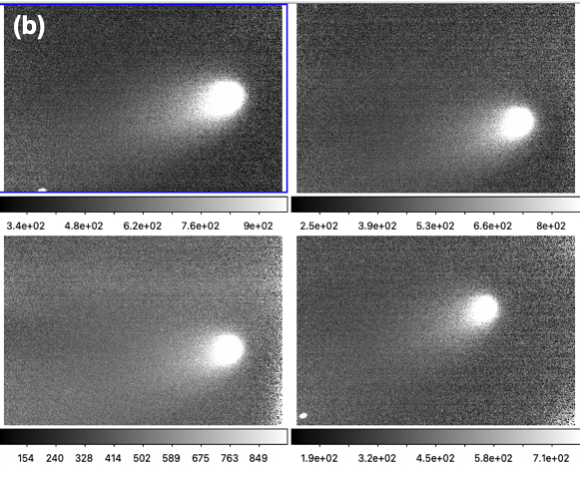
Figure (a) Optical layout of SQUIDPOL. HWP and WGF denote the half-wave plate and wire-grid filter, respectively. B1 represents the first branch, reflected by the non-polarizing beamsplitter (NPBS), while B2 is the second branch, transmitted through the NPBS.
Figure (b) A set of four images captured by SQUIDPOL in a single exposure. These images show Comet C/2023 A3, observed on 2024 October 17.
How to cite: Geem, J., Jin, S., Ishiguro, M., Park, W., Oh, H., Park, C., Lim, B., Choi, S., and Seo, J.: Design and Performance Evaluation of SQUIDPOL: A Polarimeter for Small Solar System Bodies with the SNU 60-cm Telescope, EPSC-DPS Joint Meeting 2025, Helsinki, Finland, 7–12 Sep 2025, EPSC-DPS2025-579, https://doi.org/10.5194/epsc-dps2025-579, 2025.


