
 1,2,3,4,5,1,2,6,8,9,10,
- 1Institute of Astrophysics and Space Sciences, Universidade do Porto, CAUP, Rua das Estrelas, 4150-762 Porto, Portugal
- 2Departamento de Física e Astronomia, Faculdade de Ciências, Universidade do Porto, Rua do Campo Alegre, 4169-007 Porto, Portugal
- 3Bard College, 30 Campus Rd, Annandale-On-Hudson, NY 12504, USA
- 4Institute of Astrophysics and Space Sciences, Observatório Astronómico de Lisboa, Ed. Leste, Tapada da Ajuda, 1349-018 Lisboa, Portugal
- 5Faculdade de Ciências, Universidade de Lisboa, Campo Grande 016, 1749-016 Lisboa, Portugal
- 6INAF—Osservatorio Astrofisico di Arcetri, Largo Enrico Fermi 5, 50125 Firenze, Italy
- 7National Solar Observatory, 22 Ohia Ku Street, Pukalani, HI 96768, USA
- 8LESIA, Observatoire de Paris, Université PSL, CNRS, Sorbonne Université, Université Paris Cité, 5 Place Jules Janssen, 92195 Meudon, France
- 9Université Paris-Saclay, UVSQ, DYPAC, 78000 Versailles, France
- 10Université Côte d’Azur, Observatoire de la Côte d’Azur, CNRS, Laboratoire Lagrange, Bd de l’Observatoire, CS 34229, 06304 Nice Cedex 4, France
The great diversity of detected exoplanets offers a wealth of opportunities for atmospheric characterization studies. Transmission spectroscopy has proven effective in probing the chemical composition and dynamics of hot gas giants, and is now beginning to deliver the first insights into the atmospheres of Super-Earths and terrestrial exoplanets. The extension of this technique to rocky worlds, however, has revealed fundamental challenges to atmospheric characterization, associated with their shallow atmospheres and the impact of stellar contamination on observational data [1,2].
The prospect of retrieving the atmospheric chemical composition of an Earth-sized exoplanet is currently beyond reach. Importantly, as these environments begin to be characterized, the most favourable targets for transmission spectroscopy are expected to host atmospheres more akin to Venus than to a truly Earth-like composition [3]. With the goal of informing future observation campaigns of a potential population of Venus-analogues in our galaxy (e.g., using the next-generation facility ELT-ANDES), this work analysed near-infrared transmission spectra from Venus, between 15,624-15,680 Å, as observed with DST-FIRS during the planet’s solar transit of 5–6 June 2012.
Benefiting from a high resolving power (R ~ 90,000), we could resolve distinct molecular absorption lines and disentangle between spectral features from the main isotopologues of carbon dioxide, 12C16O2 and 13C16O2, and carbon monoxide, 12C16O (Figure 1). We performed cross-correlation analyses with spectral templates from petitRADTRANS [4], enabling detections of both CO2 isotopologues and CO, together with a tentative signal for atmospheric ozone on Venus (Figure 2 and Figure 3). Our results highlight potential spectral observables to be expected for Venus-like exoplanet atmospheres, and showcase how current line lists offer sufficient precision to perform such detections with the cross-correlation technique.
This study provides a clear motivation to explore the synergy between Solar System research and the rapidly growing field of exoplanetary science, by enabling direct comparison between ground-based high-resolution data and transmission spectroscopy datasets from space probes [5,6]. Such a comparison provides a valuable calibration template to strengthen the interpretation of transmission spectra from Earth-sized exoplanets near the habitable zone.
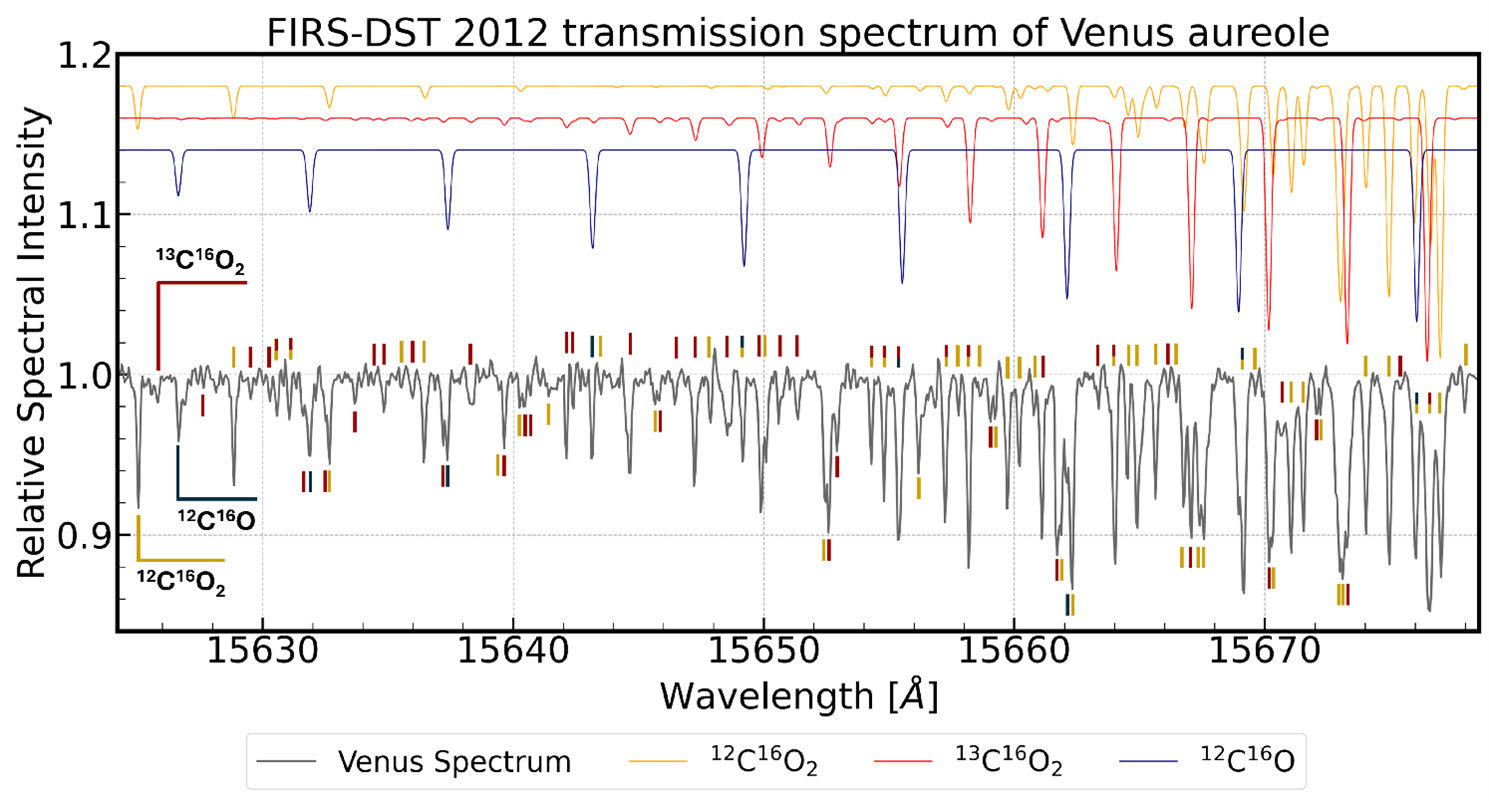
Figure 1: Average transmission spectrum of Venus extracted from the atmospheric aureole as observed during the solar transit of 2012 (in gray). Synthetic transmission spectra for CO2 and CO isotopologues were generated with petitRADTRANS and are shown for comparison. The absorption lines identified upon visual inspection of the observed spectrum have been marked: 12C16O2 (yellow), 13C16O2 (red), 12C16O (dark blue).
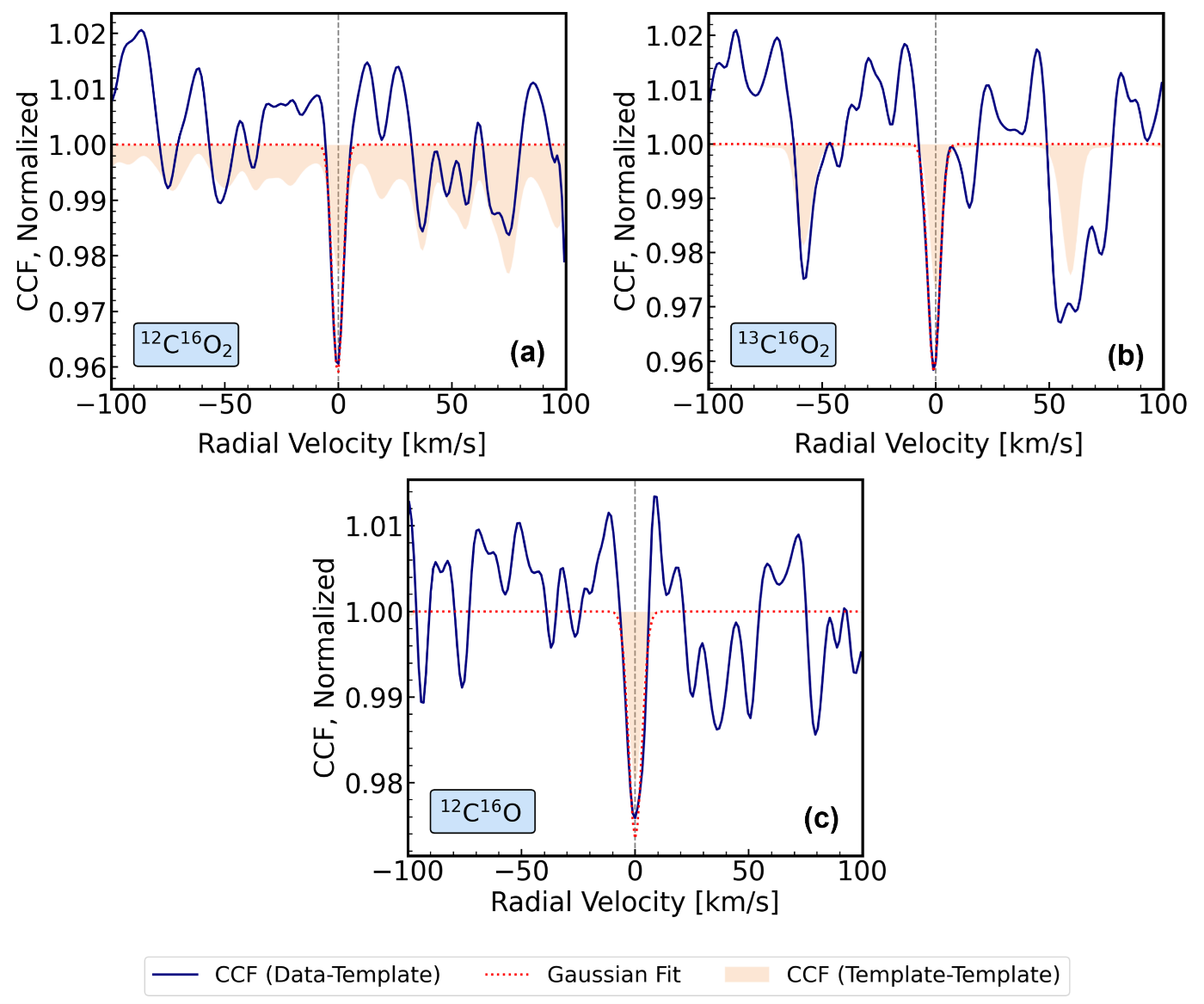
Figure 2: Cross-correlation functions for (a) 12C16O2, (b) 13C16O2, (c) 12C16O (dark blue line). The best-fit Gaussian profiles are shown for each CCF (red dashed line). All panels show the CCFs resulting from the self cross-correlation of the templates (light orange area), which are scaled arbitrarily.
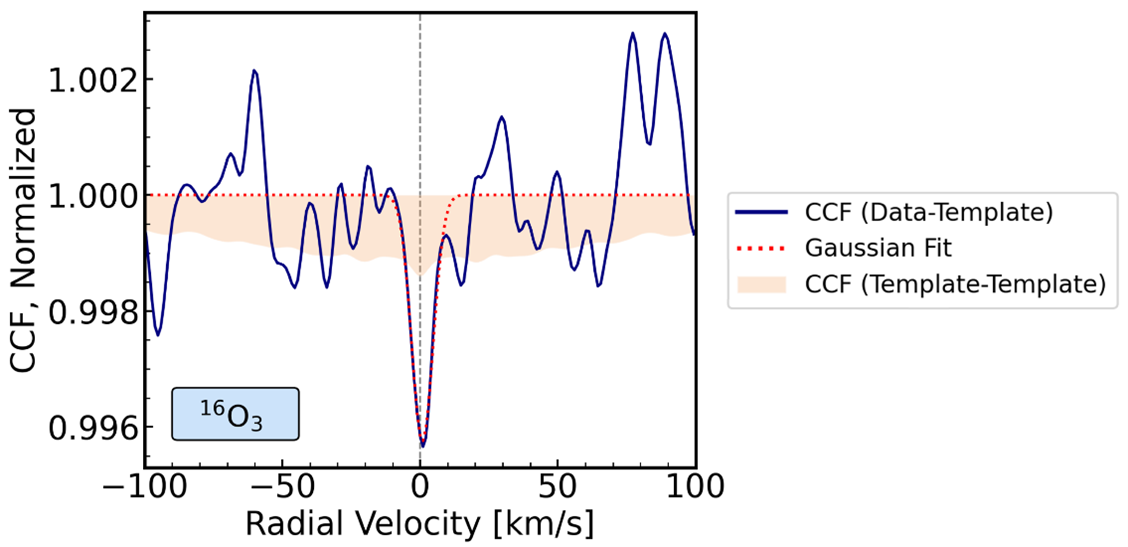
Figure 3: Cross-correlation function for 16O3 (dark blue line) along with the best-fit Gaussian profile (red dashed line). The CCF resulting from the self cross-correlation of the template is shown as a light orange area, arbitrarily scaled for comparison.
References:
[1] Moran, S.; et al. High Tide or Riptide on the Cosmic Shoreline? A Water-rich Atmosphere or Stellar Contamination for the Warm Super-Earth GJ 486b from JWST Observations. Astrophys. J. Lett. 2023, 948, L11
[2] Lim, O.; et al. Atmospheric Reconnaissance of TRAPPIST-1 b with JWST/NIRISS: Evidence for Strong Stellar Contamination in the Transmission Spectra. Astrophys. J. Lett. 2023, 955, L22
[3] Kane, S.; et al. A potential super-Venus in the Kepler-69 System. Astrophys. J. Lett. 2013, 770, L20
[4] Mollière, P.; et al. petitRADTRANS. A Python radiative transfer package for exoplanet characterization and retrieval. Astron. Astrophys. 2019, 627, A67.
[5] Ehrenreich, D.; et al. Transmission spectrum of Venus as a transiting exoplanet. Astron. Astrophys. 2012, 537, L2
[6] Hedelt, P.; et al. Venus transit 2004: Illustrating the capability of exoplanet transmission spectroscopy. Astron. Astrophys. 2011, 533, A136
How to cite: Branco, A., Machado, P., Demangeon, O., Azevedo Silva, T., Sousa-Silva, C., A. Jaeggli, S., Widemann, T., Tanga, P., and Mendoza, L.: High-Resolution Transmission Spectroscopy of Venus: A Proxy for Atmospheric Characterization of Earth-Sized Exoplanets, EPSC-DPS Joint Meeting 2025, Helsinki, Finland, 7–13 Sep 2025, EPSC-DPS2025-580, https://doi.org/10.5194/epsc-dps2025-580, 2025.


