

- Charles University in Prague, Institute of Astronomy, Faculty of Mathematics and Physics, Prague, Czechia
The spin and shape properties of asteroids carry valuable information about their collisional and dynamical history. In this study, we present an extensive new dataset of asteroid spin states and convex shape models derived from all available sparse photometric data, including Gaia DR3, ATLAS, ZTF, and other major optical surveys. This represents the most complete set of asteroid physical properties derived through lightcurve inversion to date, with significantly improved coverage and statistical reliability compared to previous works.
Combining Gaia DR3 with ground-based surveys not only increases the number of reliably modeled asteroids, but also improves the robustness of individual solutions thanks to better sampling and geometry coverage. This synergy highlights the importance of integrating space- and ground-based photometry, and paves the way for even larger datasets following future data releases—most notably Gaia DR4. The same methodology applied here can be directly extended to Gaia DR4, where longer time baselines and additional measurements will further enhance model quality and enable detailed studies of smaller or more slowly rotating bodies.
Using a unified inversion pipeline, we obtained unique spin and shape solutions for more than 25,000 asteroids. The model reliability benefits from cross-validation of photometry from multiple independent sources and optimized inversion techniques tuned for sparse time sampling. Our enhanced dataset enables us to analyze correlations between rotation period, size, elongation, and other physical parameters with unprecedented statistical power.
We focus particularly on asteroid families, using dynamical membership data to examine the evolution of spin properties within collisional groups. Young families, such as Veritas, show spin states that appear largely unaltered by dynamical or thermal processes. Their members exhibit a narrow distribution of rotation periods and broad distribution of elongations consistent with outcomes of catastrophic disruption and reaccumulation, reflecting their relatively pristine post-formation state.
In contrast, older families display a more evolved distribution of spin periods, with a noticeable excess of both fast and slow rotators. These features are consistent with long-term evolution driven by the YORP effect and collisional damping. The differences between young and old families reinforce the role of thermal torques in shaping asteroid spin distributions over Gyr timescales.
A central result of our study is the period–size diagram, which reveals a clear bimodality in the spin rate distribution: one group of fast rotators and another of slow rotators. This separation, statistically robust in our expanded sample, aligns well with the scenario proposed by Zhou et al. (2025), who interpret it as the combined outcome of YORP evolution and a population of tumbling or non-principal axis rotators. Our dataset confirms that this bimodality is not an artifact of selection effects or incomplete modeling, but a genuine structural feature of the asteroid spin distribution.
This work provides new constraints on asteroid rotational evolution, the age-dependent effects of YORP, and the initial conditions following family-forming collisions. Our results are essential for future efforts in thermophysical modeling, dynamical simulations of asteroid families, and constraining the long-term evolution of small bodies in the Solar System.
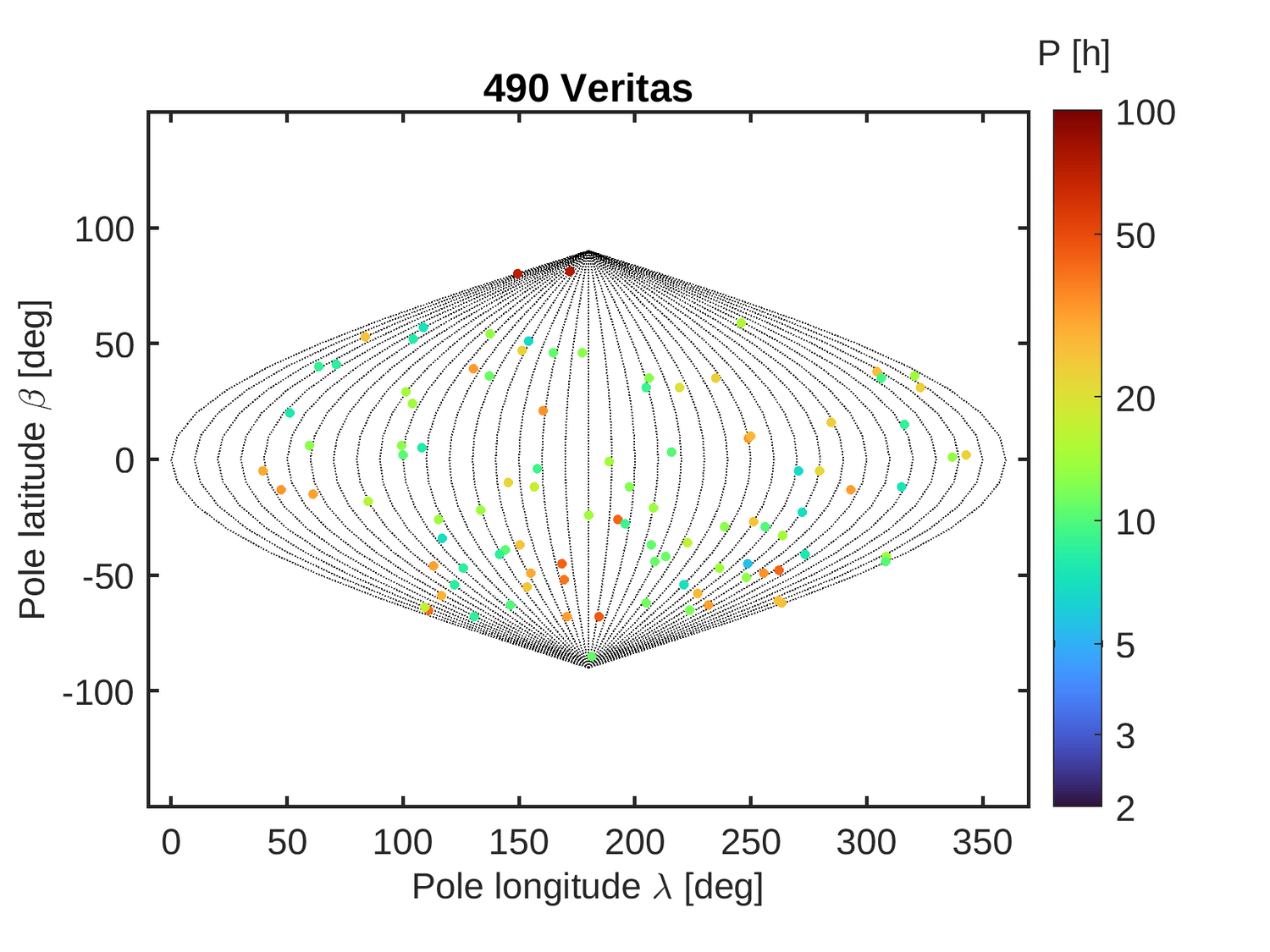
Figure 1: Distribution of spin axis directions (pole latitudes and longitudes) for asteroid members of the Veritas family. Each point represents one object with a derived shape and spin-state solution from combined Gaia DR3 and ground-based photometry. The color scale indicates the rotation period in hours. The nearly isotropic distribution of pole orientations suggests that the Veritas family is dynamically young and has not undergone significant YORP-induced spin alignment or collisional evolution.
How to cite: Hanuš, J. and Ďurech, J.: Spin and Shape Properties in Young and Evolved Asteroid Families: Insights from All-Sky Sparse Photometry, EPSC-DPS Joint Meeting 2025, Helsinki, Finland, 7–12 Sep 2025, EPSC-DPS2025-581, https://doi.org/10.5194/epsc-dps2025-581, 2025.


