
 1,1,2,1,1,1,
- 1Asteroid Engineering Laboratory, Lulea University of Technology, Kiruna, Sweden
- 2Department of Physics, University of Helsinki, Helsinki, Finland
- 3University of Stuttgart, Stuttgart, Germany
Our study investigates the potential effects of intense solar radiation heating on the physical properties of carbonaceous asteroids, such as surface textures, particle-size distributions, and porosity. The observed number of near-Earth asteroids (NEAs) with small perihelion distances (q) is smaller than theoretically predicted (Granvik et al. 2016), indicating that NEAs are catastrophically disrupted near the Sun. One proposed destruction mechanism is that intense solar radiation induces thermal fracturing, eventually leading to breakup. Notably, (3200) Phaethon has exhibited recurrent activity near its perihelion (q = 0.14 au), such as dust and/or gas ejection over several decades (Jewitt et al. 2015), suggesting it may be experiencing thermal disruption. At this moment, the physical properties of NEA surfaces can provide insights into the mechanisms affecting them during close solar encounters.
However, the effects of solar heating on the physical properties of NEA surfaces have not been extensively studied. For example, it remains unclear whether radiation heating causes sintering (leading to enlarged particles), thermal fracturing (leading to finer particles), or whether unknown mechanisms affect the resulting particle-size distributions. To address this, we simulate the near-Sun environment in the laboratory by using the Space and High-Irradiation Near-Sun Simulator located at Luleå University of Technology’s Space Campus in Kiruna, Sweden (Tsirvoulis et al., 2022), where the carbonaceous chondrite simulants (Britt et al., 2019) are irradiated under vacuum (∼10-5 atm), using a solar-like spectrum in the visible range. We have carried out the experiments at intensity levels equivalent to those at a heliocentric distance of 0.12 au, and varied the sample characteristics such as particle sizes and compositions. We find that radiation heating alters the physical properties of the simulants. For example, tamped fine-grained samples of CM simulant (samples sieved by the 351 µm sieve) show a few hundred-micrometer-sized aggregates, pits, and millimeter-scale cracks after heating (Fig. 1).
We will present our experimental results. Then, by combining these with previous polarimetric laboratory studies, we interpret the polarimetric properties of NEAs observed at large phase angles, such as the maximum polarization degree and the maximum phase angle. For this discussion, we use polarimetric measurements from both previous studies and our own observations conducted by using ALFOSC on the Nordic Optical Telescope.
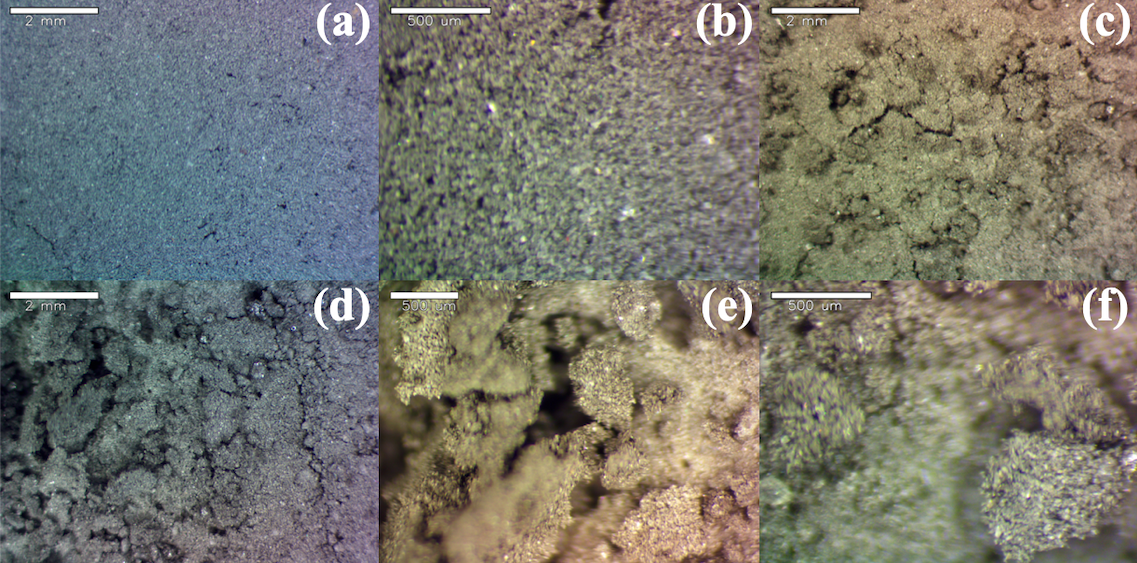
Figure 1. Stereo microscope images of (a) the tamped fine-grained samples of CM simulant before radiation heating, and (b–f) after radiation heating. White scale bars are shown at the top left of each image, with scales of 2 mm, 500 μm, 2 mm, 2 mm, 500 μm, and 500 μm for (a), (b), (c), (d), (e), and (f), respectively. Please note that image brightness and color vary due to differences in exposure time between images and are not normalized.
How to cite: Geem, J., Granvik, M., Schirner, L., Tsirvoulis, G., Toliou, A., and Fürst, P.: Investigating the Physical Properties of NEAs under Intense Solar Radiation via laboratory experiments and polarimetric observations, EPSC-DPS Joint Meeting 2025, Helsinki, Finland, 7–12 Sep 2025, EPSC-DPS2025-597, https://doi.org/10.5194/epsc-dps2025-597, 2025.


