
 1,2,1,2,4,1,3
- 1The Open University , School of Physical Sciences, Milton Keynes, United Kingdom (juan.alday@open.ac.uk)
- 2LATMOS, Guyancourt, France
- 3Space Research Institute (IKI), Moscow, Russia
- 4Department of Physics, University of Oxford, Oxford, United Kingdom
Introduction: Isotope ratios in water vapour provide key insights about the history of water on Mars and can help us unravel the fate of the large amounts of liquid water that once existed on the surface of early Mars [1]. A five-fold enrichment of the deuterium-to-hydrogen (D/H) ratio in Martian water vapour with respect to Earth suggests that a substantial amount of the water inventory escaped to space, but more quantitative estimates rely on a rigorous understanding of the relative escape between the light and heavy isotopes (e.g., [2]).
Atmospheric processes such as condensation or photolysis shape the vertical distribution of the water vapour isotopes [3,4] and in turn impact the relative supply of isotopes to the upper atmosphere, where they can escape through thermal and non-thermal processes [5]. Therefore, an in-depth understanding of the vertical distribution of the water vapour abundance and its isotopic fractionation is crucial for reconstructing the escape history of water on Mars.
In this study, we measure and model the vertical distribution of D/H and 18O/16O on Martian water vapour using infrared solar occultation observations from the Atmospheric Chemistry Suite (ACS) aboard the ExoMars Trace Gas Orbiter (TGO), together with simulations of the D/H and 18O/16O cycles on Mars from the Mars Planetary Climate Model (PCM).
TGO/ACS solar occultation observations: The mid-infrared (MIR) channel of ACS monitors the Martian atmosphere at high spectral resolution (λ/Δλ ≈ 30,000) within the spectral range 2.3-4.2 μm (~2400-4300 cm-1) in solar occultation mode [6]. To achieve high spectral resolution within the whole range, ACS MIR incorporates a secondary movable grating that allows the simultaneous selection of 7-25 diffraction orders.
In this work, we analyse observations made with secondary grating positions #5 and #11, which allow the selection of diffraction orders covering a spectral range of 3780-3990 cm-1 and 2650-2950 cm-1, respectively (see Figure 1). These spectral ranges include the most suitable absorption features to measure the vertical distribution of D/H and 18O/16O from the ACS spectra.
We will present the retrieved vertical profiles of D/H and 18O/16O using this experimental setup and following a retrieval methodology previously validated for the derivation of other isotopic ratios with TGO/ACS [7,8]. In particular, we will focus our analysis on the observations made close to aphelion (LS ~ 70˚) and perihelion (LS ~ 250˚), when the water vapour vertical distribution is particularly different, and discuss the vertical variability of the D/H and 18O/16O isotopic ratios during these two distinct seasons.
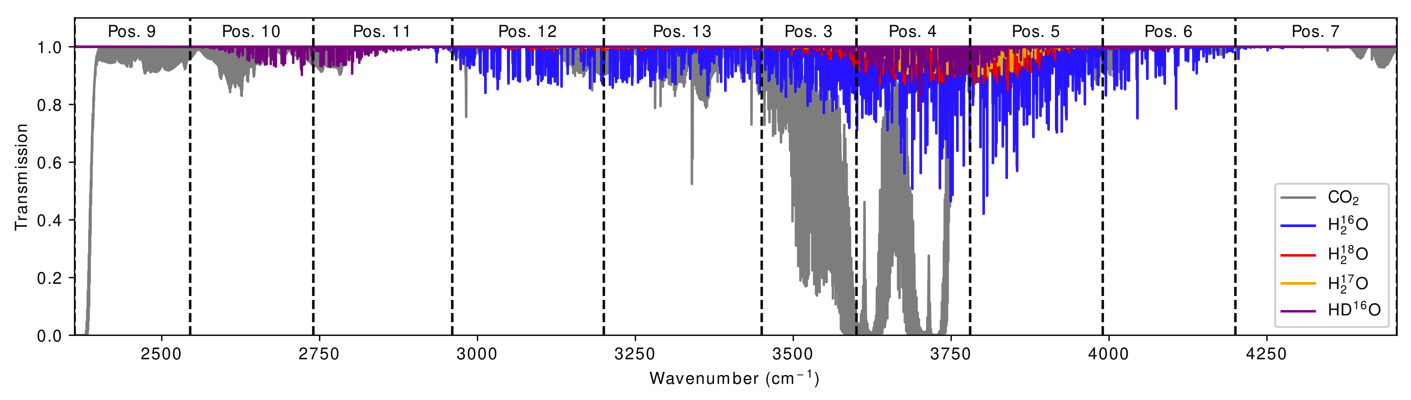
Figure 1: Synthetic transmission spectrum of the Martian atmosphere within the spectral range of ACS MIR. The figures shows the instantaneous spectral range covered by ACS MIR when using different secondary grating positions (black dashed lines), as well as the contribution by CO2 and different H2O isotopes to the spectrum (coloured lines) [7].
Simulations with the Mars PCM: Several studies have been conducted to model the variations of the D/H ratio in the atmosphere of Mars (e.g., [3,4,9]), but the variability of the 18O/16O isotopic ratio remains largely unexplored.
In this work, we include the condensation-induced fractionation effect of 18O/16O to the most recent version of the HDO scheme on the Mars Planetary Climate Model [4,10], aiming to simulate the simultaneous fractionation of both water isotopic ratios. This scheme includes the implementation of equilibrium fractionation due to the different saturation vapour pressures of the water isotopes [11,12], as well as the implementation of kinetic effects due to their different diffusivities [13].
Figure 2 shows the vertical distribution of the D/H and 18O/16O isotopic ratios modelled with the Mars PCM at the locations and times of ACS MIR measurements made during the aphelion and perihelion seasons of Martian Year 35. The altitudinal profiles of these isotopic ratios are driven by the condensation of water, either on the ground in the winter hemispheres, or through the formation of water ice clouds, which form at much higher altitudes during the warmer perihelion season than close to aphelion. While the distribution of both isotopic ratios from the model is very similar, the amplitude of the variations in the 18O/16O isotopic ratio are much smaller than those in D/H.
We will compare the simulations of the D/H and 18O/16O ratios from the Mars PCM with the measured profiles from TGO/ACS, aiming to investigate the relative supply of water isotopes to the Martian upper atmosphere.
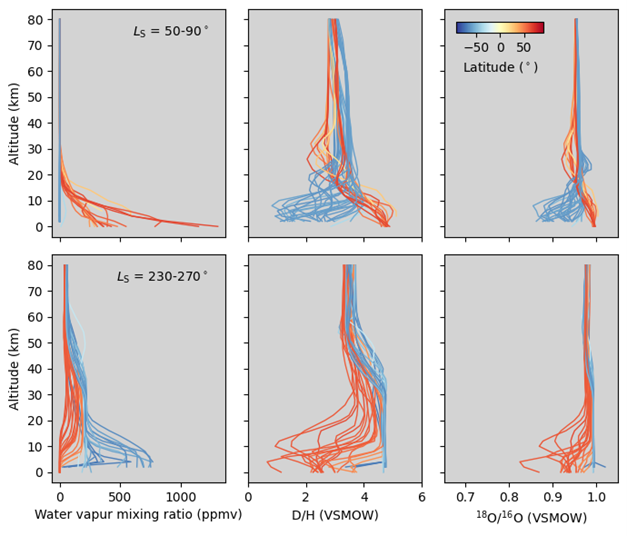
Figure 2: Vertical distribution of the water vapour volume mixing ratio, D/H and 18O/16O modelled with the Mars PCM at the locations and times of the ACS MIR during the aphelion (top) and perihelion (bottom) seasons in Martian Year 35. The lines in the different panels are coloured based on the latitude of the locations.
References:
[1] Scheller et al., Science, 2021, eabc7717. [2] Villanueva et al., Science, 2015, 348, 218. [3] Montmessin et al., J. Geophys. Res., 2005, 110, E03006. [4] Vals et al., JGR Planets, 2022, 127. [5] Cangi et al., JGR Planets, 2023, 128, e2022JE007713. [6] Korablev et al., Space Sci. Rev., 2018, 214, 7. [7] Alday et al., Nat. Astron., 2021, 5, 943. [8] Alday et al., Nat. Astron., 2023, 7, 867. [9] Daerden et al., JGR Planets, 2022, 127. [10] Rossi et al., JGR Planets, 2022, 127. [11] Lamb et al., PNAS, 2017, 114, 5612. [12] Majoube, Nature, 1970, 226, 1242. [13] Hellmann & Harvey, JGR Planets, 2021, 126.
How to cite: Alday, J., Patel, M. R., Montmessin, F., Fedorova, A. A., Holmes, J., Petzold, G., Baggio, L., Trokhimovskiy, A., Olsen, K. S., Belyaev, D., Mason, J. P., and Korablev, O.: The vertical distribution of water vapour isotopes on Mars from the Atmospheric Chemistry Suite aboard the ExoMars Trace Gas Orbiter, EPSC-DPS Joint Meeting 2025, Helsinki, Finland, 7–13 Sep 2025, EPSC-DPS2025-626, https://doi.org/10.5194/epsc-dps2025-626, 2025.


