
 1,1,1,3
- 1Department of Physics, University of Helsinki, Finland
- 2Instituto de Astrofísica de Andalucía (CSIC), Spain
- 3Space Science Institute, Boulder, CO, USA
Light scattering by cosmic dust particles is central to interpreting photometric and polarimetric observations in planetary science. The scattering properties of particles are described by the 4×4 scattering Mueller matrix (F). For ensembles of randomly oriented particles and their mirror counterparts, the Mueller matrix reduces to a block-diagonal form with six non-zero angular functions: a₁, b₁, a₂, a₃, b2, and a₄,

These functions encode the angular behavior of scattering and are often derived from theoretical computations or laboratory measurements. However, existing models may violate required symmetry relations or lack flexibility for inverse modeling tasks.
We provide a concept of an explicit parametric model of complex angular dependencies of scattering matrix elements by empirical parameterization of the Mueller matrix based on analytical functions [1]. The model incorporates physical insights, such as forward- and backward-scattering behaviors and backscattering surges, while enforcing symmetry constraints derived from scattering theory [2]. It enables compact representations of the Mueller matrix: measured matrices can be described with as few as 28 free parameters averaging fewer than five per function. The full model supports up to 44 parameters in its most general form for increased flexibility. The model further allows for an efficient transport and utilization of scattering matrices in multiple scattering applications.
The parameter estimation process consists of three stages: initialization, nonlinear least-squares optimization, and uncertainty quantification using Markov chain Monte Carlo (MCMC) methods. The MCMC approach allows us to derive statistical distributions for all model parameters, producing confidence intervals and uncertainty envelopes for the modeled scattering matrix elements.
We applied our model to a range of experimental scattering matrices from the updated Granada-Amsterdam Light Scattering Database [3], which includes measurements for cosmic dust analogs such as meteorites, regolith simulants, minerals (e.g., feldspar, hematite, rutile), as well as water ice [4]. Across these samples and wavelengths, the model achieves relative root-mean-square deviations on the order of 1%, demonstrating its robustness and accuracy. The model also enables the extraction of physically meaningful descriptors—such as asymmetry parameters, polarization minima and maxima, and inversion angles—which support interpretation of phase curve dependencies.
In particular, we show that the parameterization accurately reproduces the angular trends in both intensity and polarization, including features like negative polarization branches and forward-scattering peaks. The model handles noisy or incomplete data gracefully, and symmetry enforcement helps reduce overfitting and improve physical plausibility.
Our empirical model serves as a valuable tool for radiative transfer applications, including the modeling of disk-integrated photometric and polarimetric phase curves of atmosphereless Solar System objects (e.g., satellites, asteroids, comets) [5]. The compact parameterization facilitates both forward simulations and inverse retrievals of dust properties. Moreover, it opens possibilities for applying machine learning methods to scattering data analysis, due to its consistent structure and small parameter set.
In conclusion, the presented parameterized Mueller matrix approach enables efficient, physically grounded modeling of light scattering by cosmic dust. It bridges the gap between complex experimental data and practical radiative transfer applications [6,7].
Ongoing work focuses on applying the model to the full Granada-Amsterdam database, developing global trends across materials, and integrating the parameterization into inverse modeling of remote sensing observations.
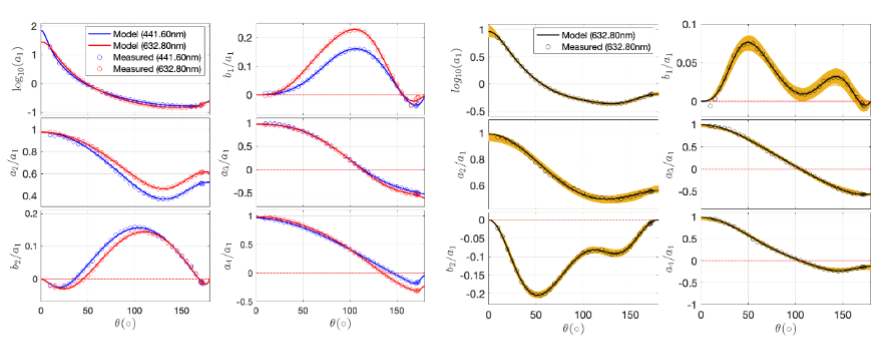
Figure 1: Measured data and model for feldspar (left) and hematite measured data and model with uncertainty envelope (right).
[1] Muinonen, K. & Leppälä, A, in preparation, (2025)
[2] Hovenier, J.W., van der Mee, C.V.M. (1983). Fundamental relationships relevant to the transfer of polarized light in a scattering atmosphere. Astronomy & Astrophysics 128, 1-16.
[3] Muñoz O., Frattin E., Martikainen J. et al. (2025). Updated Granada-Amsterdam Light Scattering Database. JQSRT 331, 109252.
[4] Muinonen, K. & Markkanen, J. 2023, in Light, Plasmonics and Particles, ed. M. P. Mengüç & M. Francoeur, Nanophotonics (Elsevier), 149–165
[5] N. Kiselev et al., New Polarimetric Data for the Galilean Satellites: Io and Ganymede Observations and Modeling, Planet. Sci. J. 5, 10 (2024)
[6] K. Muinonen, A. Penttilä, Scattering matrices of particle ensembles analytically decomposed into pure Mueller matrices, JQSRT 324, (2024)
[7] K. Muinonen et al., Coherent backscattering in discrete random media of particle ensembles, JQSRT 330, (2025)
How to cite: Leppälä, A., Muinonen, K., Penttilä, A., Muñoz, O., and Videen, G.: Empirical Parameterization of Mueller Matrices for Light Scattering by Cosmic Dust, EPSC-DPS Joint Meeting 2025, Helsinki, Finland, 7–12 Sep 2025, EPSC-DPS2025-632, https://doi.org/10.5194/epsc-dps2025-632, 2025.


