
 1,1,
1,1,- 1University of Maryland Baltimore County, CSST, United States of America
- 2NASA Goddard Space Flight Center
The Transiting Exoplanet Survey Satellite (TESS) is a NASA mission focused on exploring and finding exoplanets around nearby stars using the transiting method. The TESS telescope covers a large field of view of 96 sq. deg in a single exposure. It has four cameras arranged vertically pointing from the ecliptic plane toward the poles. During its first two years of observations, TESS saved full-frame images (FFI) with a 30-minute cadence during about 27 days covering one celestial hemisphere per year.
Thanks to this configuration and observing schedule, TESS is able to observe asteroids with a high duty cycle (see Figure 1 for an example of observed asteroid projected tracks in a typical TESS field). Current techniques to search for asteroid signals on images rely on the shift-and-stack method, which relies on testing all possible combinations of directions and speeds an object can move across the image to maximize the detection signal and find the asteroid’s track. This method is computationally expensive, and only attainable when the parameter space (direction-velocity) is constrained, usually to the most common direction of motion(e.g. orbits parallel to the ecliptic plane) and common speeds (e.g. main belt asteroids). This introduces a bias against fast-moving asteroids and high-inclination orbits (projected tracks perpendicular to the eclliptic plane).
To solve this, we implemented a rotationally invariant neural network (NN) model that performs semantic segmentation to find moving objects in TESS FFIs. This NN has an architecture that uses a W-Net architecture (two 3D U-Nets stacked) with skip connections that output a 3D segmentation mask with asteroid detections. Figure 2 shows details of the W-Net architecture. We constructed a custom training set using 64x64x64 cubes of pixel flux time series and truth masks with the tracks of known asteroids from the JPL Horizon Ephemeris system. During training, these cubes are randomly rotated and flipped to enforce rotational invariance. Our NN model can find known and new asteroids with all kinds of track orientations, showing no bias against objects moving at high inclination orbits, or fast-moving asteroids, or tracks with a change in direction. Figure 3 shows that our NN model detects ~90% of known asteroids down to apparent visual magnitude 20th and has a detection limiting magnitude of ~21. This is on par with current implementations of the shift-and-stack method but without the bias introduced by limiting the range of track direction and velocity.
This machine learning model present an orthogonal method to search for peculiar solar system objects, such as Trans Neptunian Objects or Near Earth Objects, and provides a complimentary approach to current methods. Additionally, is directly applicable to other all-sky survey like observations, such as the Galactic Bulge Time Domain Survey of the upcoming Roman Space Telescope.
In this talk, we will introduce the NN mode, training set construction and details,l and present results from predictions using years 1 and 2 of TESS data. Additionally, we will show preliminary light curves extracted from new asteroids detected by our model.
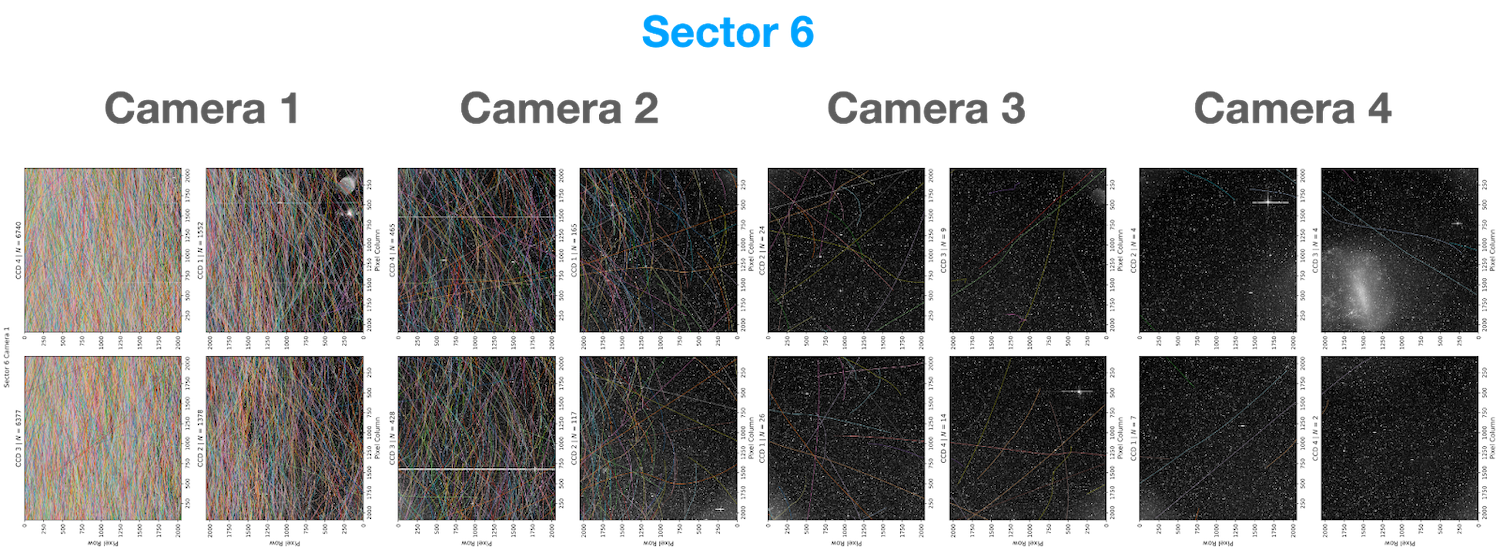
Figure 1: TESS Sector 6 FFIs with known observed asteroids brighter than V<22, tracks were obtained from the JPL Horizon system. TESS has 4 cameras with 4 CCD each stacked vertically with respect to the ecliptic plane (left) and the celestial pole (right).
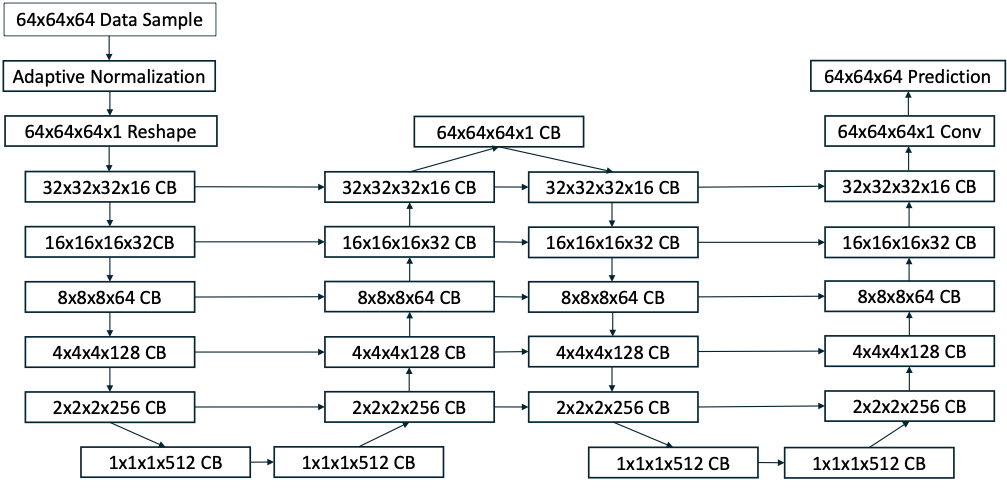
Figure 2: W-Net architecture of the neural network model used to identify moving objects in TESS FFI cubes. The network as an Adaptive Normalization layer particularly developed for this data, inputs flux cubes of size 64, and outputs an asteroid prediction probability cube of the same shape.
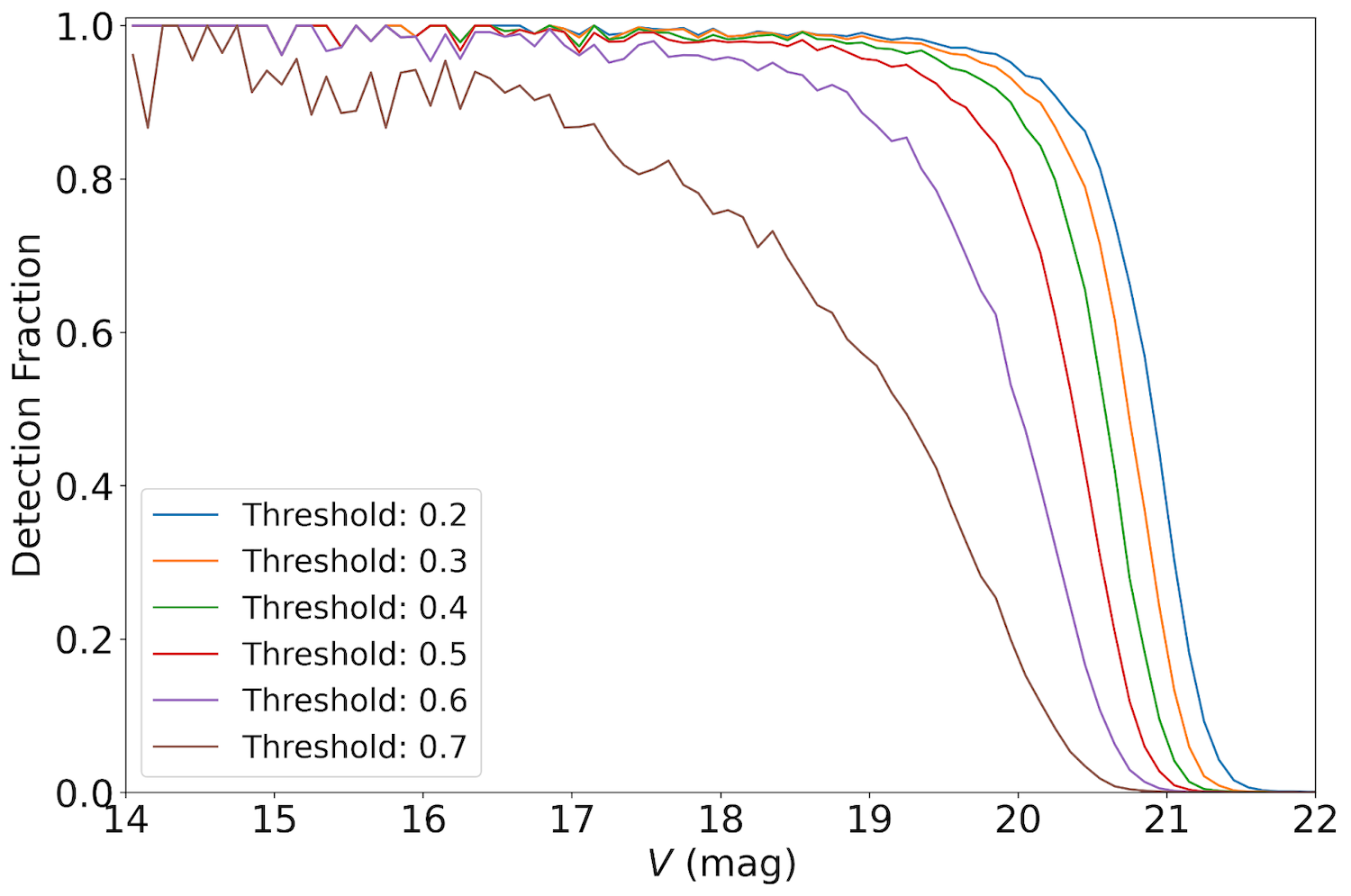
Figure 3: Asteroid detection fraction as a function of object brightness for multiple predicted probability thresholds. Lower thresholds improves detection fraction reaching 90% at magnitude V=20 for a threshold value of 0.5.
How to cite: Martinez Palomera, J., Powell, B., Tuson, A., and Hedges, C.: AI-enabled Asteroid detection in TESS data , EPSC-DPS Joint Meeting 2025, Helsinki, Finland, 7–12 Sep 2025, EPSC-DPS2025-64, https://doi.org/10.5194/epsc-dps2025-64, 2025.


