
 1,2,1,1,1,1,4,1
- 1Delft University of Technology, Faculty of Aerospace Engineering, Astrodynamics and Space Missions Section, Delft, Netherlands
- 2ESA/ESTEC, Noordwijk, The Netherlands
- 3Purdue University, School of Aeronautics and Astronautics, West Lafayette, Indiana, USA
- 4Universität der Bundeswehr München, Germany
- 5The Exploration Company, München, Germany
The TU Delft Astrodynamics Toolbox (Tudat) [1] is a free open-source software (FOSS) suite geared towards research and education in computational astrodynamics (https://docs.tudat.space/). The primary focus of its functionality is numerical propagation and estimation of the dynamics of objects in space, with applications to a broad range of past, current, and future planetary missions and data sets.
The uniqueness of Tudat and its powerful estimation module stems from its versatility and modularity, combined with its fully open-source nature. It handles diverse data sets (e.g. radio range and Doppler, optical astrometry, VLBI, radar), while offering high-fidelity models for both spacecraft and Solar System bodies dynamics alike, covering a wide range of different dynamical regimes. These features make the Tudat software suite equally suitable for estimating the dynamics (and related physical parameters) of spacecraft, small bodies (asteroids, minor moons), natural satellites, and planets.
Building upon a strong legacy in simulation (see https://docs.tudat.space/en/latest/_src_about/research_output.html for a list of publications), Tudat’s capabilities have recently been expanded to real data analyses, with a development team comprised of both professional research software engineers and planetary scientists/astrodynamicists. Here we showcase these capabilities, demonstrating the readiness level of our observation and dynamical models for state-of-the-art analyses, and providing an outlook on our future plans.
Tudat makes it possible for the user to both perform and disseminate their analyses with full transparency regarding their underlying assumptions, settings, and models. Ongoing studies by the research team using these new features of Tudat will be published along with the full analysis code and results, allowing anyone in the community to entirely and easily reproduce all results. This not only allows for cross-examination of the results and underlying models by the full community, but will also facilitate building upon this analysis, allowing new ideas and methods to be tested and applied with a minimum of effort by any interested party, and not only the original authors. Such an approach is expected to improve the scientific return of current and future dynamical studies of various Solar System bodies.
At present, Tudat provides capabilities to process several categories of Earth- and space-based observational data: (i) deep-space range and (closed-loop) Doppler tracking data of planetary missions (e.g. [2]) collected by the Deep Space Network (DSN) and ESA’s ESTRACK, supporting multiple standard data formats such as IFMS, ATDF, ODF and TNF; (ii) deep-space (open-loop) Doppler and VLBI tracking data of planetary missions collected by the Planetary and Radio Interferometry and Doppler Experiment (PRIDE) with radio(astronomy) telescopes [3]; (iii) optical astrometry and radar tracking archived by the Minor Planet Center (MPC)[4] and the Natural Satellite Data Center (NSDC)[5].
Tudat’s deep-space radiometric processing capabilities have been successfully tested for several missions including GRAIL (Fig. 1) and Cassini (Fig. 2). By comparing post-fit residuals and estimated orbits against those obtained from reference solutions, we validate that our dynamical and observation models reproduce the measured data within the expected noise characteristic of the data.
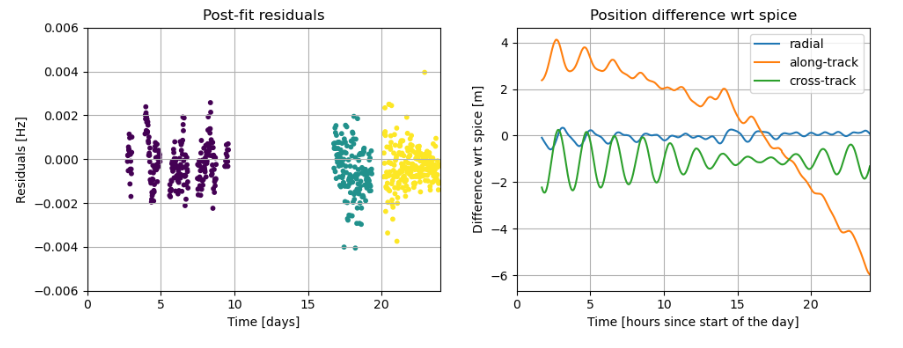
Fig. 1: Post-fit residuals and orbit differences for GRAIL from S-band Doppler data.
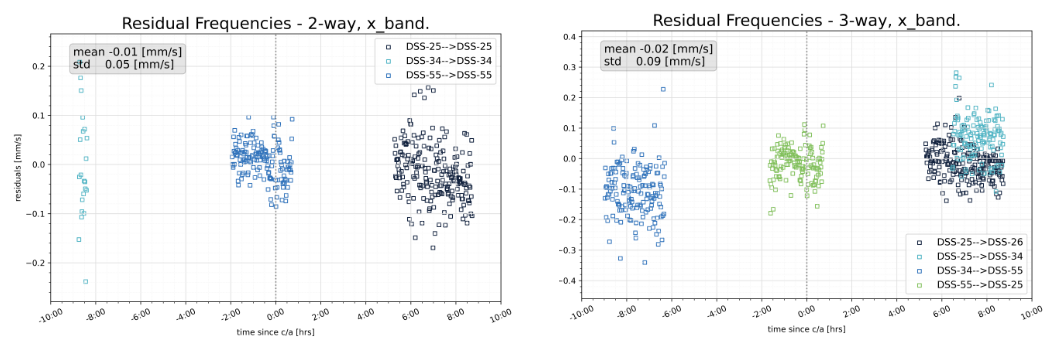
Fig. 2: Pre-fit residuals for Cassini from X-band Doppler data at Titan flyby T033.[8]
In another demonstration involving different system dynamics and data types/quality, our software has been successfully applied to orbit estimation of small bodies from astrometric observations. Fig. 3 shows the post-fit residuals for the MPC observations of Eros. The difference between our estimated orbit and the JPL Horizons orbit (used as a reference) is consistent with the expected level of uncertainty.

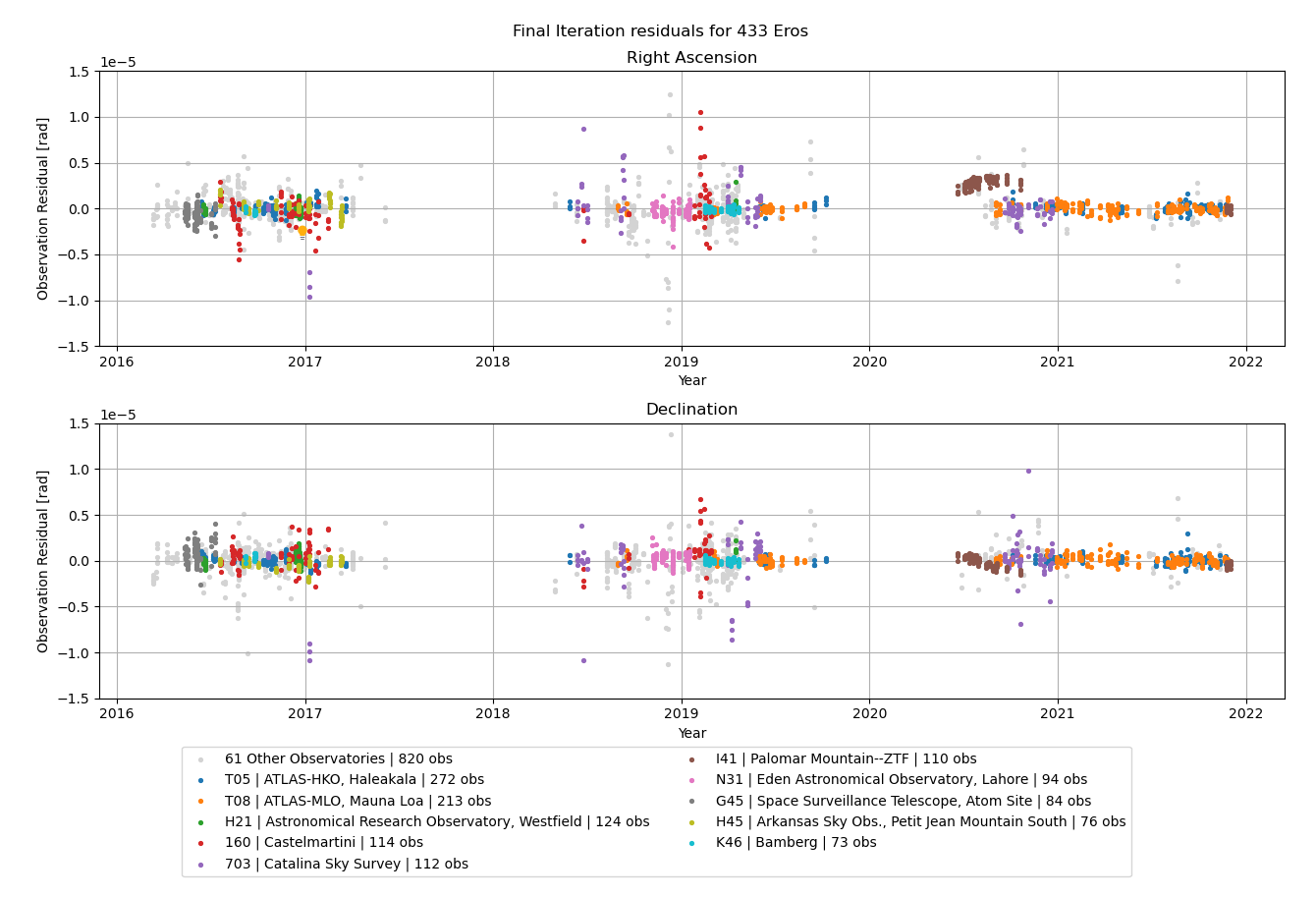
Fig 3: Orbit differences w.r.t. JPL Horizons (top) and post-fit residuals (bottom) for Eros from a six-year arc of MPC optical astrometry
Finally, the scope and accuracy of our dynamical models have been demonstrated to reproduce the motion of both spacecraft and natural bodies with the fidelity level required for high precision orbit estimations (see Fig. 4 for an example of Galilean satellites). This ensures that our software has the capability to fully exploit the quality of the available data sets and provide physically realistic orbital solutions and physical parameter estimates.
Fig 4: Orbit differences of Galilean moons over 1 year between Tudat and NOE ephemerides (as generated during validation of analyses in [7])
Tudat’s real data processing capabilities are now at the core of several research projects, primarily focusing on the orbits, interiors, and/or dynamical evolution of Solar System bodies.
Current analyses include the investigation of long-term time variations of Mars’ gravity field as a means to probe the physics of its deep interior, by combining tracking data from various Martian orbiters [7]. A re-analysis of Cassini tracking data acquired during Titan flybys is also ongoing (to be ultimately combined with long-term astrometry observations), with a particular focus on solving existing discrepancies in the estimation of tidal parameters [8]. Data analysis of Rosetta Doppler tracking coupled with high-fidelity coma density modelling will commence soon with the goal of improving understanding of the interior and dynamics of comet 67P [9]. Tudat will also be used to process the open-loop Doppler and VLBI data of the PRIDE experiment on the JUICE mission.
[1] Dirkx, D., et al. (2022). The open-source astrodynamics Tudatpy software–overview for planetary mission design and science analysis. EPSC2022, (EPSC2022-253).
[2] Gurvits, L. I., et al. (2023). Space Science Reviews, 219(8), 79.
[3] Asmar, S. W. (2022). Radio science techniques for deep space exploration. John Wiley & Sons.
[4] Minor Planet Center. (n.d.). Minor Planet Circulars (MPCs). Cambridge, MA: Smithsonian Astrophysical Observatory. https://www.minorplanetcenter.net/
[5] Arlot, J. E., & Emelyanov, N. V. (2009). Astronomy & Astrophysics, 503(2), 631-638.
[6] Fayolle, M.,et al. (2023). Astronomy & Astrophysics, 677, A42.\
[7] Alkahal, R. and Root, B.C. (2024) Satellite gravity-rate observations to uncover Martian plume-lithosphere dynamics. EPSC2024, (EPSC2024-952).
[8] Hener, J. et al. (2025), Re-visiting determination of Saturn-Titan tidal interaction parameters using the open-source Tudat software.these proceedings
[9] Reichel, M. et al. (2025), Assessing the impact of perturbations on the motion of Rosetta spacecraft near Comet 67P/Churyumov-Gerasimenko, these proceedings
How to cite: Dirkx, D., Fayolle, S., Avillez, M., Dijkstra, T., Filice, V., Gisolfi, L., Hener, J., Hinüber, L., Sanchez Rodriguez, A., Alkahal, R., Cowan, K., Gehly, S., Hu, X., Jeanjean, M., Langbroek, M., Lopez Rivera, A., Minervino Amodio, A., Plumaris, M., Reichel, M., and Van Hulle, S.: Tudat: an open-source, high-fidelity orbit and parameter estimation software – Overview of planetary mission data analysis capabilities, EPSC-DPS Joint Meeting 2025, Helsinki, Finland, 7–12 Sep 2025, EPSC-DPS2025-673, https://doi.org/10.5194/epsc-dps2025-673, 2025.


