
 1,3,
1,3,- 1Amentum, NASA Johnson Space Center, Houston, TX 77058, USA
- 2JHU Applied Physics Laboratory, Laurel, MD, USA
- 3Southwest Research Institute, San Antonio, TX, USA.
The NASA OSIRIS-REx mission returned a sample of ~120 grams from the carbonaceous near-Earth asteroid Bennu. Laboratory analyses of the returned sample revealed that it is dark, featuring brighter inclusions and veins, and contains millimeter-sized stones predominantly exhibiting hummocky, mottled, and angular patterns (Lauretta, Connolly, et al. 2024; Connolly, Lauretta, et al. 2025). These laboratory analyses confirmed that Bennu underwent aqueous alteration, akin to other carbonaceous asteroids, such as asteroid Ryugu (Nakamura et al. 2022).
As part of a NASA Laboratory Analysis of Returned Samples (LARS) study, we have received a chip of the asteroid Bennu, weighing ~113 mg, from NASA's Johnson Space Center curation (OREX-800084-0). This study aims to evaluate the relationship between organic and carbonate phases and their relationship to aqueous processes on the asteroid's parent body. The Bennu chip was transported and stored in a Teflon bag inside a sealed stainless-steel canister before being opened inside a nitrogen-purged glovebox for spectroscopic analyses. The spectroscopic measurements of the Bennu sample were conducted at the Johns Hopkins University (JHU) Applied Physics Laboratory (APL), where we used a nitrogen-purged glovebox to prevent contamination by terrestrial water while opening the sample container and manipulating the sample (installing it on the sample holder).
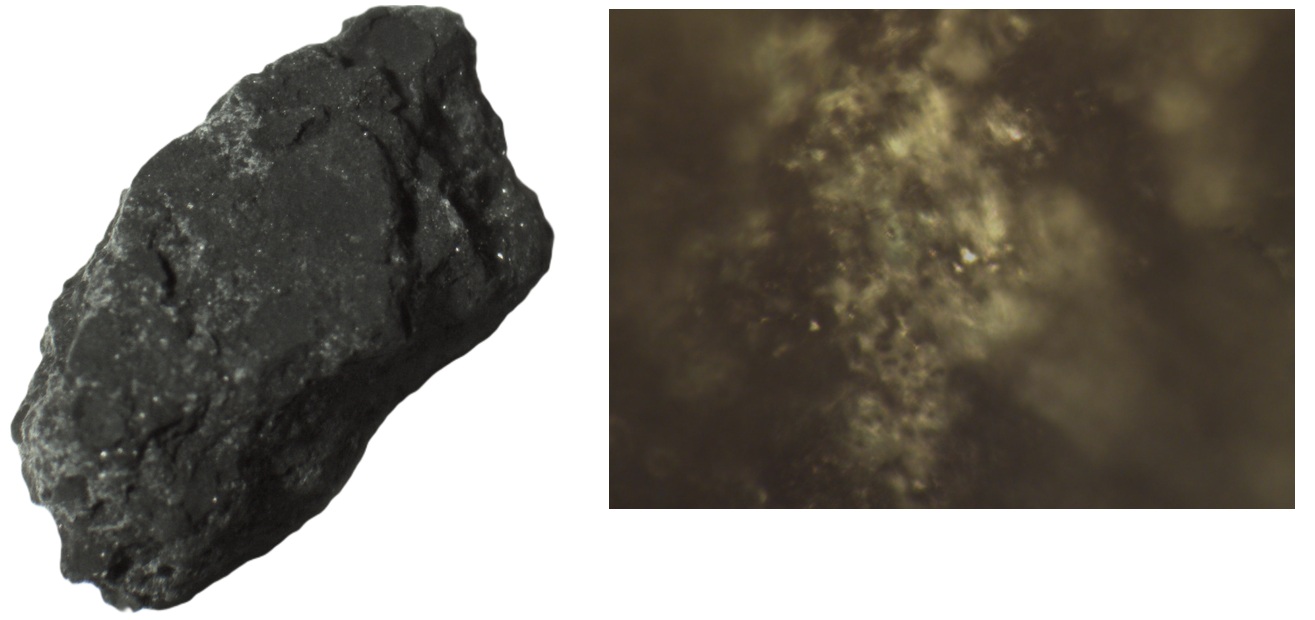
Figure 1. (Left) Microscope image (0.75X) of the Bennu chip OREX-800084-0. The length of the chip is about 9 mm across. (Right) An image (300x200 µm) of a bright clast in the Bennu sample that was spectrally analysed.
Upon opening the canister and unwrapping the Teflon bag in the glovebox, we examined the Bennu chip and found it to have an angular shape (~9 mm x 4 mm x 4 mm) with some bright clasts (~0.5 mm x 1 mm) (Fig. 1, left). Subsequently, we used a nitrogen-purged transfer and measurement container to transport the sample to the APL Geological Near-IR Optimized Microspectroscopic Experiment (GNOME) lab for measurements under nitrogen purge. Reflectance measurements were collected using a Hyperion 2000 FTIR microscope and Invenio-R spectrometer with a spectral field of view of ~100 µm. We collected infrared microscopic (~1.25-28.65 µm) and imaging data from various regions of interest in the Bennu sample (e.g., Fig. 1, right).
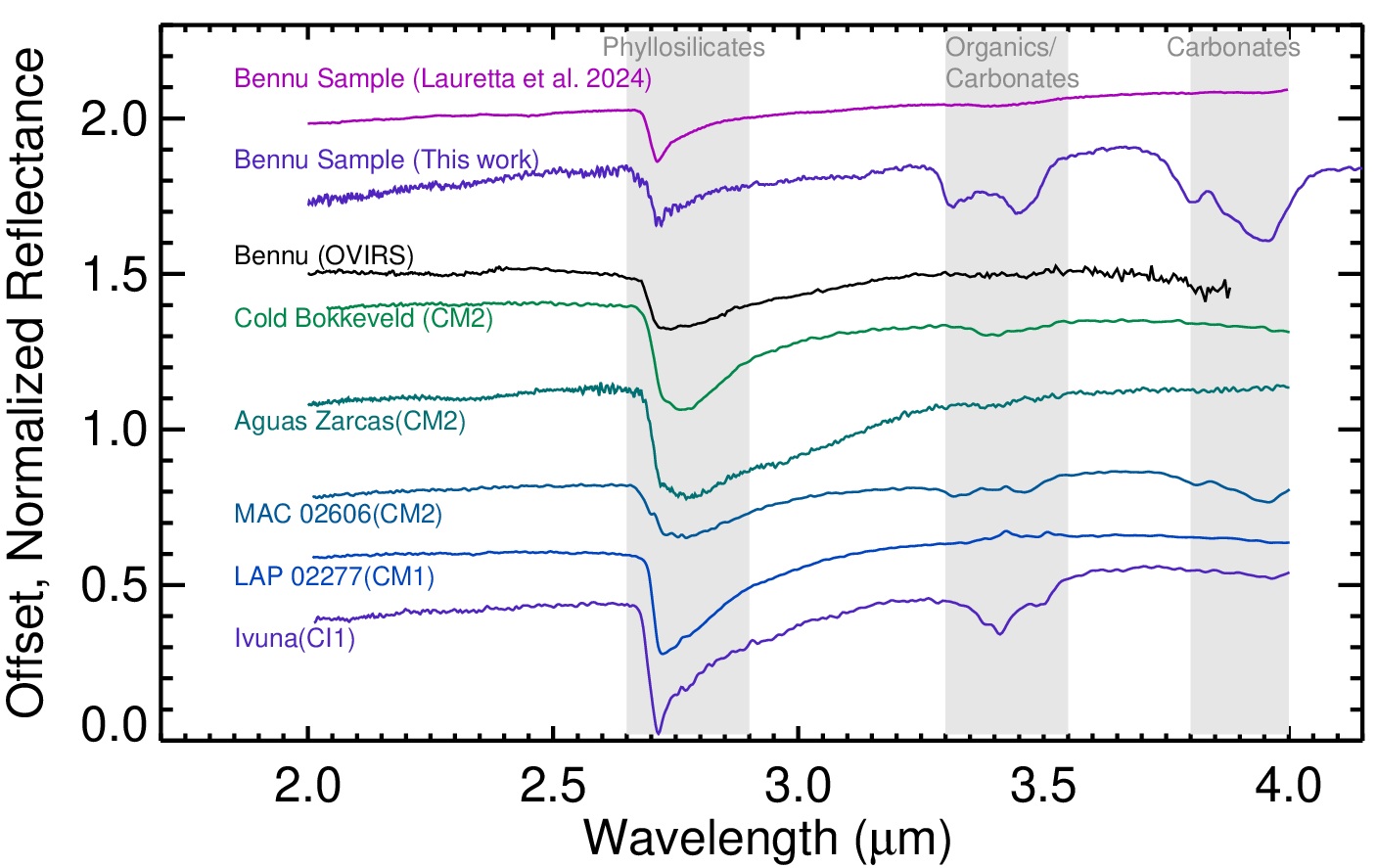
Figure 2. The spectrum we acquired of a bright clast in the Bennu sample is plotted with spectra of other Bennu samples (Lauretta et al. 2024), OSIRIS-REx OVIRS (Hamilton et al. 2019), and CM and CI carbonaceous chondrites (Takir et al. 2013).
Figure 2 presents the measured infrared reflectance spectrum of one of the bright spots shown in Figure 1 (right) from ~ 2 to 4 μm. The longer wavelength data are still being analyzed. The spectrum confirms a narrow absorption band centered at ~ 2.72 μm, which is indicative of Mg-rich serpentine and clay minerals. This absorption feature aligns with those found in CM chondrites, such as LAP 02277, and CI chondrites, like Ivuna. This observation suggests that both Bennu and these meteorites likely experienced similar aqueous alteration environments.
Additionally, the spectrum of the bright clast in the Bennu sample displays two prominent doublet absorptions attributed to the planar carbonate CO32- ion (Buijs & Schutte 1961, Hunt, G.R. & Salisbury 1971); these are located at ~ 3.2-3.4 μm (the overtone 2ν3 of the fundamental vibration ν3 at 6.9 μm) and at ~ 3.8-4.0 μm (a combination of ν1 and ν3, where ν1 corresponds to the fundamental vibration at 9 μm and ν3 at 6.9 μm). This carbonate feature is consistent with dolomite, as Figure 3 (upper) illustrates.
Organic features due to carbon-hydrogen (C-H) bond stretching typically overlap with one of the carbonate doublets at ~3.4 μm. However, the feature observed in the Bennu sample at ~3.4 μm indicates the presence of pure carbonates with no organics (Fig. 3, lower). In this talk, we will discuss additional spectra of the Bennu sample and their implications for constraining the evolution of carbon reservoirs during secondary processing events (e.g., aqueous alteration) experienced by asteroid Bennu.
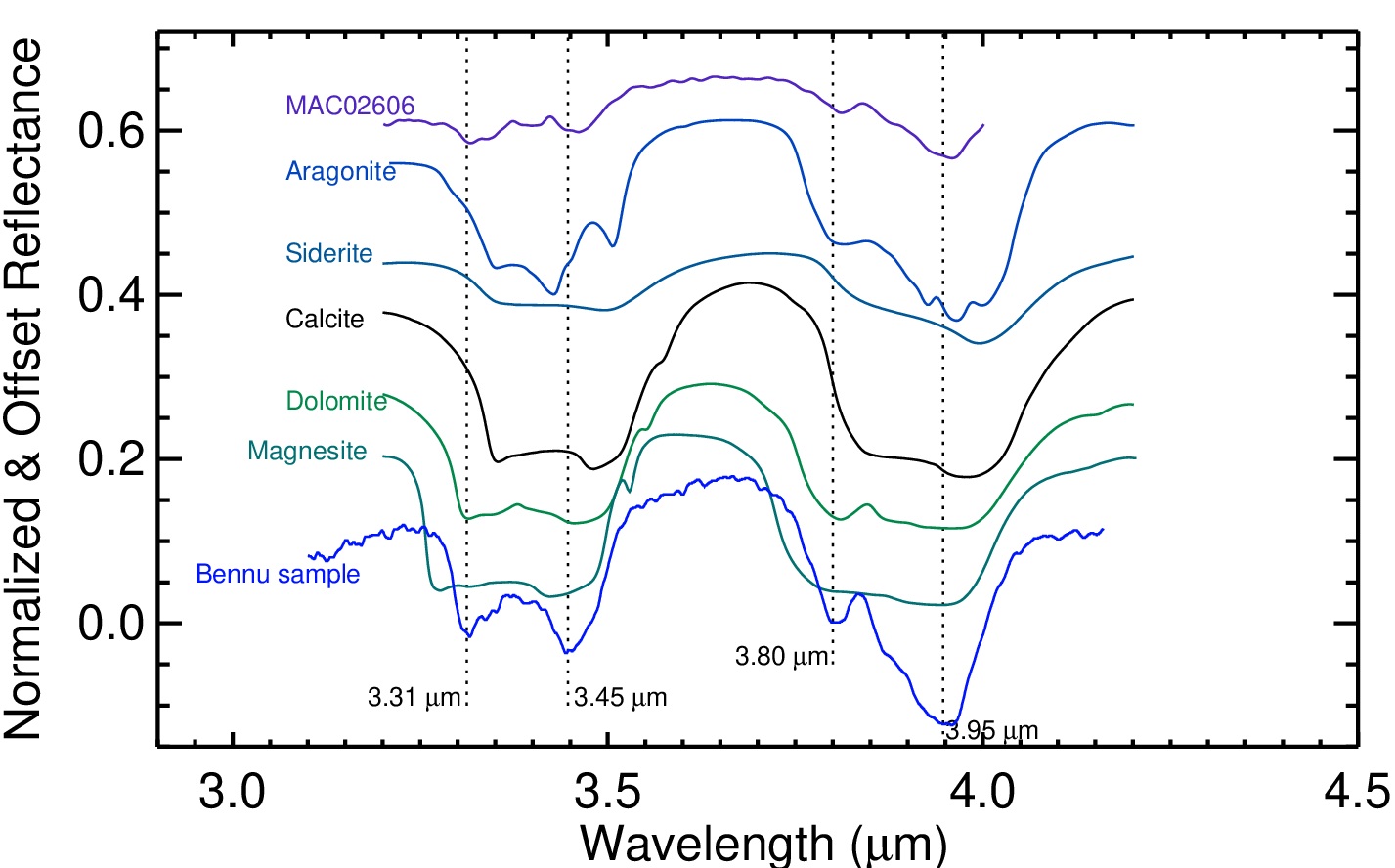
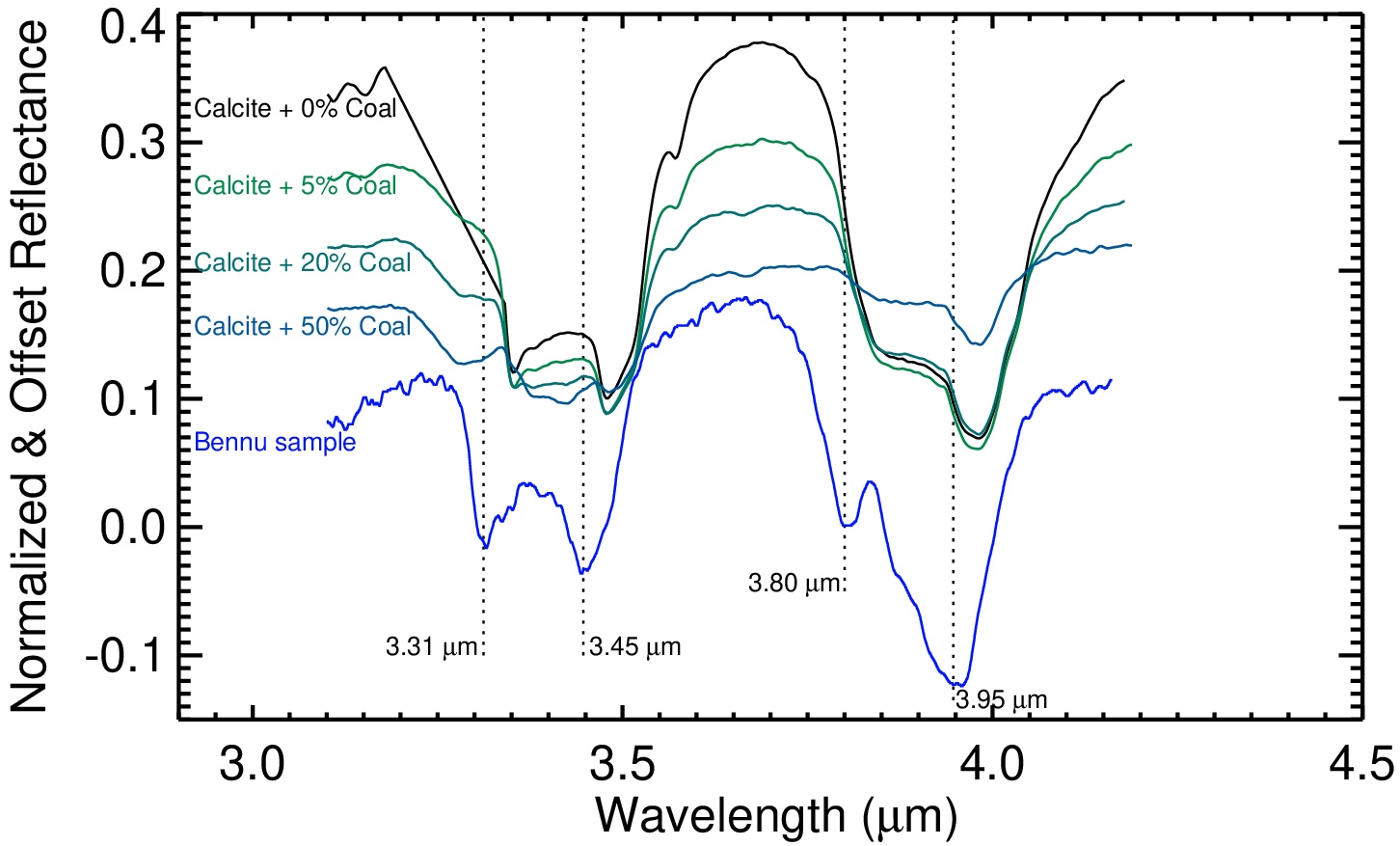
Figure 3. (Upper) The 3-to-4-μm region of the spectrum of the Bennu sample is compared with those of various carbonaceous phases compiled from the RELAB spectral library. The carbonate feature observed in Bennu is consistent with dolomite and inconsistent with calcite. (Lower) The spectrum of our Bennu sample is plotted alongside the spectra of calcite and coal mixtures (Hancock et al., 2025).
Acknowledgements: We would like to acknowledge the support of the NASA LARS grant 80NSSC23K0402. We would also like to thank the OSIRIS-REx mission, including scientists, engineers, and other team members, for their years of dedication to return this sample, as well as the NASA JSC OSIRIS-REx curation team for their work to make the sample available for analysis.
References:
Buijs, K., and Schutte, C.J.H. 1961, Spectrochimica Acta, vol. 17, pp. 927-932.
Connolly Jr., H. C., Lauretta, D. S., et al. 2025, MAPS,1-18.
Hancock, A., et al. 2025, LPSC meeting, Abstract #1350.
Hunt, G.R. & Salisbury,J.W. 1971) Mod. Geol. 2, 23–30.
Lauretta, D. S., Connolly Jr., H. C., et al. 2024, MAPS, 59, Nr 9, 2453–248.
Nakamura, T. et al. 2022, Science, 379, Issue 6634.
Takir, D. et al. 2013, Meteor. Planet. Sci., 48, 1618.
How to cite: Takir, D., Hibbitts, C., Miller, K., and Wagoner, C.: Infrared Spectroscopy of Bennu Sample OREX-800084-0, EPSC-DPS Joint Meeting 2025, Helsinki, Finland, 7–12 Sep 2025, EPSC-DPS2025-678, https://doi.org/10.5194/epsc-dps2025-678, 2025.


